
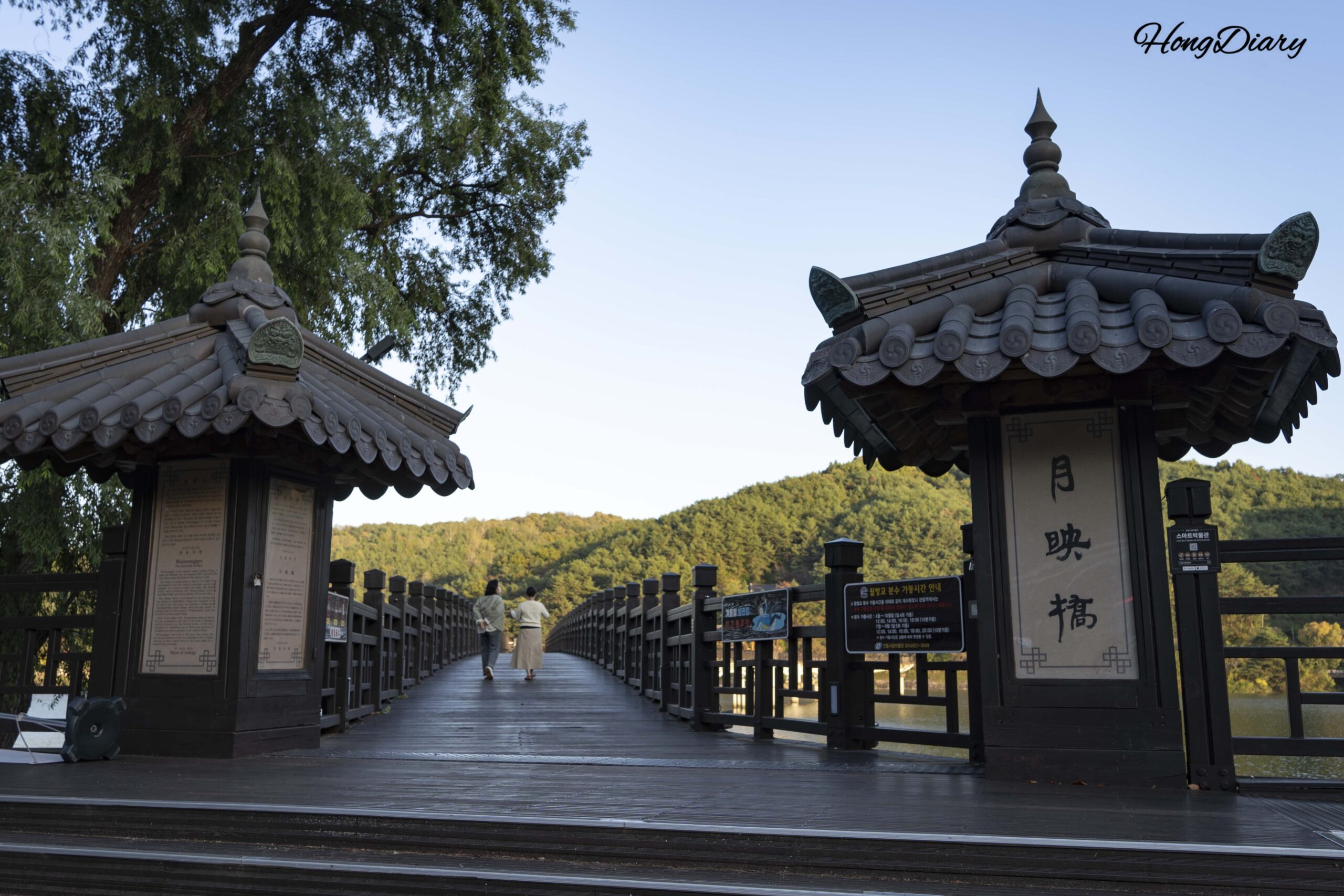
I had no plans to visit Woryeonggyo Bridge in Andong. After a full morning at Dosan Seowon, I wandered into downtown looking for coffee and a way to kill time before my bus back to Busan. A local at the café overheard me asking about things nearby and told me, without hesitation, that this bridge was the one place I shouldn’t leave Andong without seeing. So I went — and it ended up being the quiet highlight of the entire trip.
Andong sits in northern Gyeongsangbuk-do, a province in Korea’s eastern interior often called the heartland of Korean Confucian culture. Woryeonggyo Bridge stretches across the reservoir formed by Andong Dam on the Nakdong River, roughly a 10-minute taxi ride from the bus terminal. If you’ve already been to Dosan Seowon or Hahoe Folk Village earlier in the day, the bridge fits naturally into the same itinerary.
Table of Contents
Basic Information: Address, Hours, Night Lighting Schedule, and How to Get to Woryeonggyo Bridge
| Detail | Info |
|---|---|
| Address | 569 Sanga-dong, Andong-si, Gyeongsangbuk-do |
| Hours | Open 24 hours |
| Night Lighting | Automatic at sunset, 6:00 PM – 12:00 AM |
| Fountain Show | April – October; weekends at 12:00 PM, 2:00 PM, 6:00 PM, 8:00 PM (weekdays possible July–September) |
| Admission | Free |
| Bridge Length | 387 m — Korea’s longest wooden pedestrian bridge |
| Getting There | Bus No. 3 from Andong Station (~10 min) or taxi from Andong Intercity Bus Terminal (~20 min) |
Prices converted at approximately $1 USD ≈ ₩1,400 / €1 EUR ≈ ₩1,575 (as of September 2026). Rates may fluctuate.
The Love Story Behind the Bridge
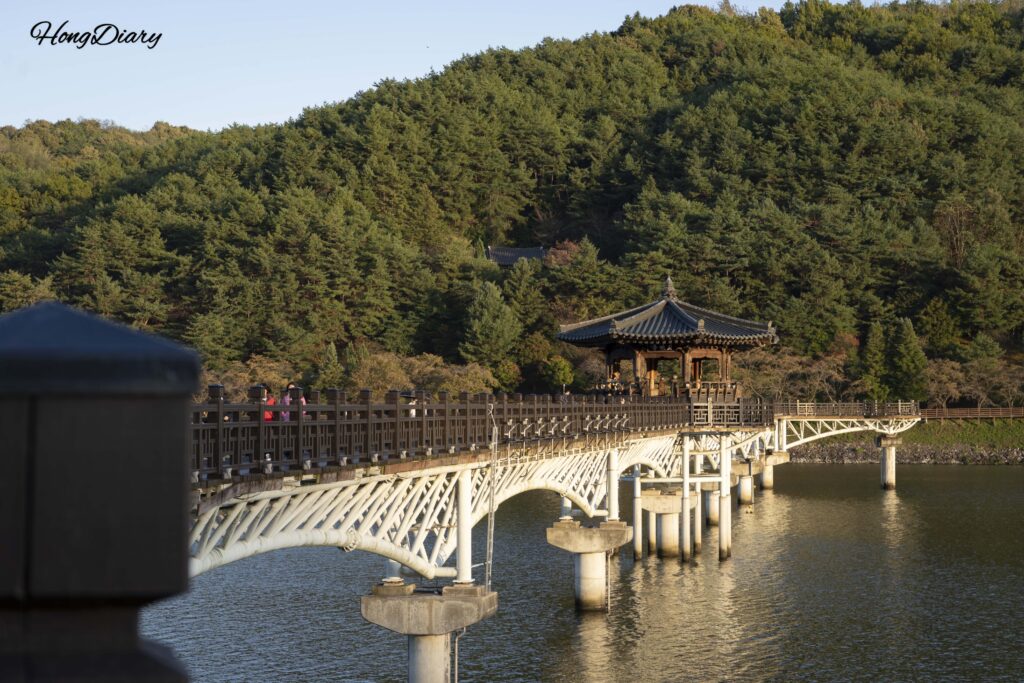
Woryeonggyo doesn’t just mean “bridge” — the name translates roughly to “the bridge where moonlight casts its shadow.” But the real reason people remember this place has nothing to do with architecture or scenery. It’s a love story, and an unusual one.
In the 16th century, a man named Lee Eung-tae and his wife lived in the Andong area. When he died, she was devastated. What she did next is the part that still catches people off guard: she cut her own hair and wove it into a pair of mituri — traditional Korean shoes made from hemp or straw, commonly worn during the Joseon Dynasty (1392–1897). She placed the hand-woven shoes in his coffin as a final gesture, along with a letter.
For four hundred years, nobody knew any of this.
In 1998, a tomb was excavated in Andong, and inside, researchers found the letter and the hair-woven shoes, remarkably preserved. The letter, now known as “The Letter from Won-i’s Mother,” is written from a pregnant wife to her dead husband. She writes about how she cannot understand how he could leave her, how she has nowhere to put her sorrow, and how she hopes to see him in her dreams. It became one of the most well-known historical love letters in Korea overnight.
The bridge was designed in the shape of mituri to honor that story. If you look at the structure from above, the woven pattern of the railings and the curved silhouette are meant to echo the shoes she made from her hair. At the center of the bridge sits Woryeongjeong Pavilion, a wooden resting area where you can stop and look out over the water in both directions. Knowing the backstory changes the walk across it — the bridge stops being just a bridge.
Walking Across Korea’s Longest Wooden Bridge
The first thing that caught me off guard was the length. I assumed it would be a short crossing — walk to the other side, take a photo, walk back. But Woryeonggyo stretches 387 meters across the reservoir, and the entire structure is built from pine wood. It connects the parks around Andong Dam to Andong Folk Village on the opposite shore, and the wood creaks slightly underfoot as you go.
I visited close to sunset, and the timing turned out to be a good call. The mountains surrounding the Nakdong River were starting to catch the last of the light, and the water below reflected the ridgeline in a way that kept me stopping every few steps. The bridge sits low enough over the reservoir that you feel like you’re walking just above the surface, with the dam’s wide basin curving around you on all sides.
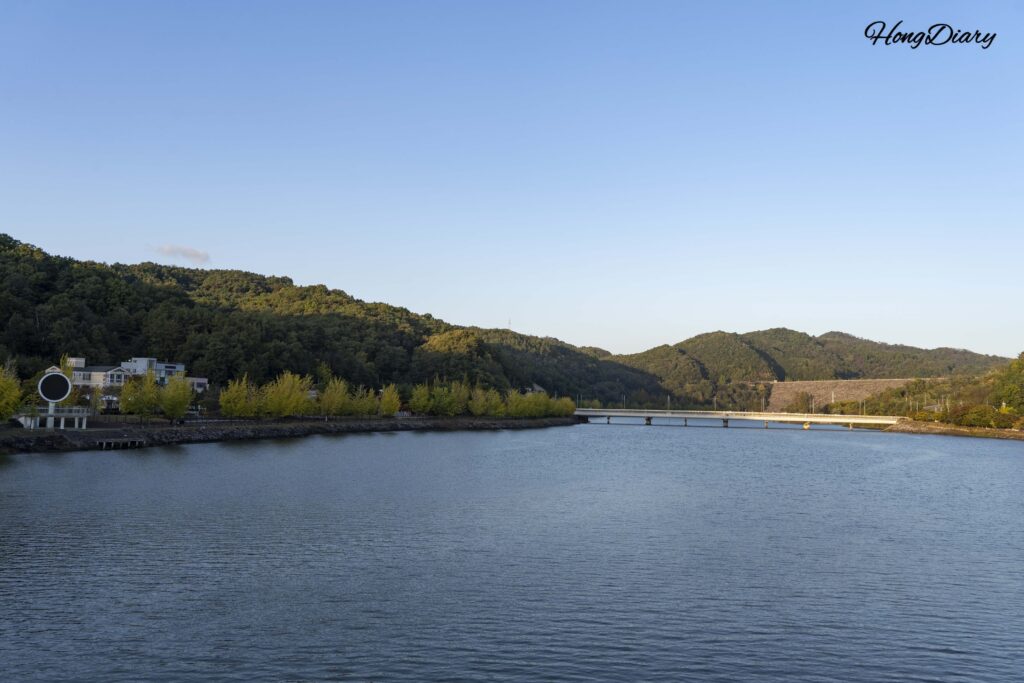
Beyond the main bridge, a 2,080-meter lakeside boardwalk continues from Woryeonggyo all the way to Beopheung Bridge. Along the trail, there are eight observation decks and two traditional pavilions spaced out at intervals — enough to make the walk feel unhurried. From March through October, street lights along the path turn on after sunset and stay lit until midnight, which is why this stretch is one of Andong’s most popular spots for evening walks.
I didn’t get to see the full night view — my bus schedule didn’t allow it. But even in the fading daylight, the atmosphere was calm in a way that made me want to sit on one of the benches and just stay for a while. Looking at photos later, I saw what the bridge looks like after dark: the lanterns lining both sides glow against the water, and Moon Boats — small, lit-up boats shaped like crescent moons — drift across the reservoir. That’s the version I want to come back for.
If you can time your visit, arriving around sunset and staying into the evening would give you both. The bridge is free and open around the clock, so there’s no pressure to rush.
Heotjesabap at Mat 50-nyeon — Andong’s “Fake Ritual Feast”
Walking back from the bridge, I noticed a small cluster of restaurants and cafés near the entrance. One name kept coming up in reviews: Mat 50-nyeon Heotjesabap — roughly translated as “Taste of 50 Years, Fake Ritual Rice.” I had been curious about this dish since arriving in Andong, so I stopped in for dinner.
What Is Heotjesabap?
To understand this dish, you need a bit of cultural context. In Korea, jesa is a formal ceremony held to honor deceased ancestors — typically on the anniversary of their death or during major holidays like Chuseok (Korean harvest festival) and Seollal (Lunar New Year). During jesa, families prepare an elaborate spread of food as offerings: rice, soup, various seasoned vegetables (namul), pan-fried dishes (jeon), fish, meat skewers (sanjeok), and fruit. The food is arranged on a table following specific rules, and after the ritual, the family eats everything together.
Heotjesabap literally means “fake jesa food” — heot (fake) + jesa (ancestral rite) + bap (rice). There are two popular origin stories, both rooted in Andong during the Joseon Dynasty. One version says that commoners who couldn’t afford to hold real ceremonies would stage mock rituals just to enjoy the feast. The other says Confucian scholars, often short on food supplies, used the excuse of a “practice ceremony” to cook and eat well. Either way, the name stuck.
Over time, the dish was commercialized — particularly after Andong Dam was built and several traditional houses were relocated near the Folk Village area. Some of those houses were converted into restaurants serving Andong’s heritage foods, and heotjesabap became one of the signature offerings.
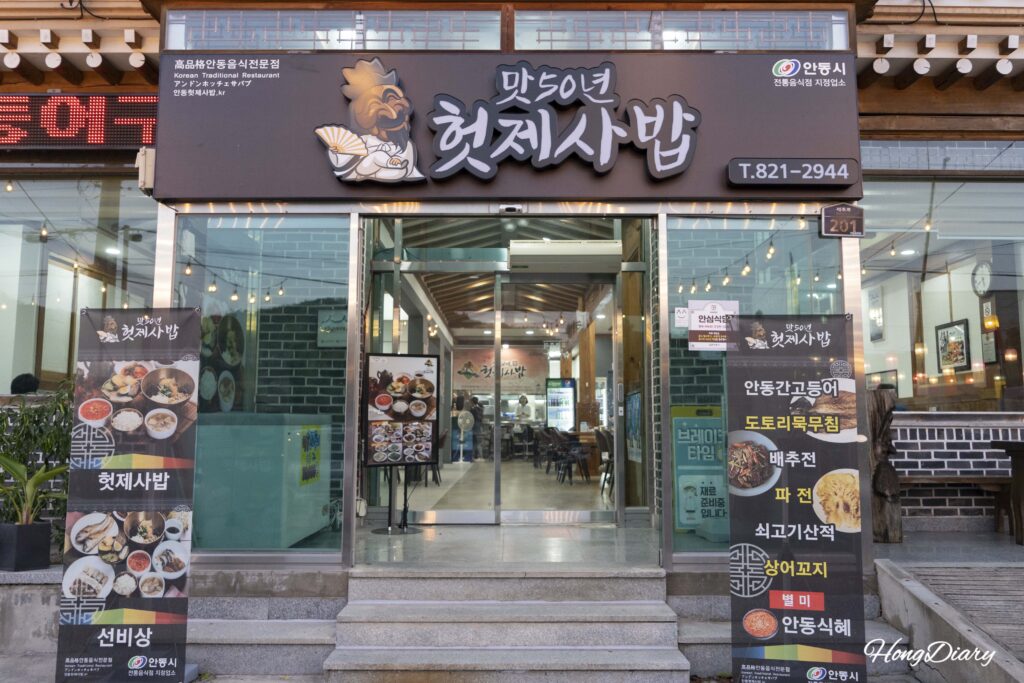
Restaurant Info — Mat 50-nyeon Heotjesabap
| Detail | Info |
|---|---|
| Address | 201 Seokju-ro, Andong-si, Gyeongsangbuk-do |
| Hours | 10:00 AM – 8:00 PM (closes at 7:00 PM in winter) |
| Closed | Every Tuesday |
| Solo Dining | Available |
Menu Highlights
| Menu Item | Price |
|---|---|
| Heotjesabap (Soy Sauce Bibimbap Set — includes Andong sikhye) | ₩14,000 (~$10.00 USD / ~€8.89 EUR) |
| Seonbi Sang / Scholar’s Table (expanded set, min. 2 guests) | ₩23,000 (~$16.43 USD / ~€14.60 EUR) per person |
| Heonhakkeum Sang (full course with mackerel + shark, min. 4 guests) | ₩40,000 (~$28.57 USD / ~€25.40 EUR) per person |
| Grilled Andong Salted Mackerel | ₩15,000 (~$10.71 USD / ~€9.52 EUR) |
| Shark Meat Skewers | ₩14,000 (~$10.00 USD / ~€8.89 EUR) |
| Beef Skewers | ₩14,000 (~$10.00 USD / ~€8.89 EUR) |
| Napa Cabbage Pancake | ₩10,000 (~$7.14 USD / ~€6.35 EUR) |
| Green Onion Pancake | ₩10,000 (~$7.14 USD / ~€6.35 EUR) |
| Andong Sikhye (traditional rice beverage) | ₩3,000 (~$2.14 USD / ~€1.90 EUR) |
I ordered the basic Heotjesabap set at ₩14,000 (~$10.00 USD / ~€8.89 EUR). I’d already eaten Andong salted mackerel for lunch near the bus terminal, so I kept it simple.
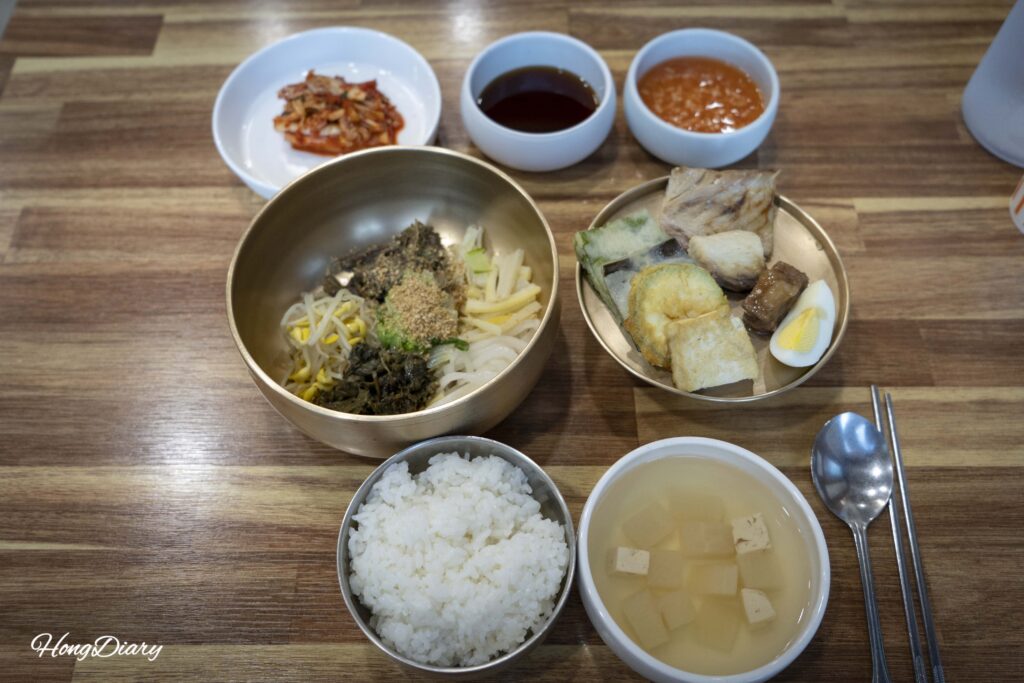
What Arrived at the Table
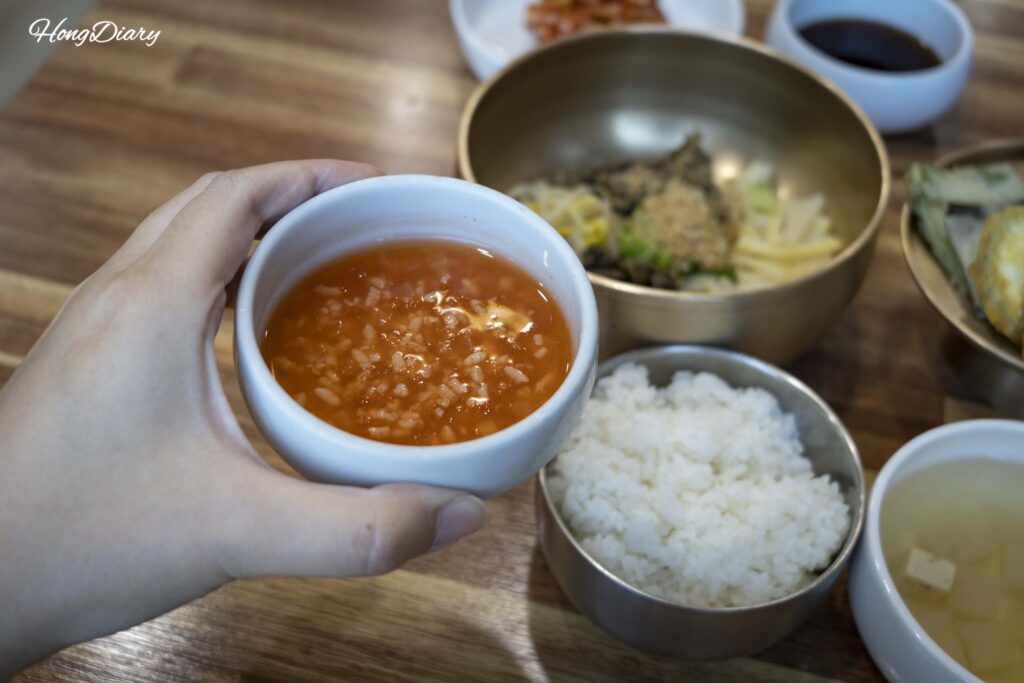
The spread came out on brass tableware — the kind traditionally reserved for ceremonial occasions. A bowl of white rice sat at the center, surrounded by six types of seasoned vegetables (namul), each prepared differently: some blanched, some sautéed, some dressed in sesame oil. On the side, a platter of assorted jeon — thin, pan-fried bites including egg, tofu, fish, and vegetables.
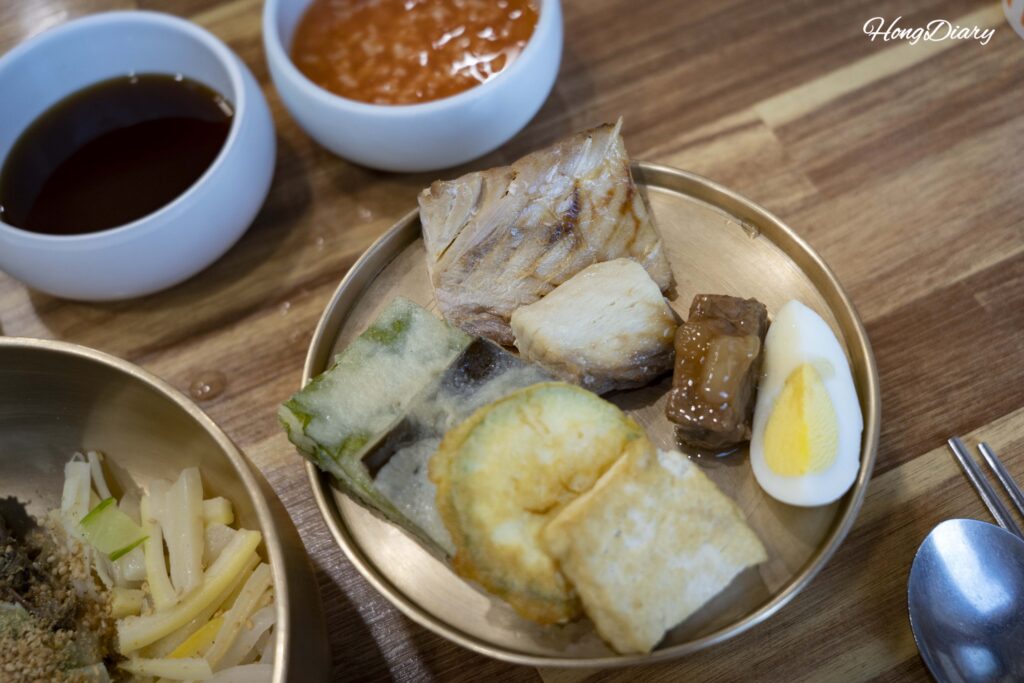
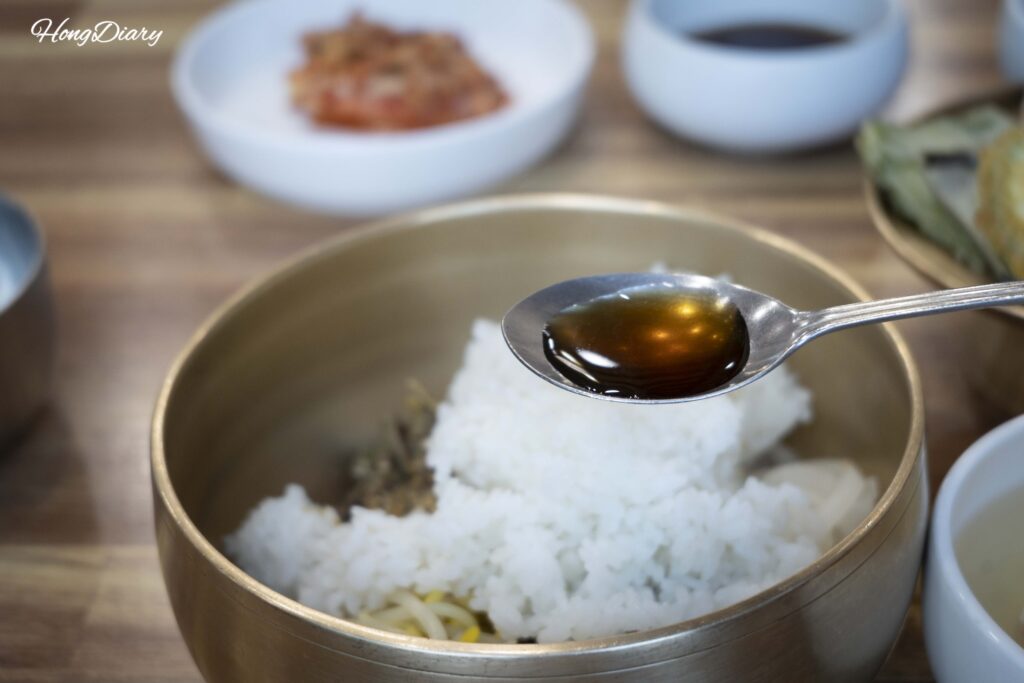
The way you eat it is straightforward: spoon the vegetables and rice together, then drizzle aged soy sauce (ganjang) over the top and mix. This is what sets heotjesabap apart from regular bibimbap — the Korean mixed rice bowl most travelers already know, typically served with vegetables and a generous spoonful of gochujang (fermented chili paste). Here, there’s no chili paste at all. The restaurant keeps the traditional method here, using only soy sauce and ground sesame seeds for seasoning. The result is much milder than what most visitors expect from Korean food. Kimchi does come on the side, though that’s a modern addition — original jesa food wouldn’t have included anything heavily spiced. It’s a small example of how the dish has been adapted over the years to suit contemporary palates.
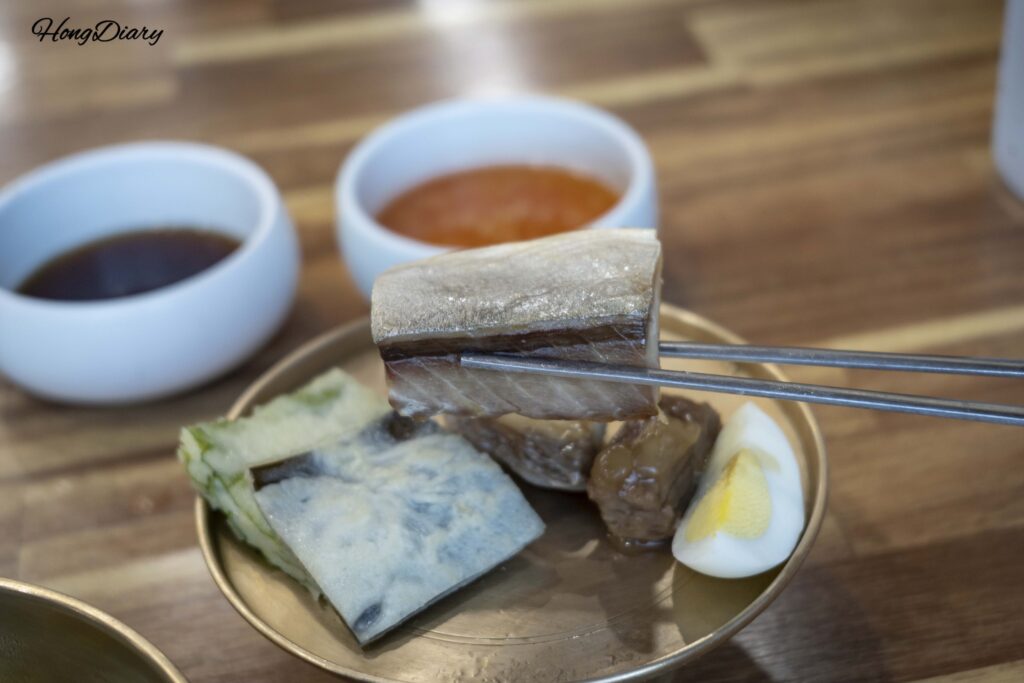
The most unusual item on the table was the shark meat sanjeok — skewered pieces of shark, threaded with sliced onion and beef. Shark meat isn’t something you see on most Korean menus, but it has deep roots in Andong’s ritual food tradition. The texture is dense and chewy, closer to pork than fish, with a faint ocean-floor taste that’s hard to place. It’s not unpleasant, just genuinely unfamiliar.
Then there was the Andong sikhye. Regular sikhye — a sweet, milky rice drink served as dessert across Korea — was something I’d had dozens of times before. Andong’s version is nothing like it. It’s reddish-brown, made with ginger, chili powder, and malt, and hits you with a sweet-spicy-tangy combination that I genuinely didn’t expect. It’s served cold, and the flavor is strange in a way that kept me taking another sip to figure it out.
An Honest Take
I wouldn’t call heotjesabap a must-try in the way that Andong jjimdak (braised soy chicken) or salted mackerel might be. The flavors are deliberately understated — this is ritual food, after all, designed to honor the dead rather than excite the living. Visually, the brass dishes and the spread of colors across the table made for a striking first impression, and I appreciated getting to taste ingredients I wouldn’t encounter anywhere else, especially the shark skewers and that odd, spicy sikhye.
But here’s where it gets complicated. The original point of heotjesabap was cultural: it was food that connected the living to their ancestors, shared among family in a moment of collective memory. As Andong leaned into tourism, the dish became a commercial product. Spicier side dishes were added. The ceremonial context faded. What remains is something closer to an unusual set meal than an authentic ritual experience.
The French cultural critic Guy Sorman once said that a cultural product must contain culture — otherwise it loses its value as a cultural product. Sitting in that restaurant, mixing soy sauce into rice from a brass bowl, I kept thinking about that line. The food was fine. The history behind it was genuinely interesting. But I left feeling like I’d read the last chapter of a story that had already ended, rather than experiencing something still alive.
Take it as a cultural window rather than a dining recommendation, and you’ll walk away with something worth remembering.
Wrap-Up
Woryeonggyo Bridge in Andong turned out to be the kind of place that earns its reputation without trying too hard. The love story gives the walk emotional weight, the bridge itself is long enough to feel like a real excursion, and the sunset light over the Nakdong River does most of the work for you. I came without expectations and left wanting to return after dark — next time with enough schedule margin to watch the Moon Boats drift under lantern light.
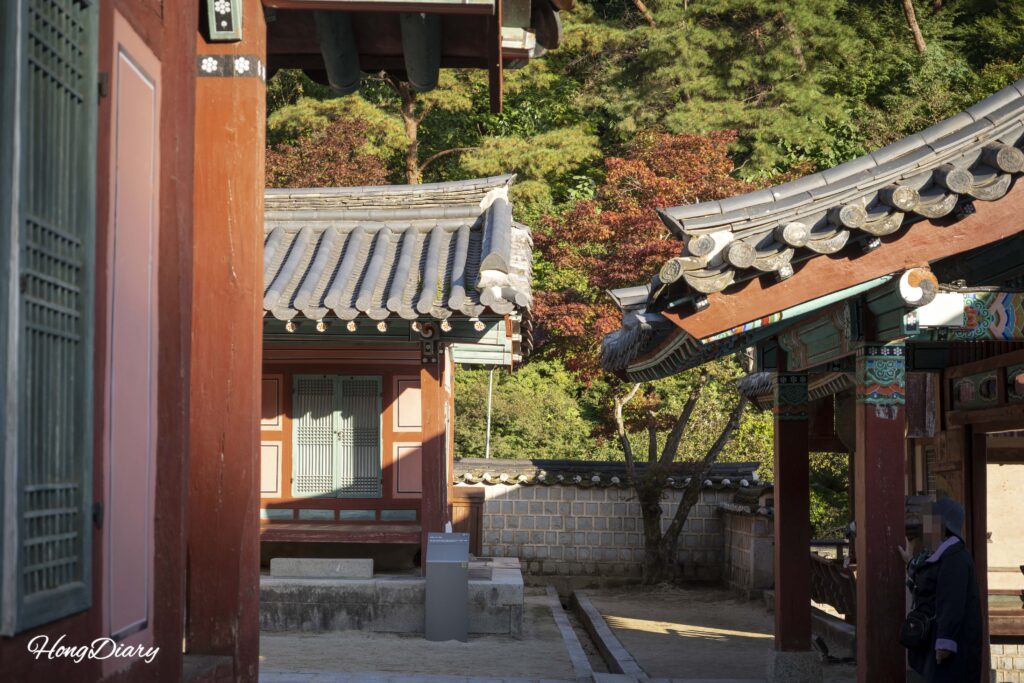
If you’re building an Andong itinerary, the bridge pairs naturally with a morning visit to Dosan Seowon, the Confucian academy featured on Korea’s ₩1,000 bill.
The two sit on opposite ends of the city, and together they cover a full day that moves from mountain-ringed scholarly history to a quiet, lamp-lit walk above the river.
The heotjesabap was worth trying once for the cultural backstory and the novelty of shark-meat skewers served on brass dishes. Whether the dish itself justifies a dedicated trip is another question — but as a dinner stop within walking distance of Woryeonggyo Bridge, it made for a fitting, if bittersweet, end to an unplanned evening in Andong.
Visitor Guide & FAQ: Best Time to Visit, Evening Views, and Practical Walking Tips for Woryeonggyo Bridge
What is Woryeonggyo Bridge in Andong, and why is it famous?
Woryeonggyo Bridge is a 387-meter wooden pedestrian bridge spanning the Nakdong River reservoir near Andong Dam in Gyeongsangbuk-do, South Korea. It holds the title of Korea’s longest wooden footbridge. The bridge was built to commemorate the love story of Lee Eung-tae and his wife from the 16th century — she wove a pair of traditional shoes called mituri from her own hair after his death, and the bridge’s design echoes the shape of those shoes. It’s open 24 hours, free to enter, and especially popular at sunset and after dark when lanterns illuminate the full length of the structure.
When is the best time to visit Woryeonggyo Bridge?
The most recommended time is around sunset through late evening. Night lighting turns on automatically at dusk and stays lit until midnight (6:00 PM – 12:00 AM). If you visit between April and October, you can also catch a fountain show that runs at 12:00 PM, 2:00 PM, 6:00 PM, and 8:00 PM on weekends (and some weekdays in July through September). Arriving 30 to 60 minutes before sunset gives you both the golden-hour river views and the lit-up bridge afterward.
How do I get to Woryeonggyo Bridge from Andong Station or the bus terminal?
From Andong Station, take Bus No. 3 directly to the bridge — the ride is roughly 10 minutes, with buses running at one-hour intervals. From Andong Intercity Bus Terminal, a taxi takes about 20 minutes. Alternatively, you can take Bus No. 0, 0-1, 1, or 2 to Andong Station and transfer to Bus No. 3 from there. Driving is also an option; parking is available at the nearby Andong Municipal Folk Museum lot, which tends to fill up less quickly than the bridge’s own lot.
What is heotjesabap, and what does “fake ritual feast” mean?
Heotjesabap (literally “fake jesa rice”) is a traditional dish from Andong. Jesa refers to Korea’s Confucian ancestor memorial ceremonies, where families prepare elaborate food spreads to honor the deceased. The word heot means “fake” — the story goes that during the Joseon Dynasty, scholars or commoners would stage mock ceremonies just to enjoy the ceremonial food without waiting for an actual occasion. The dish is essentially a soy-sauce bibimbap (rice mixed with six types of seasoned vegetables and aged soy sauce instead of chili paste), served alongside assorted jeon (pan-fried dishes), soup, and sometimes shark-meat skewers.
How much does heotjesabap cost at Mat 50-nyeon near Woryeonggyo Bridge?
The basic Heotjesabap set costs ₩14,000 (~$10.00 USD / €8.89 EUR) per person and includes rice, six types of seasoned vegetables, assorted jeon, soup, and Andong sikhye (a traditional spicy-sweet rice drink). The Seonbi Sang (Scholar’s Table), an expanded version, is ₩23,000 ($16.43 USD / €14.60 EUR) per person with a two-person minimum. The full-course Heonhakkeum Sang, which adds grilled salted mackerel and shark skewers, runs ₩40,000 ($28.57 USD / ~€25.40 EUR) per person for groups of four or more. Solo dining is available for the basic set.
What is Andong sikhye, and how is it different from regular Korean sikhye?
Standard Korean sikhye is a sweet, milky-white rice drink typically served cold as a dessert. Andong sikhye is a distinctly different beverage — it’s reddish-brown, made with ginger, chili powder, radish, and malt, and has a sweet-spicy-tangy flavor profile that surprises most first-timers. It’s traditionally served as a digestive after heavy meals and is included with the basic heotjesabap set at Mat 50-nyeon at no extra charge. If ordered separately, it costs ₩3,000 (~$2.14 USD / ~€1.90 EUR).
Can I visit both Dosan Seowon and Woryeonggyo Bridge in the same day?
Yes, and it’s a natural pairing. Dosan Seowon sits about 25 km north of downtown Andong, while Woryeonggyo Bridge is on the southern edge near Andong Dam — the two are on opposite sides of the city. A common approach is to visit the Confucian academy in the morning, return to downtown Andong for lunch, and then head to the bridge in the late afternoon to catch sunset and the early evening lighting. Bus No. 3 from the city center connects to both areas, though schedules are limited, so checking return times in advance is recommended.
Prices converted at approximately $1 USD ≈ ₩1,400 / €1 EUR ≈ ₩1,575 (as of September 2026). Rates may fluctuate.