
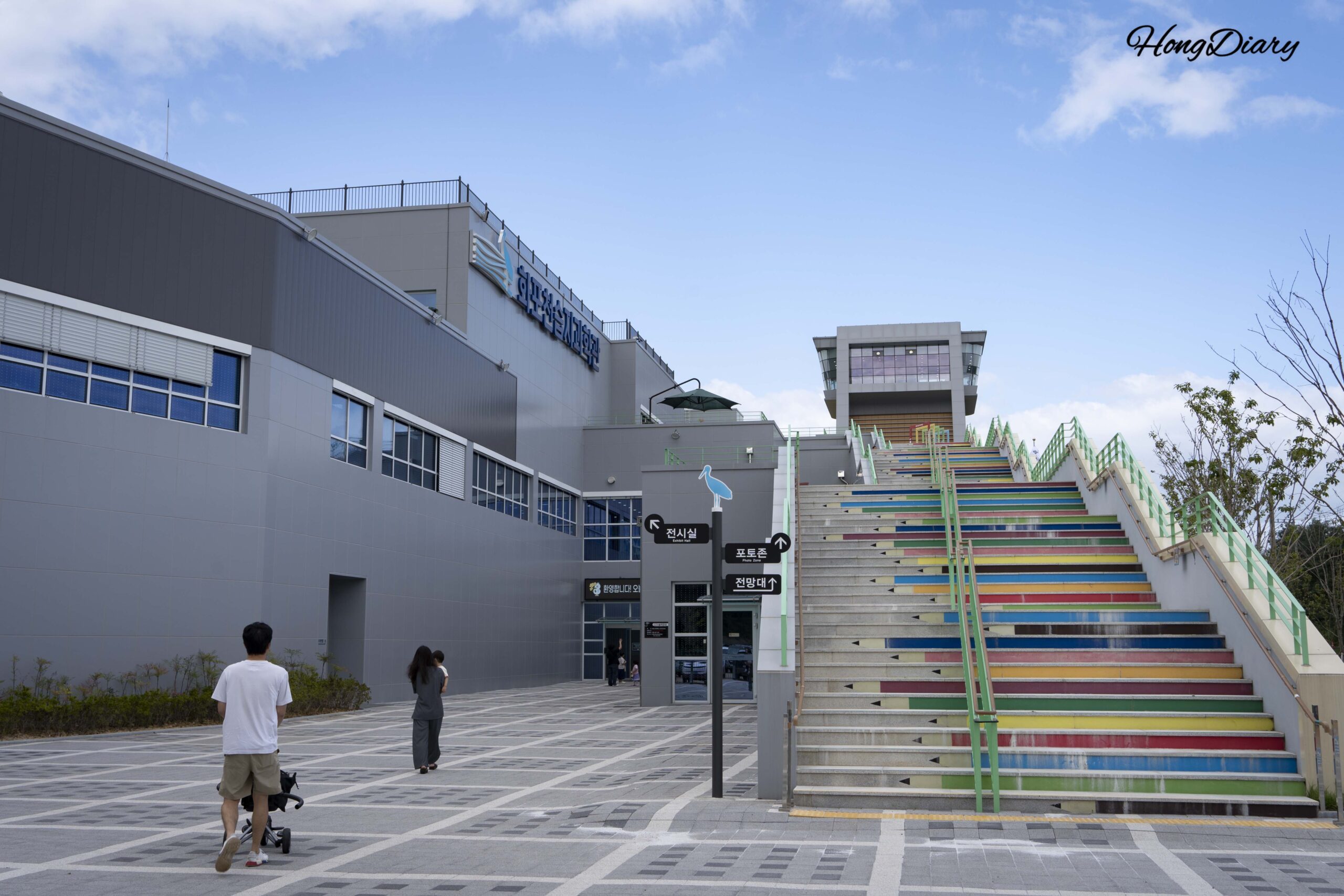
Not every destination earns a spot on a must-visit list — and sometimes, that is exactly the point. On a late-summer weekend, with the worst of the heat finally easing off, I went searching for something low-key near Busan. No crowds, no entrance fees, no tour buses. What I ended up finding was the Hwapocheon Wetland Science Museum, tucked into a quiet corner of Gimhae that most visitors fly over — literally — without a second thought.
I want to be upfront: this is not the kind of place that will make your jaw drop. But if you are curious about how South Korea has been restoring one of its most ecologically significant wetlands, or if you simply want a free, well-designed museum with solid interactive exhibits on a slow afternoon, the Hwapocheon Wetland Science Museum is worth knowing about.
Table of Contents
Hwapocheon Wetland Science Museum Basic Info
| Detail | Information |
|---|---|
| Address | 183-300 Hallim-ro, Hallim-myeon, Gimhae-si, Gyeongsangnam-do |
| Hours | Tuesday – Sunday, 9:00 AM – 6:00 PM (last entry 5:00 PM) |
| Closed | Every Monday |
| Admission | Free (₩0 / $0 USD / €0 EUR) |
| Parking | Free |
| Website | gimhae.go.kr/hwapo.web (partial English, Japanese, and Chinese support) |
Prices converted at approximately $1 USD ≈ ₩1,400 / €1 EUR ≈ ₩1,575 (as of September 2026). Rates may fluctuate.
Getting there from Gimhae International Airport:
The museum is reachable by public transit, but it takes some patience. From the airport, board the Busan-Gimhae Light Rail (a driverless elevated train connecting Busan and Gimhae) at Airport Station and ride to Gaya University Station — roughly 35 minutes. From the Gaya University bus stop, take Bus No. 140 and ride 16 stops (about 20 minutes) to the Seolchang stop. From there, it is a 2.5-kilometer walk (around 35 minutes on foot) to the museum entrance. That last stretch is the tricky part. There is no convenient shuttle, and the roads leading in are narrow and still partially under construction, even by car. If you are driving, be prepared for tight single-lane roads near the site.
Practical note: This museum is realistically best reached by car or taxi. The public transit route works, but the total door-to-door time from the airport exceeds 90 minutes each way. Budget your time accordingly.
Where Exactly Is This Place?
Most international travelers know Gimhae only as the city whose name is on Busan’s airport. But Gimhae has a much deeper story. It sits directly west of Busan in Gyeongsangnam-do province and was the heartland of the ancient Gaya Confederacy (42–532 AD), a group of city-states that rivaled the more famous kingdoms of Silla and Baekje in Korea’s early history. Today, the city’s smaller districts still carry a rural, unhurried pace. Jinyeong, where the museum stands, is one of them — locals associate it with dangam (Korean sweet persimmons, a variety prized for being eaten firm rather than soft), which thrive in the mild climate here.
The wetland that gives this museum its name, Hwapocheon, is classified as Korea’s largest streamside wetland: 8 kilometers long, covering 3.1 square kilometers, with over 800 documented species living in and around it. In January 2025, Gimhae earned official accreditation as a Ramsar Wetland City — an international certification given to cities that actively protect and conserve their wetlands. As of that date, only 74 cities across 27 countries worldwide hold this title. That recognition put Hwapocheon — and this small corner of Gimhae — on the global conservation map.
First Impressions: A Building That Practices What It Teaches
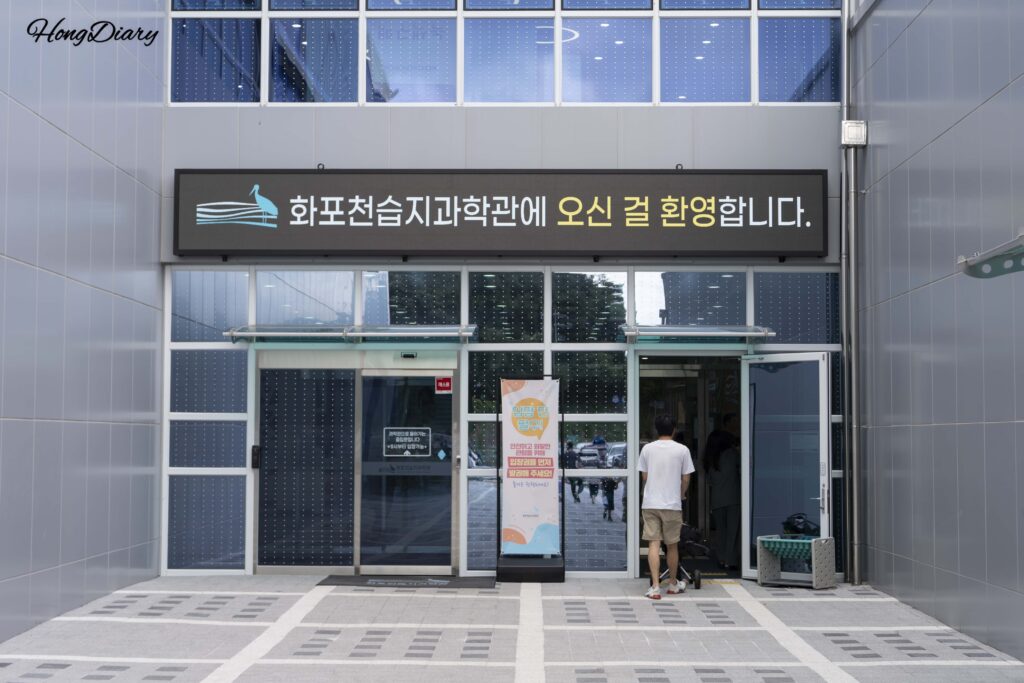
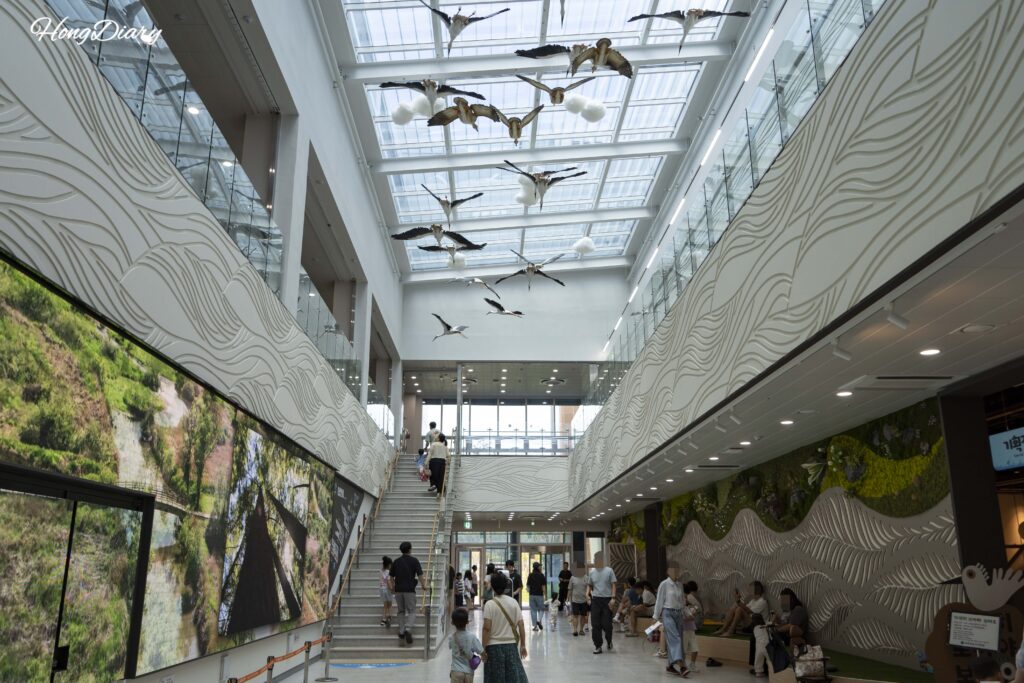
Walking up to the Hwapocheon Wetland Science Museum, the first thing that struck me was the building itself. It is a clean, modern three-story structure with high ceilings and an open atrium that lets natural light pour in from above. The design feels deliberate — not flashy, but thoughtfully done.
There is a reason for that. This was the first publicly funded ecological education facility in South Korea to earn Passive House certification. If that term is new to you: Passive House (or passivhaus) is a building standard originating from Germany that maximizes insulation and airtight design so the structure needs minimal external energy for heating or cooling. Instead of blasting air conditioning in summer or cranking heaters in winter, the building regulates its own temperature through design — thick insulated walls, strategic window placement, and controlled ventilation.
I visited in late August, during what Koreans call cheoseo — one of the 24 traditional solar terms that divide the year by seasonal shifts, roughly marking the point when summer’s peak heat begins to break. It was still warm outside, and the museum interior felt comfortable without being aggressively air-conditioned. Knowing the building maintains its climate passively made that mild warmth feel intentional rather than uncomfortable.
For anyone interested in green architecture or sustainable design, the building alone is worth a look. For everyone else, it is a pleasant space to walk through — airy, quiet, and well-lit.
Programs and Reservations
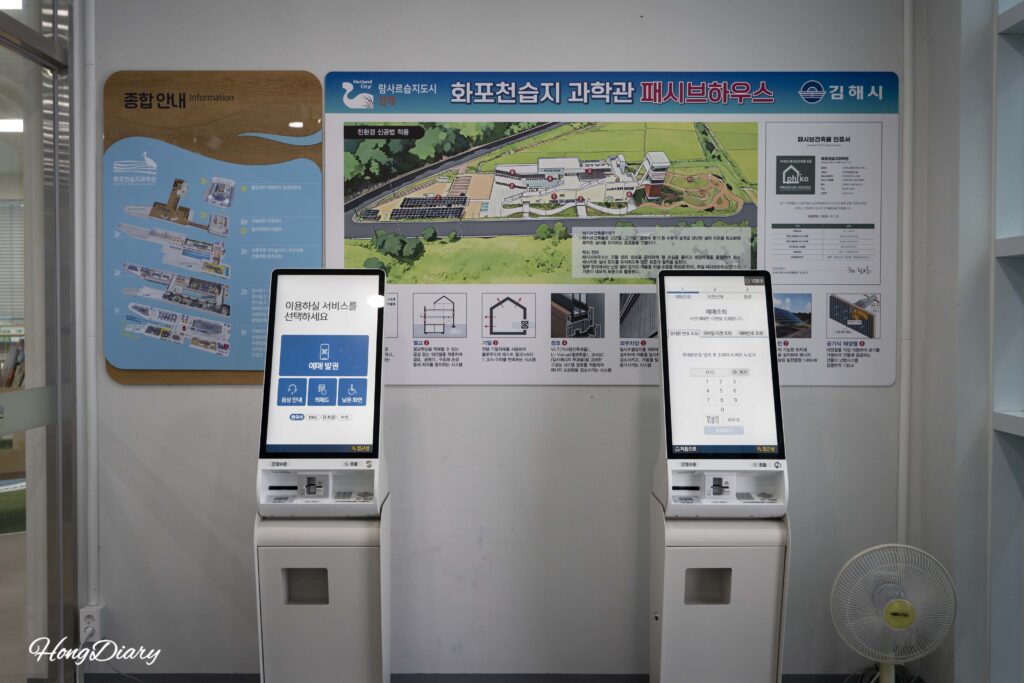
Just inside the entrance, I noticed a digital kiosk for reserving hands-on programs. The museum rotates its educational offerings monthly — craft workshops, guided ecological walks along the wetland, puppet shows for younger children, and even short film screenings about local wildlife. I did not know about these in advance, so I had not reserved anything. Programs can be booked through the museum’s website ahead of time, and I would recommend doing so if you plan to visit with children.
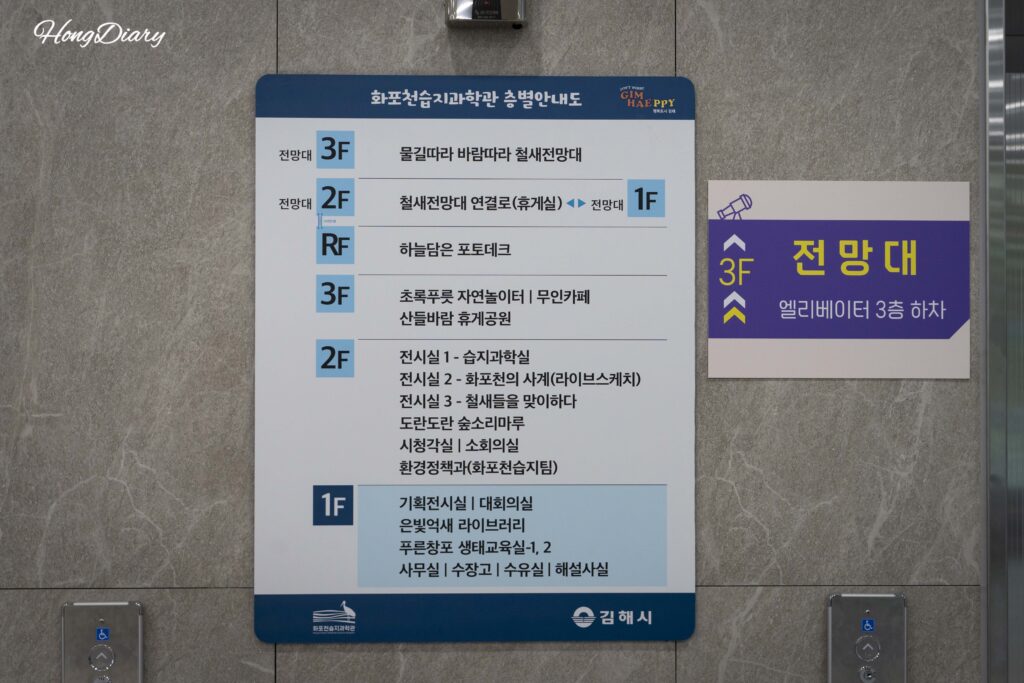
The building is laid out across three floors plus a rooftop level, with a separate Bird Observatory Tower connected from the roof:
| Floor | What You Will Find |
|---|---|
| 1F | Special exhibition hall, ecological education rooms, children’s library (stocked mostly with picture books and nature guides for kids), conference hall, nursing room |
| 2F | Three permanent exhibition rooms (Wetland Science Lab, Hwapocheon Through the Four Seasons, Welcoming the Migratory Birds), screening room, forest-themed rest area |
| 3F | Nature-themed playground for children, unmanned cafe (a self-service cafe with no staff — you order and pay through a kiosk or card terminal, then grab your drink from an automated machine; these staffless cafes are common across South Korea), outdoor rest garden |
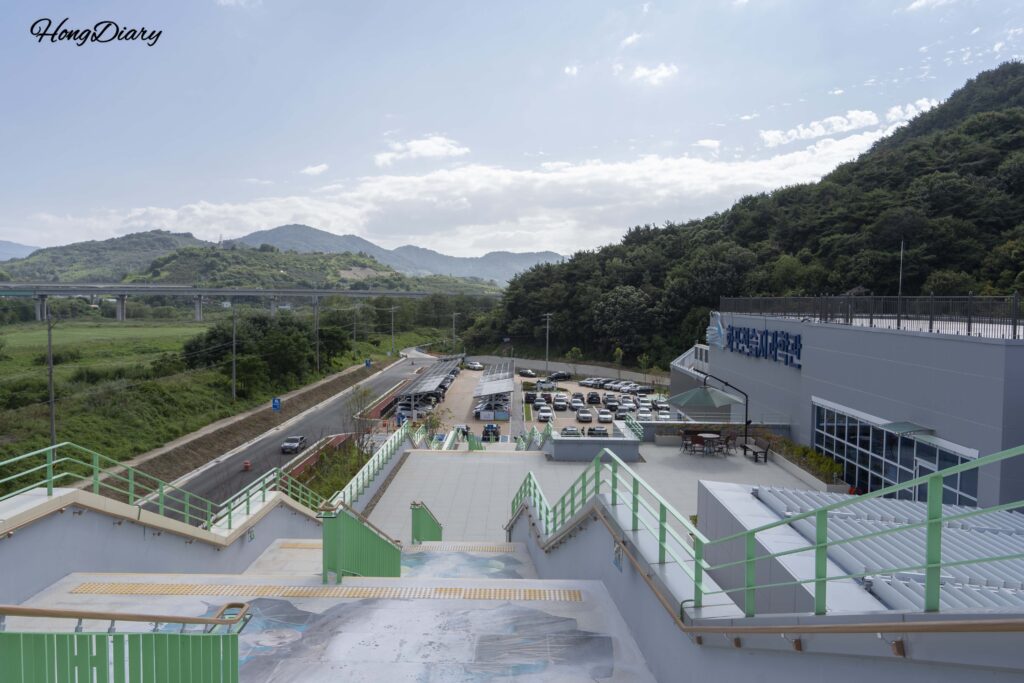
| RF (Rooftop) | Open-air photo deck with views of the wetland and surrounding landscape — also serves as the walkway connecting the main building to the Bird Observatory Tower |
Family-friendly note: A nursing room is available on the first floor, and the children’s library offers a quiet space to take a break between exhibits.
Inside the Exhibitions
First Floor: Interactive Learning Space
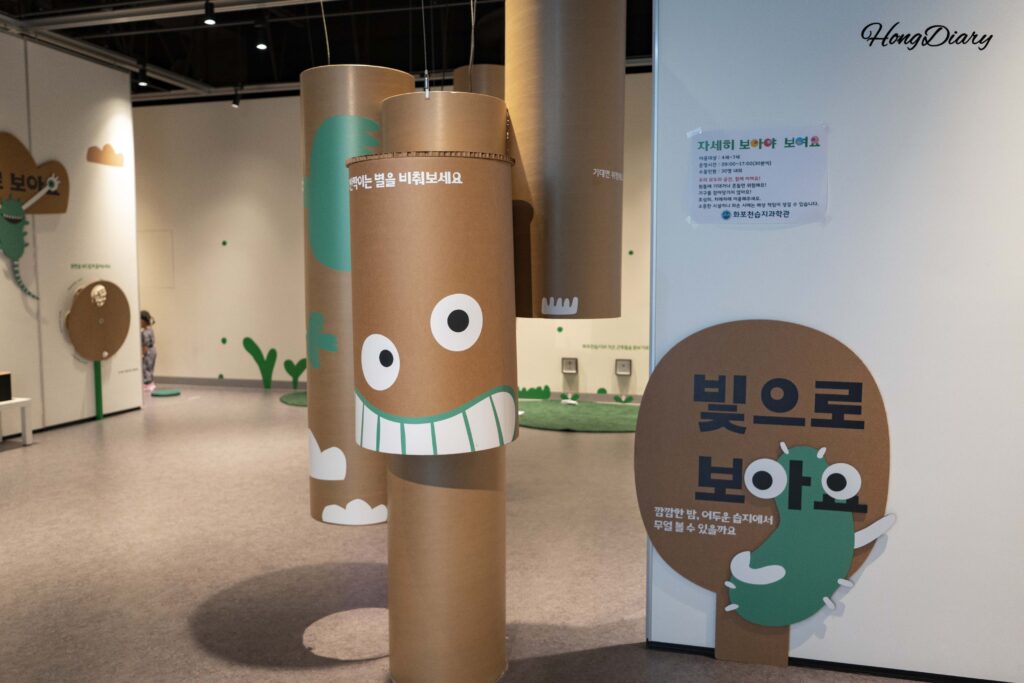
The ground floor doubles as a space for rotating special exhibitions and hands-on activities. When I visited, the temporary exhibit was designed almost entirely for children — tactile displays, coloring stations, and simple ecological games. If you are visiting without kids, this floor is a quick walkthrough at best. With children, though, it is surprisingly engaging; my kid spent more time here than I expected.
Second Floor: The Heart of the Museum
The permanent exhibits begin on the second floor, and this is where the Hwapocheon Wetland Science Museum finds its stride. The space is divided into three themed rooms.
Exhibition Room 1 — Wetland Science Lab
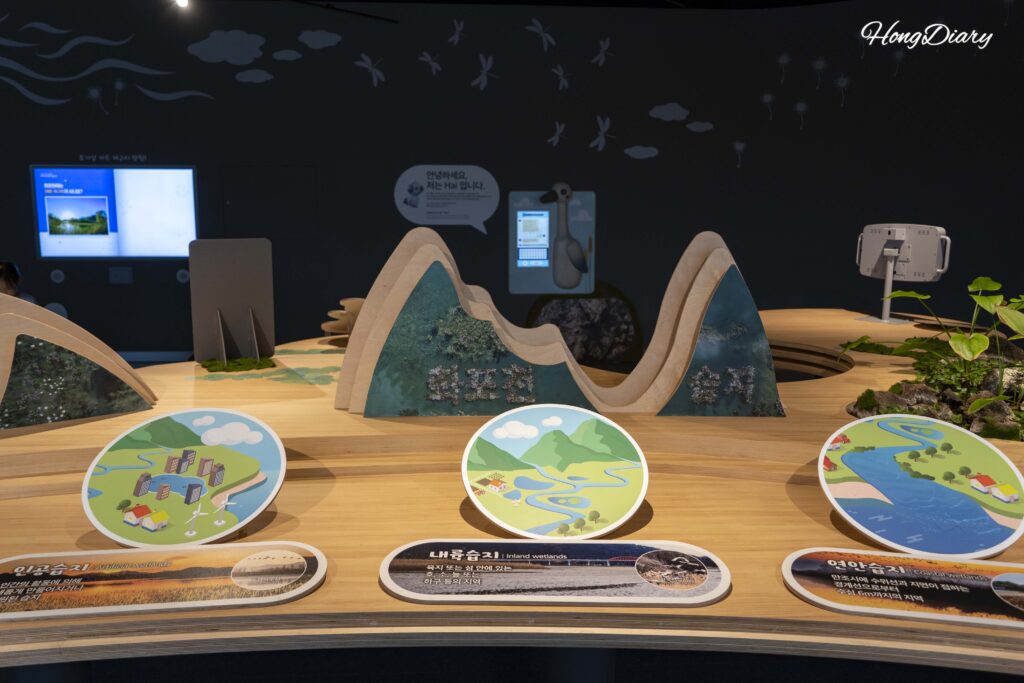
This room covers the fundamentals: what wetlands are, why they matter, and the different types that exist worldwide. Panels explain the difference between riverine wetlands (like Hwapocheon), coastal wetlands, and peatlands, with visual comparisons and diagrams. Most labels are in Korean, but the visual displays — maps, cross-section models, touchscreen elements — are intuitive enough to follow without reading every word.
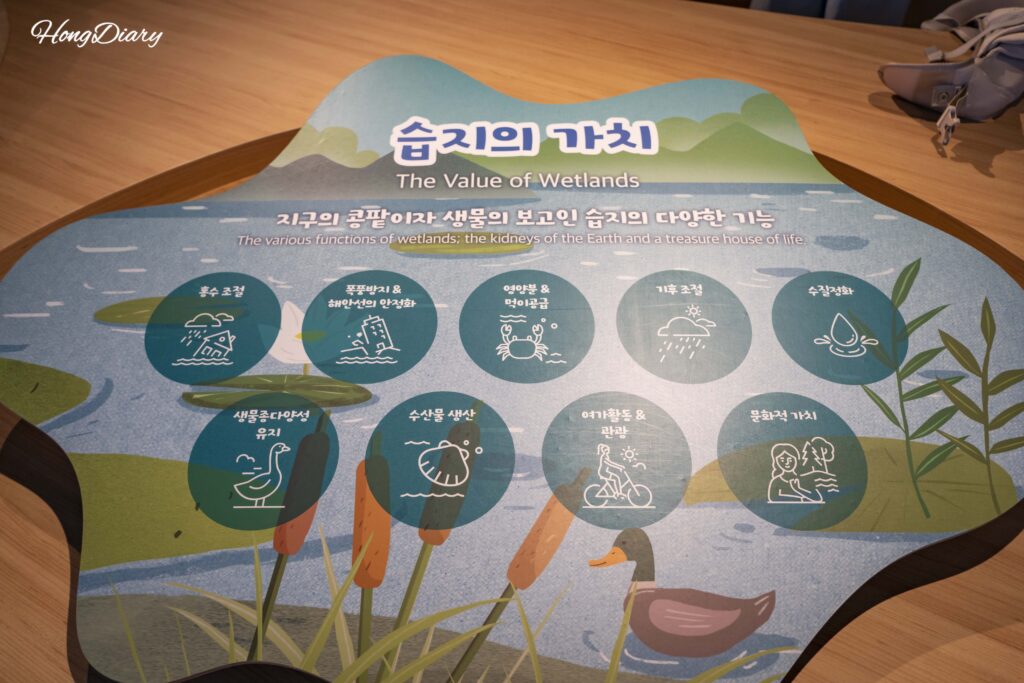
Informational panels throughout this section explain why wetlands function as natural water filters, flood buffers, and carbon stores — context that frames the Hwapocheon restoration story covered later in the observatory.
Exhibition Room 2 — Hwapocheon Through the Four Seasons
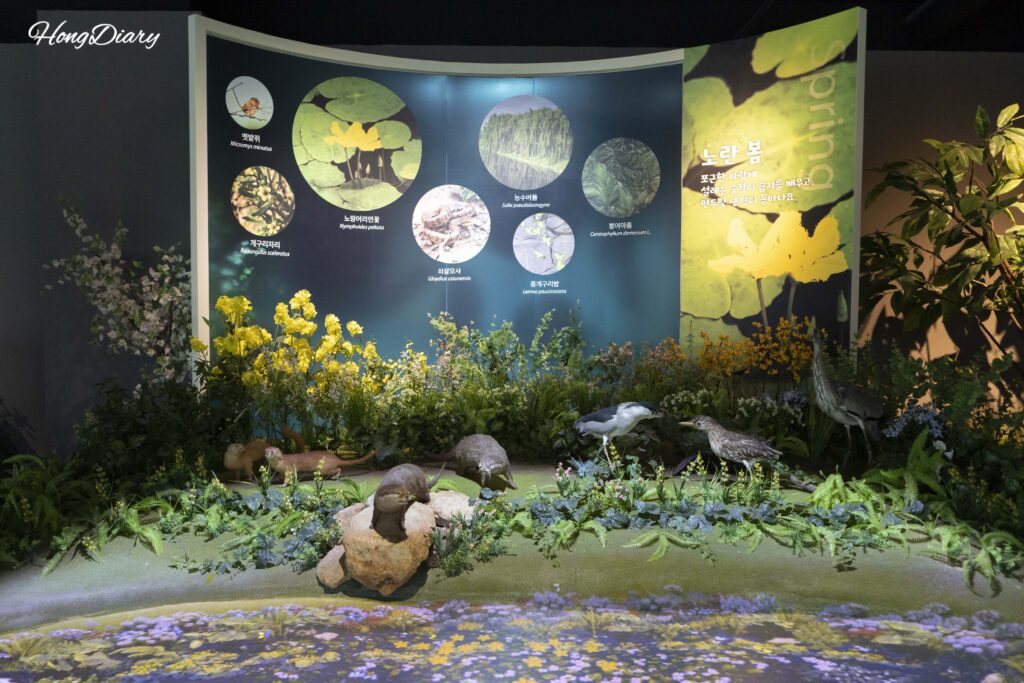
This was the most visually interesting section. Detailed dioramas recreate the wetland across spring, summer, autumn, and winter, with lifelike models of the plants and animals that inhabit each seasonal cycle. The room also features media art installations — real-time digital projections of flowing water, birdsong, and rustling reeds layered over the displays. It goes beyond static exhibits and gives a sense of what the wetland actually feels and sounds like at different times of year.
Exhibition Room 3 — Welcoming the Migratory Birds
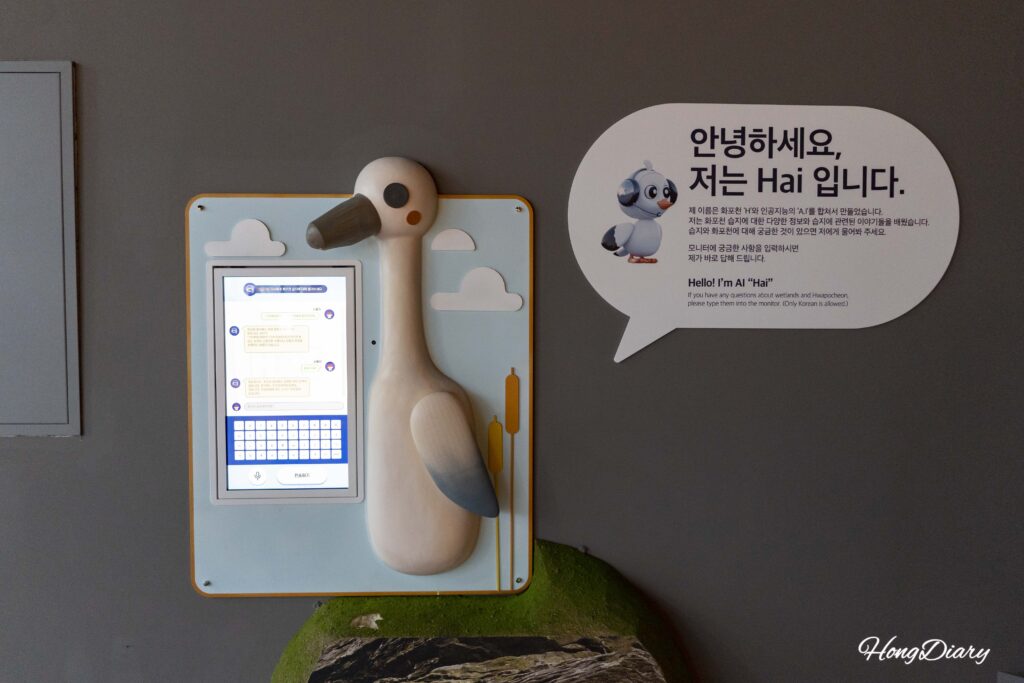
The final room focuses on the migratory birds that arrive each winter. Hwapocheon draws between 10,000 and 20,000 migratory birds annually, and the exhibit maps their flight routes and nesting patterns. An AI-powered interactive display called “Hai” — the museum’s digital mascot — lets visitors explore species information through a touchscreen. English labels are sparse here, but tapping through the screens is straightforward regardless of language.
The numbers behind this wetland are striking. Hwapocheon is home to 24 nationally designated endangered species, including Eurasian otters, leopard cats (a small wild feline native to Asia), and a freshwater tortoise called the namsengi. Rarer visitors include Steller’s sea eagles and eagle-owls, though spotting either of those requires serious luck and timing.
The Rooftop Photo Deck and Bird Observatory Tower
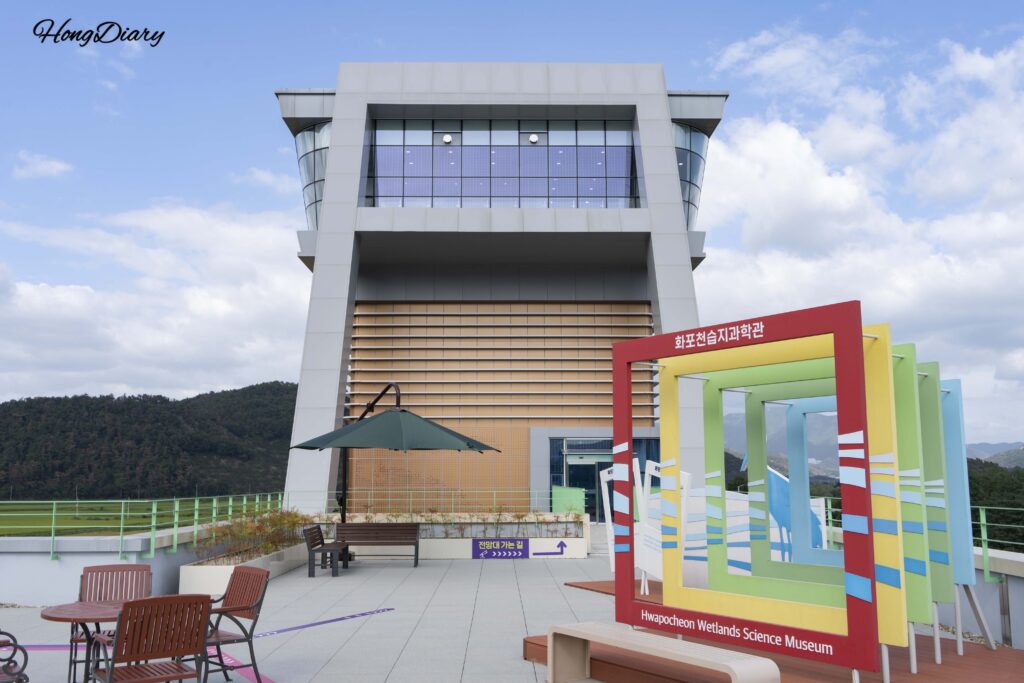
After the third-floor playground, I took the elevator up to the rooftop level — labeled RF on the floor guide. This open-air photo deck sits on top of the main building and offers an unobstructed view of the wetland and the hills beyond. It is a good spot to pause, take a few photos, and get your bearings before heading to the observatory.
The photo deck also serves as the connecting walkway to the Bird Observatory Tower, which is a separate structure. You cross over from the rooftop, enter the tower building, and take its elevator up to the observation floor. It is not a long walk, but knowing the route in advance helps — there are no English signs guiding you through the transition.
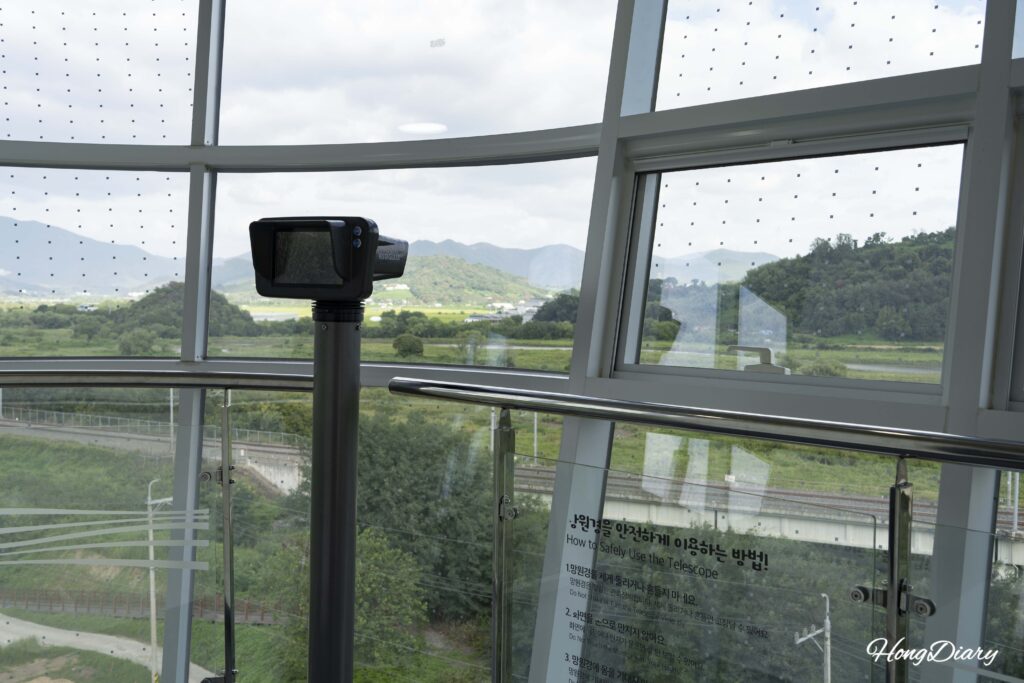
The top floor of the observatory houses free digital telescopes pointed at the wetland below. In theory, this is where you scan the landscape for birds and wildlife. In practice — at least on my visit — there was not much to see. The wetland stretched out below in a wide, green expanse bordered by rice paddies and farmland, but no birds were in range. Winter visits (December through February) would likely be different, when thousands of migratory geese, swans, and ducks settle into the area.
The View and the Restoration Story
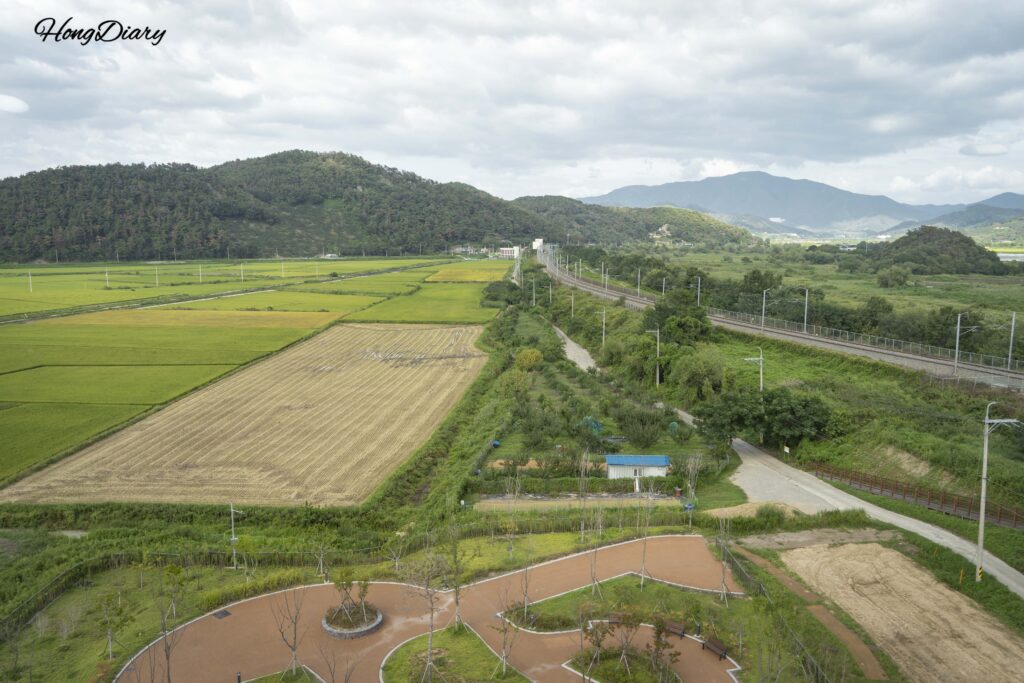
Still, the view from the tower gave me something the exhibits could not: a sense of scale. Seeing the wetland laid out in every direction, bordered by agricultural fields and low hills, made the restoration story feel real. Hwapocheon was once heavily polluted by industrial runoff from upstream factories. After years of cleanup and restoration work, the stream gradually recovered — enough to earn protected status as a National Wetland Conservation Area in 2017, and eventually to help Gimhae secure its Ramsar Wetland City accreditation in 2025.
If you are unfamiliar with the Ramsar Convention: it is an international treaty established in 1971 in the Iranian city of Ramsar, focused on the conservation of wetlands worldwide. A Ramsar Wetland City is a step beyond individual wetland protection — it recognizes an entire city for its commitment to wetland conservation. Gimhae is one of two Korean cities on that list, alongside Mungyeong (home to the Mungyeong Doline Wetland). Other well-known Korean wetland sites include the Upo Wetland in Changnyeong and the Suncheon Bay on the southern coast.
Below the observatory, the Hwapocheon Wetland Ecological Park extends along the stream with walking trails and observation decks. I did not have time to explore it fully, but on a cooler day — especially in autumn or spring — pairing the museum with a walk through the park would round out a comfortable half-day trip.
Final Thoughts: Who Should Visit the Hwapocheon Wetland Science Museum?
Here is where I want to be honest. The Hwapocheon Wetland Science Museum is an educational facility first and a tourist attraction second. Most of the exhibits are geared toward children, with touchscreens, games, and simplified explanations that work at a younger level. The display organisms are models and digital recreations, not live animals. English signage exists in places but is inconsistent — you will manage, but you will also miss context.
If you are traveling with children and want a free, interactive, indoor-outdoor experience near Busan, this museum delivers. If you are an eco-travel enthusiast or a birder curious about Korea’s wetland conservation efforts, the Ramsar connection and the observatory tower offer genuinely interesting material. If you are looking for traditional sightseeing, though, this is probably not the stop for you.
The access roads remain narrow and partially unfinished, public transit requires significant time and effort, and the surrounding area does not have much else within walking distance. This is not a drawback so much as a reality check: the Hwapocheon Wetland Science Museum is a local facility doing meaningful work in environmental education, not a polished tourist destination.
But I left thinking that was part of what made it interesting. Not every worthwhile place needs to be Instagram-ready. Sometimes the value is in the quieter story — a wetland that was nearly lost to pollution, brought back over decades, and now home to hundreds of species most people never hear about. If that kind of story matters to you, it is free, it is open, and it is waiting in a corner of Gimhae that nobody else is writing about.
Hwapocheon Wetland Science Museum FAQ & Practical Tips
Is the Hwapocheon Wetland Science Museum free to enter?
Yes. Both admission and parking are completely free of charge (₩0 / $0 USD / €0 EUR). The museum is publicly funded by Gimhae City. Some seasonal hands-on programs may require advance reservation through the website, but these are also offered at no cost.
How do I get to the Hwapocheon Wetland Science Museum from Gimhae International Airport?
Take the Busan-Gimhae Light Rail from Airport Station to Gaya University Station (about 35 minutes), then transfer to Bus No. 140 and ride 16 stops to the Seolchang stop (about 20 minutes). From there, it is a 2.5-kilometer walk (roughly 35 minutes) to the museum. The total trip takes over 90 minutes each way. Driving or taking a taxi is significantly faster, though the access roads near the museum are narrow and partially under construction.
Are the exhibits available in English?
English signage exists in some areas but is not consistent throughout the museum. Most interactive displays — touchscreens, media art installations, and visual exhibits — are intuitive enough to navigate without full Korean fluency. The museum’s official website offers partial English, Japanese, and Chinese support for basic visitor information.
Is the Hwapocheon Wetland Science Museum suitable for adults traveling without children?
The museum is primarily designed as an educational facility for families and school groups. Most interactive exhibits target a younger audience. Adults with an interest in ecology, wetland conservation, or green architecture will find value in the Ramsar Wetland City context, the Passive House-certified building, and the observatory tower views. However, general sightseers may find the experience on the quieter side.
What is a Ramsar Wetland City, and why does it matter for Gimhae?
A Ramsar Wetland City is an international accreditation under the Ramsar Convention — a 1971 treaty focused on wetland conservation. It honors cities that have taken measurable steps to preserve and manage their wetlands. Gimhae received this certification in January 2025, making it one of only 74 cities across 27 countries to hold the title. The Hwapocheon stream, which runs beside the museum, was the primary reason for the accreditation.
What wildlife lives in the Hwapocheon Wetland?
The wetland is home to over 800 documented species, including 24 nationally endangered animals. Notable residents include Eurasian otters, leopard cats, and the namsengi (a Korean freshwater tortoise). During winter (December to February), between 10,000 and 20,000 migratory birds — including Bean geese, Whooper swans, and occasionally Steller’s sea eagles — visit the area.
How do I get from the museum to the Bird Observatory Tower?
The observatory is not a separate walk outside. From the third floor of the main building, take the elevator up to the RF (rooftop) level. You will step out onto an open-air photo deck with wetland views. Walk across the deck to enter the Bird Observatory Tower building, then take its elevator up to the observation floor with the free digital telescopes. The route passes through the building and across a short open-air rooftop section, and no additional admission is required (₩0 / $0 USD / €0 EUR).