
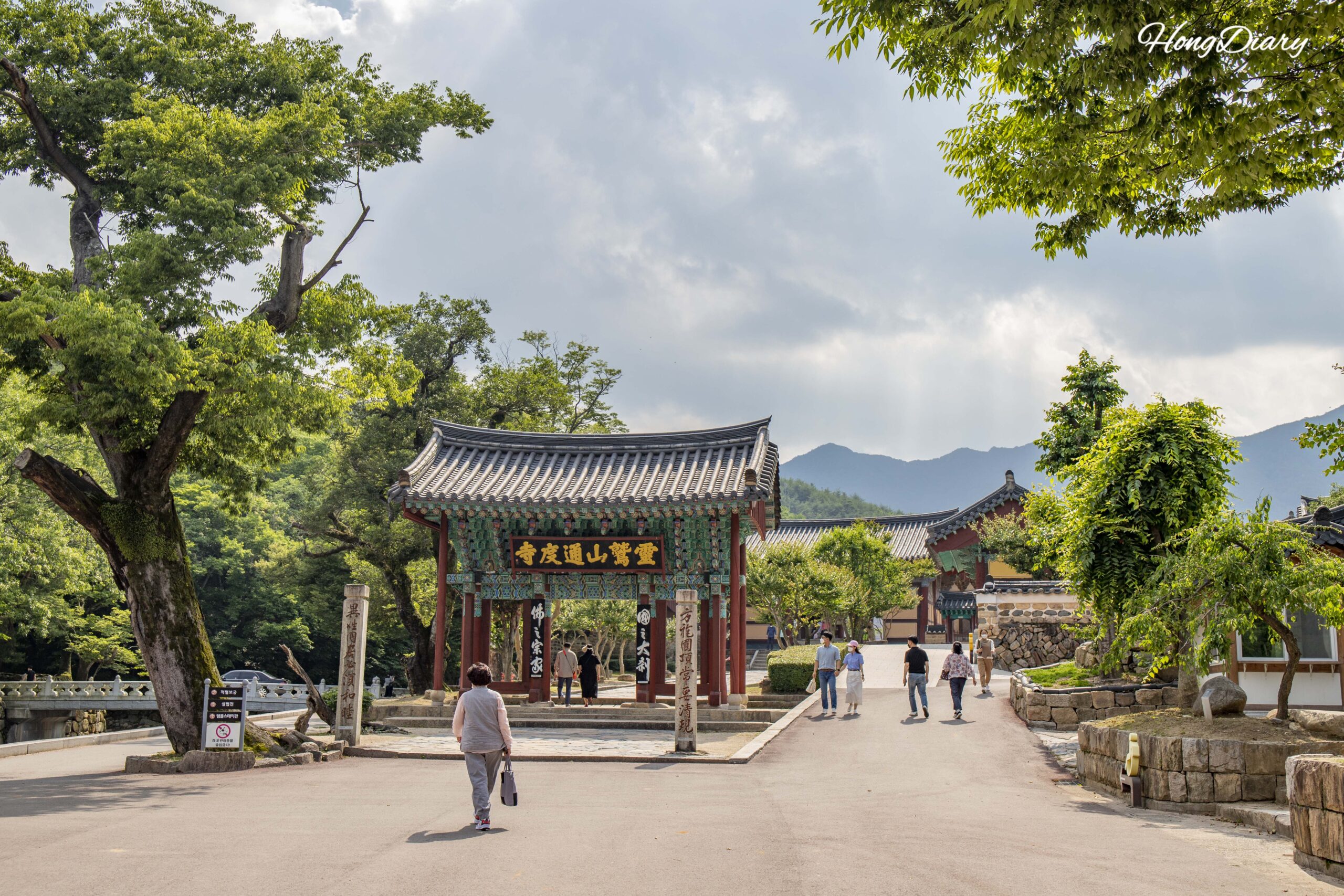
I walked into the main hall expecting a large golden Buddha — the kind you see at every Korean temple. Instead, the altar was bare. No statue, no image, just an open window at the back of the hall framing a stone platform outside. That single detail changed the entire visit. Tongdosa Temple, tucked into the forested slopes of Yeongchuksan Mountain in Yangsan, is the only major temple in Korea where the main hall holds no Buddha statue at all. The reason turns out to be far more compelling than I anticipated.
Tongdosa sits in Habuk-myeon, Yangsan-si, Gyeongsangnam-do Province — a small city wedged between Busan to the south and Ulsan to the north, two of South Korea’s largest metropolitan areas. The temple was inscribed as a UNESCO World Heritage Site in 2018 under the collective designation “Sansa, Buddhist Mountain Monasteries in Korea.” For anyone already based in Busan, it works as a comfortable half-day trip: roughly 25 minutes by intercity bus from Nopo Station, plus a 1.8 km walk from the bus terminal to the entrance. No car rental necessary, though driving is straightforward if you prefer. Founded in 646 CE during the Silla Dynasty, this 1,380-year-old complex is the largest Buddhist temple in Korea by building count and remains a functioning monastery — not a museum piece preserved behind glass.
Table of Contents
Visitor Info & Transport
| Detail | Info |
|---|---|
| Address | 108 Tongdosa-ro, Habuk-myeon, Yangsan-si, Gyeongsangnam-do |
| Hours | 06:30 – 17:30 daily |
| Entrance Fee | Free (since May 2023) |
| Parking | ₩6,000 / $4 USD / €3 EUR (regular) · ₩3,000 / $2 USD / €2 EUR (compact car) · Free lot available near the main road entrance |
| Getting There | Busan Subway Line 1 → Nopo Station → intercity bus to Tongdosa Sinpyeong Terminal (25 min, ₩2,800 / $2 USD / €2 EUR) → 1.8 km walk (about 30 min) |
| Time Needed | 2–3 hours (main compound + museum) |
The Walk In — Stream, Shade, and Stone Cairns
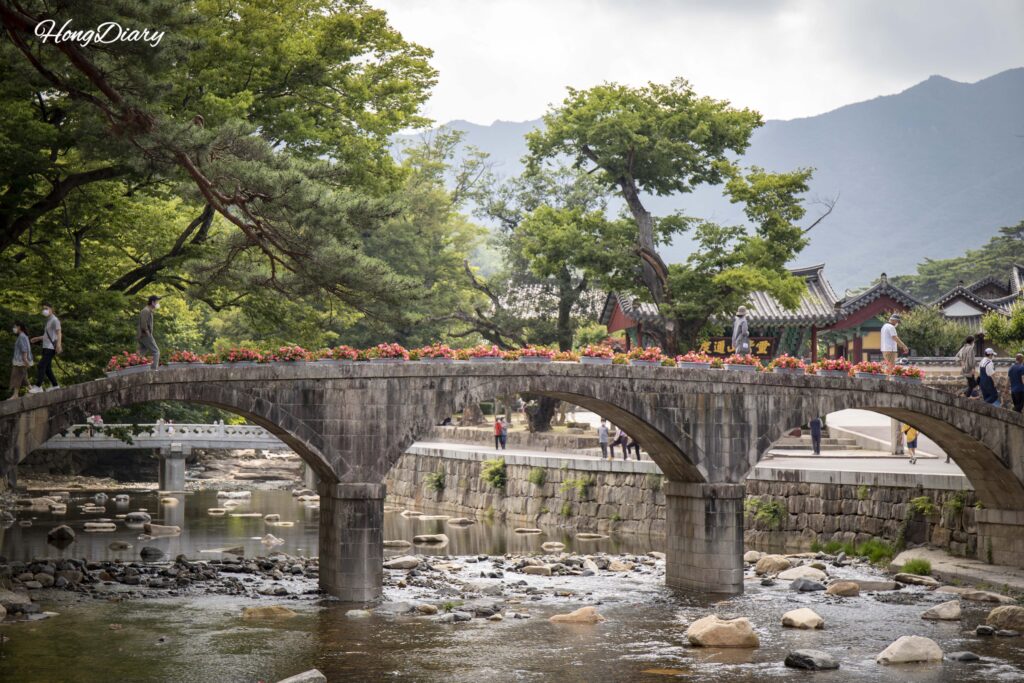
The parking lot sits at the bottom of the complex, and from there a stream runs alongside the path leading toward the temple grounds. A stone bridge crosses the water near the entrance — one of those spots where you end up pausing longer than planned. Cafes, small shops, and resting spots line the route. On the day I went — a weekend — families had set up blankets under the trees, and more than a few visitors weren’t even heading into the temple itself. They’d come to sit by the water and enjoy the shade.
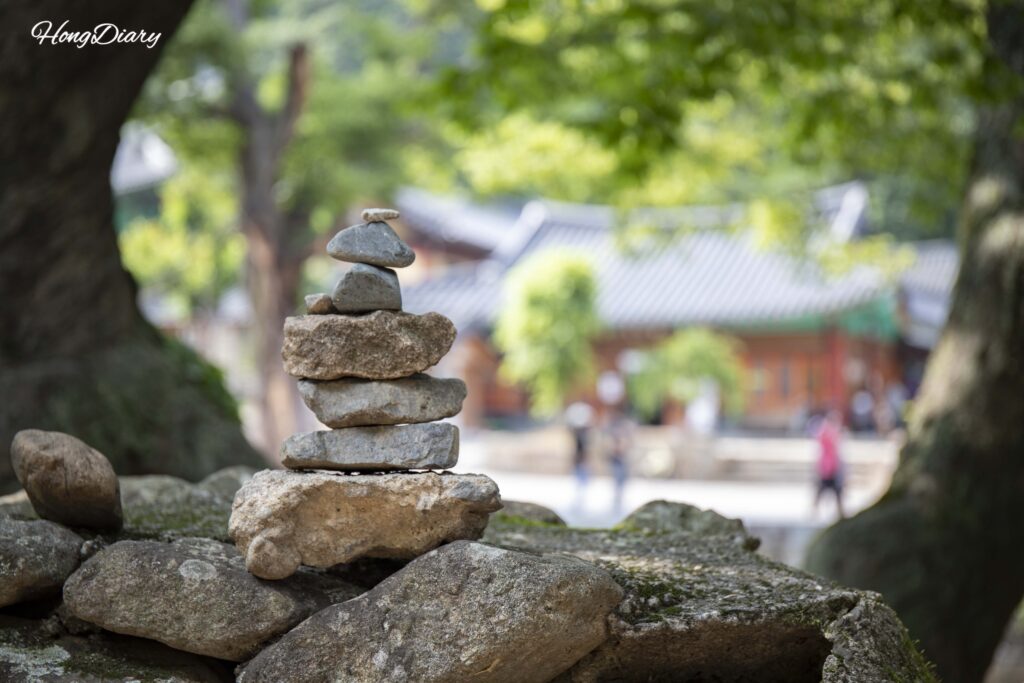
Along the path, small stone cairns stacked by visitors dot the edges of the trail — each one a quiet wish or prayer left behind. It’s a common sight at Korean temples, but here, with the stream running beside them and the mountain rising behind, the scene carries a particular stillness.
There are two parking areas. The one closer to the temple entrance charges ₩6,000 / $4 USD / €3 EUR for a regular-sized car and ₩3,000 / $2 USD / €2 EUR for a compact. But the lot near the main road is free. If the weather is cooperating, parking there and walking up is a solid option — the trail is shaded by tall pines and feels more like a nature walk than a commute. I came back after my visit and sat on one of the benches along the stream. A breeze came through the tree canopy, and I understood why people linger here for hours.
Stepping Through the Iljumun Gate
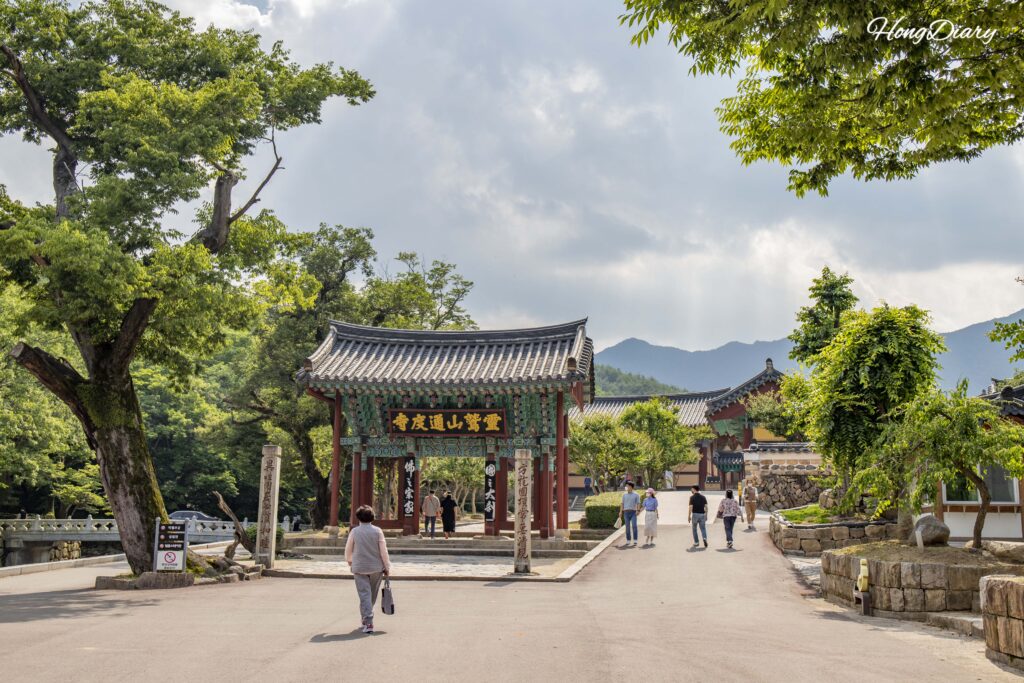
The first structure you encounter is the Iljumun — the One Pillar Gate that marks the symbolic threshold between the everyday world and sacred ground. The wooden plaque above the gate reads “Yeongchuksan Tongdosa” in calligraphy attributed to Heungseon Daewongun, the powerful regent of the late Joseon Dynasty. Along the side columns, characters by the calligrapher Kim Gyu-jin declare this place “Gukjidaechal” (great temple of the nation) and “Buljijongga” (ancestral home of the Buddha).
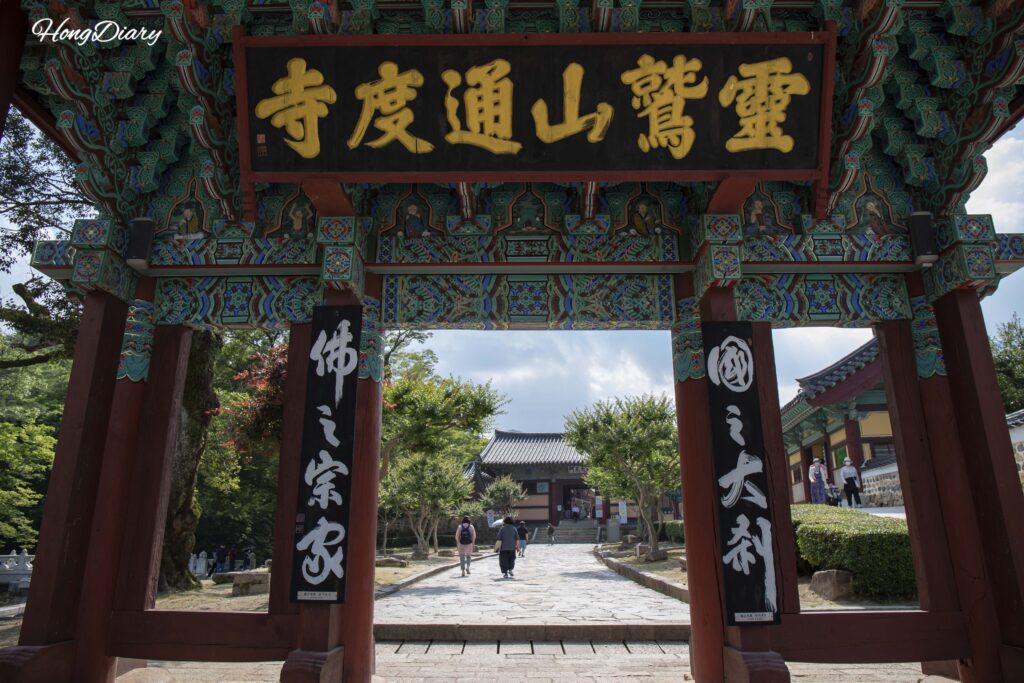
It’s a strong entrance. You’re not just walking through a decorative archway — you’re crossing a line that people have considered meaningful for nearly fourteen centuries.
Three Courtyards, Over Sixty Buildings
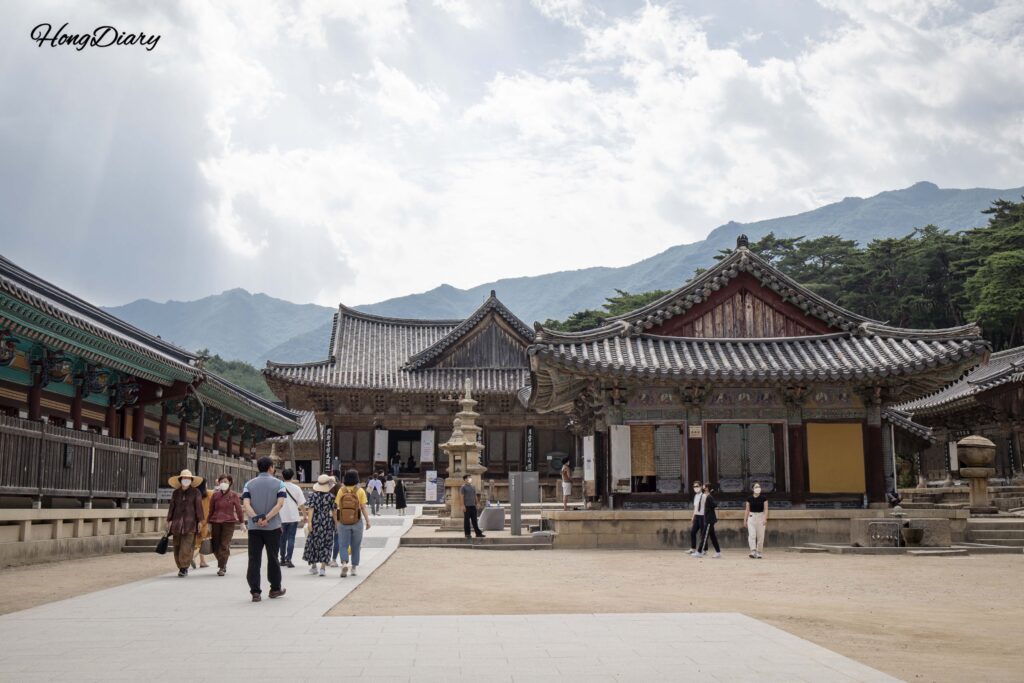
Tongdosa is organized into three sections: Harojeon (lower courtyard), Jungrojeon (middle), and Sangrojeon (upper). You enter at the bottom and walk uphill through all three. Over 65 buildings are distributed across the main compound, with another 19 hermitages scattered through the surrounding mountains.
The scale catches you off guard, but what struck me more was the atmosphere. Certain areas are clearly marked as off-limits — monks’ living and practice quarters. Signs ask visitors to keep quiet. Unlike some of the more tourist-oriented temples closer to major cities, this place still operates as a working monastery. You can feel it in the pace of the compound: unhurried, deliberate, not performing for anyone.
The Hall With No Buddha
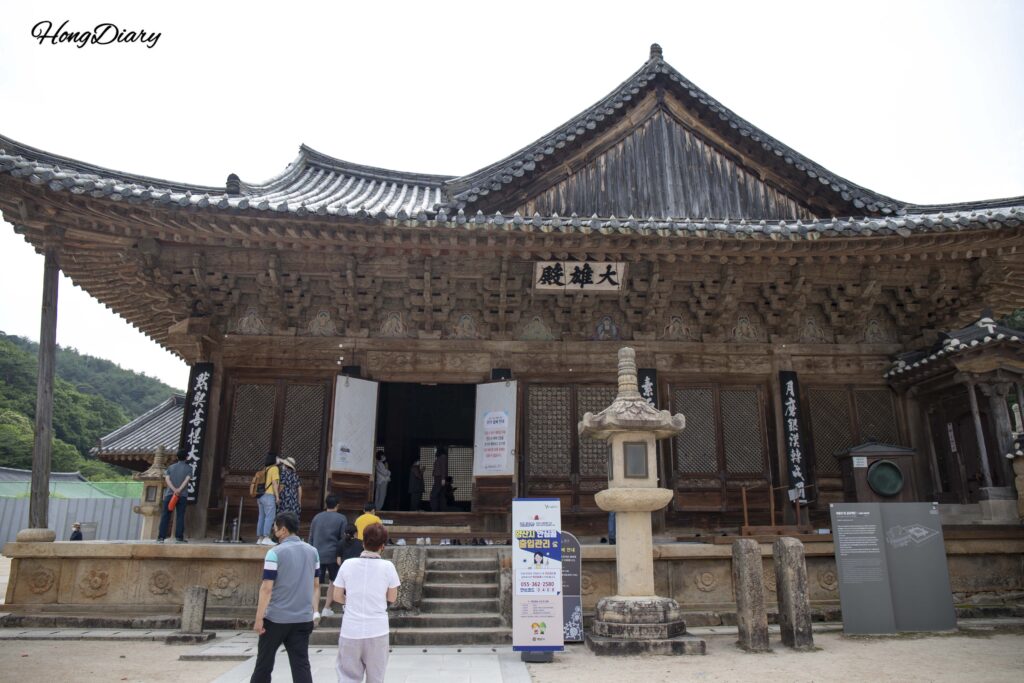
This is what makes Tongdosa unlike anything else in Korea.
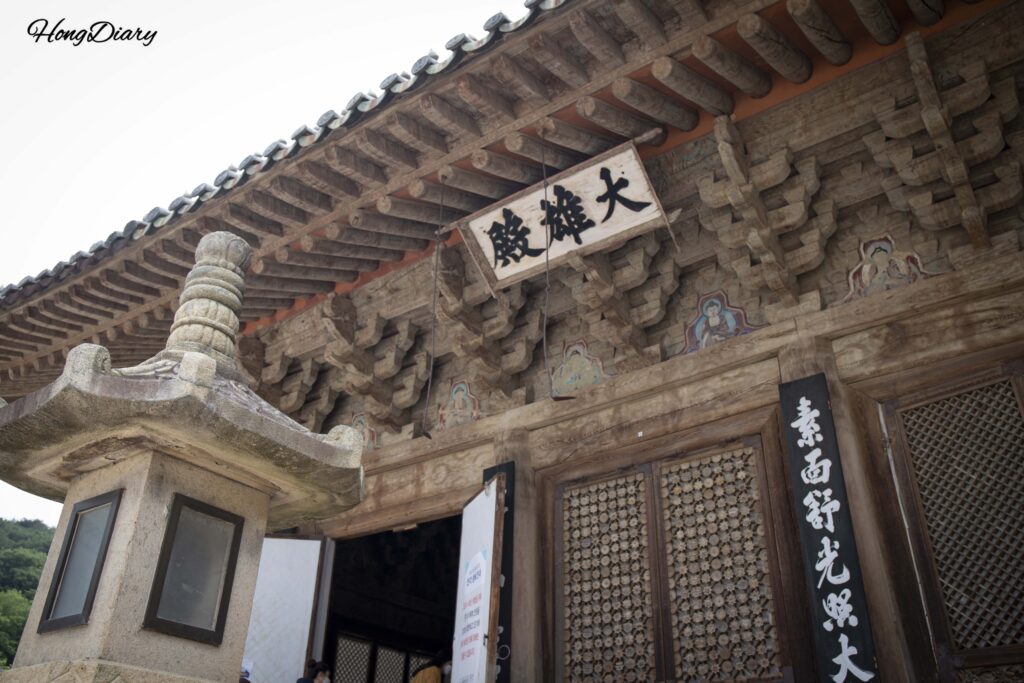
At virtually every major Korean temple — Bulguksa, Beopjusa, Haeinsa — the main hall, the Daeungjeon, centers around a large gilded Buddha statue on the altar. At Tongdosa, the altar is present. Incense burns. Offerings are placed. But there is no statue. The focal point is a window cut into the rear wall, and through it you can see the raised stone platform behind the hall.
That platform is the Geumgang Gyedan — the Diamond Ordination Platform — believed to contain the actual physical relics of Shakyamuni Buddha. Bone fragments, a robe, and a begging bowl, brought to Korea from Tang Dynasty China by the monk Jajang in 646 CE.
The reasoning behind the empty hall is direct: when the real thing is present, there’s no need for a representation.
This is what separates Tongdosa from a sightseeing stop. Korea’s Three Jewel Temples each safeguard one of Buddhism’s foundational treasures. Haeinsa in Hapcheon holds the Tripitaka Koreana — 81,258 carved woodblocks of Buddhist scripture — representing the Dharma, the teachings. Songgwangsa in Suncheon produced the most National Master monks in Korean history, representing the Sangha, the community. Tongdosa holds the Buddha’s physical remains, representing the Buddha himself.
One description I came across frames it this way: Songgwangsa is about people, and people change. Haeinsa is about scripture, and texts endure. Tongdosa is about the Buddha — invisible, yet here.
Knowing this context before I entered the Daeungjeon changed the experience entirely. I wasn’t looking at old architecture. I was standing in a space built so that nothing — no image, no representation — would stand between you and what it protects.
Visiting the Geumgang Gyedan
The ordination platform is a designated National Treasure, and public access is limited to protect the relics. If you want to see it up close, plan around one of these lunar calendar dates: the 1st through 3rd, the 15th, the 18th (Jijang-jae), or the 24th (Gwaneumjae), between 11:00 AM and 2:00 PM. I’ve visited three times now and still haven’t managed to time it right — so plan ahead if this matters to you.
Guryongji — The Pond That Never Dries
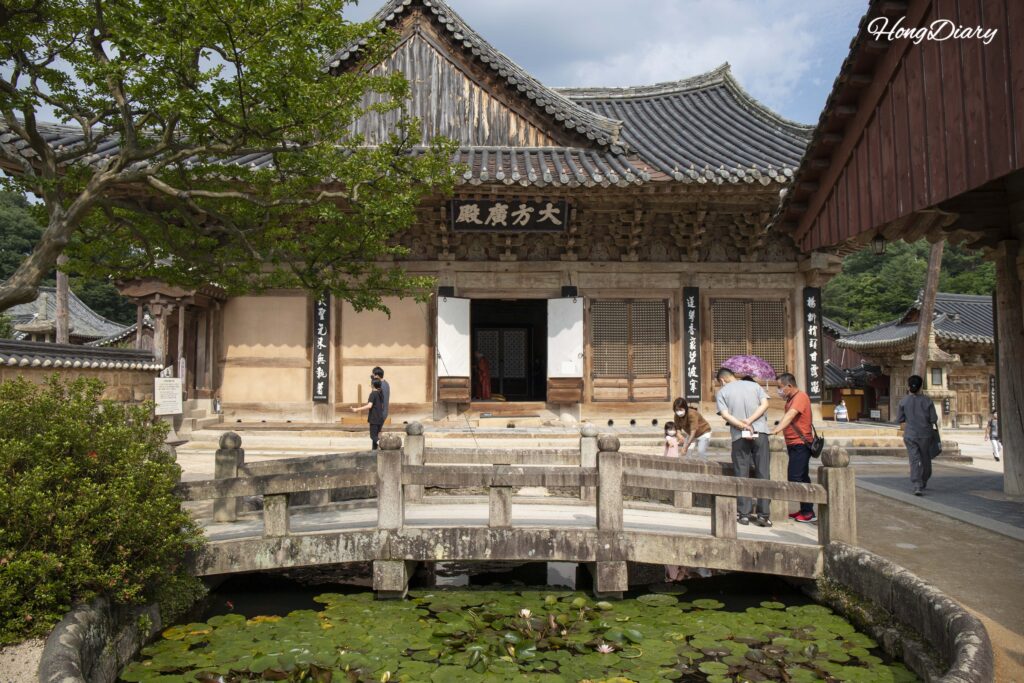
Just beside the Daeungjeon, there’s a small, quiet pond called Guryongji — the Nine Dragon Pond. It’s easy to walk past without noticing, but the story behind it is one of the more memorable pieces of Korean temple folklore.
When the monk Jajang returned from China and selected this site for the temple, the land was a large swamp inhabited by nine venomous dragons. He used his spiritual authority to drive them out. Eight fled. The ninth — blind and stubborn — refused to leave, and instead pledged to remain and guard the Buddha’s relics for all time.
Jajang, moved by the dragon’s resolve, allowed it to stay and left a corner of the original swamp intact. That corner is Guryongji.
Here’s the part that gets your attention even if legends aren’t your thing: no matter how severe the drought, the water in this pond has reportedly never dried up. Coins from visitors making wishes sit at the bottom. Whether or not you put stock in dragon lore, a pond on a mountainside that stays full through every dry season is, at minimum, geologically interesting. I dropped a coin in and wished for my family’s health. It felt like the right thing to do in a place like this.
A Place That Outlasted Empires
Most visitors come for the scenery or the architecture, and both deliver. But the history underneath is heavier than it appears.
Tongdosa survived the Mongol invasions of the 13th century, when the Goryeo court was under sustained pressure from the Yuan Empire. It survived the Imjin War — the Japanese invasions of the 1590s — though much of the complex was burned and later rebuilt. Through every crisis, the relics were protected and never lost.
During the Korean War in the early 1950s, the temple served as a field hospital. A Buddhist monastery treating wounded soldiers — that fact alone tells you how embedded this place is in Korea’s collective memory, well beyond its religious identity.
It’s easy to see Tongdosa as a scenic temple or a plum blossom photo spot, and there’s nothing wrong with either of those. But walking through it with some awareness of what it endured adds a layer that stays with you after you leave.
When to Visit — Plum Blossoms and Autumn Gold
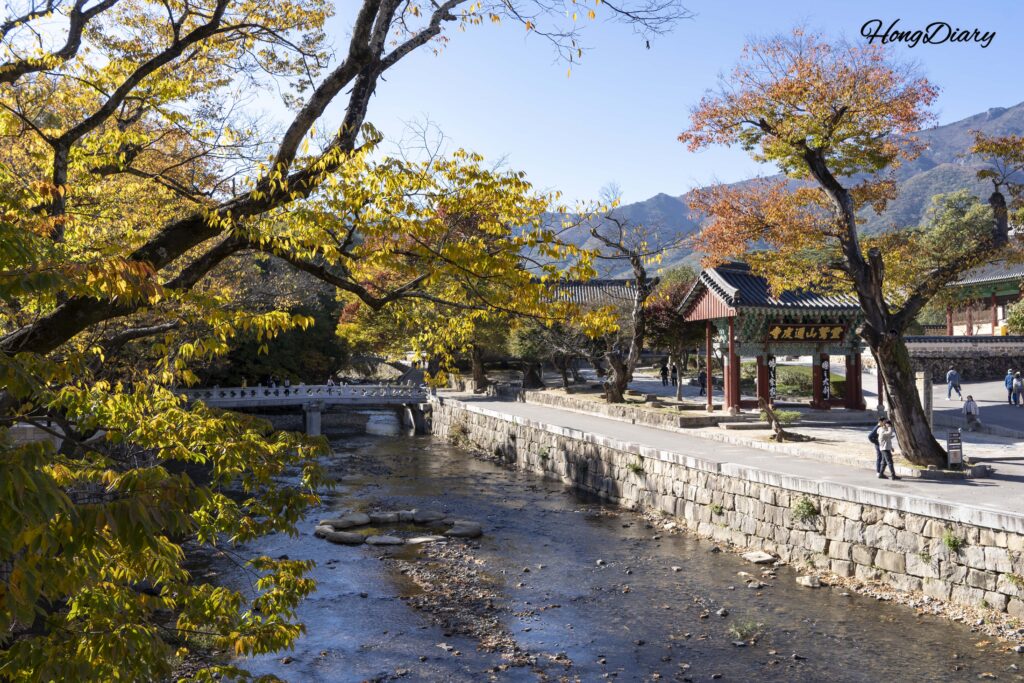
Tongdosa looks meaningfully different in every season, and that’s part of what brings people back.
| Season | What to Expect |
|---|---|
| Early Spring (Feb–Mar) | The red plum blossoms (hongmaehwa) are the main attraction. This is one of the most popular plum blossom destinations in Korea. Expect weekend crowds. |
| Late Spring–Summer | Full green canopy, warm but shaded trails. The stream area is at its most inviting. |
| Autumn (Oct–Nov) | Mountain foliage turns the trails behind the temple into deep reds and golds. Generally fewer visitors than spring. |
| Winter | Quiet, stark, occasionally snow-covered. The fewest visitors and the most contemplative atmosphere. |
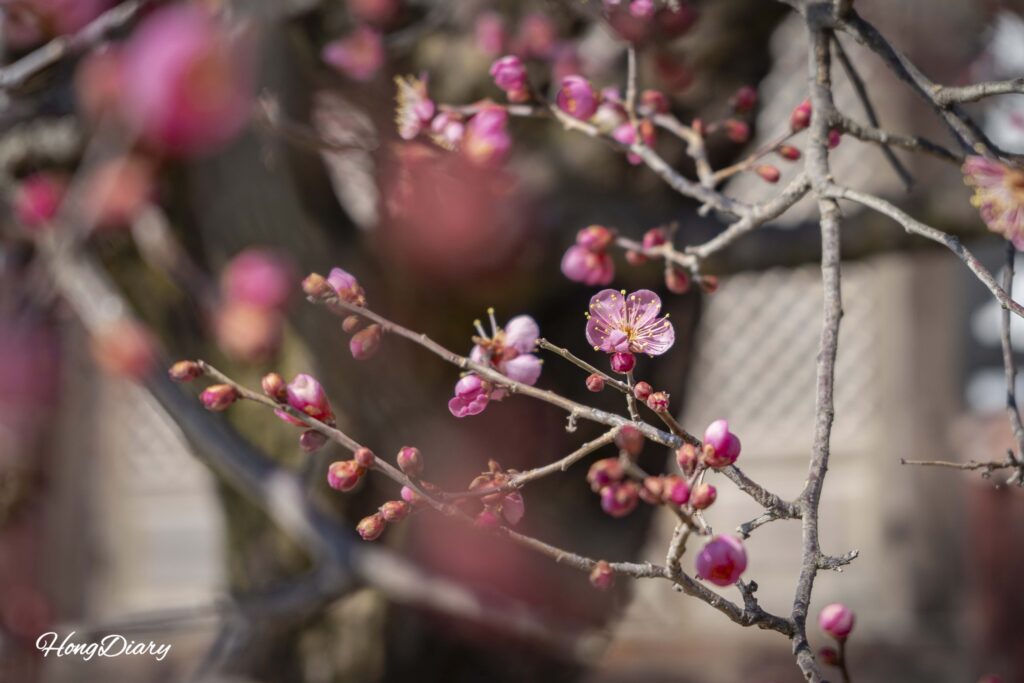
If you’re aiming for a peaceful visit with fewer people, a weekday in mid-autumn or early spring — just before the plum blossoms fully peak — tends to offer the best balance.
Seongbo Museum — One More Stop Before You Leave
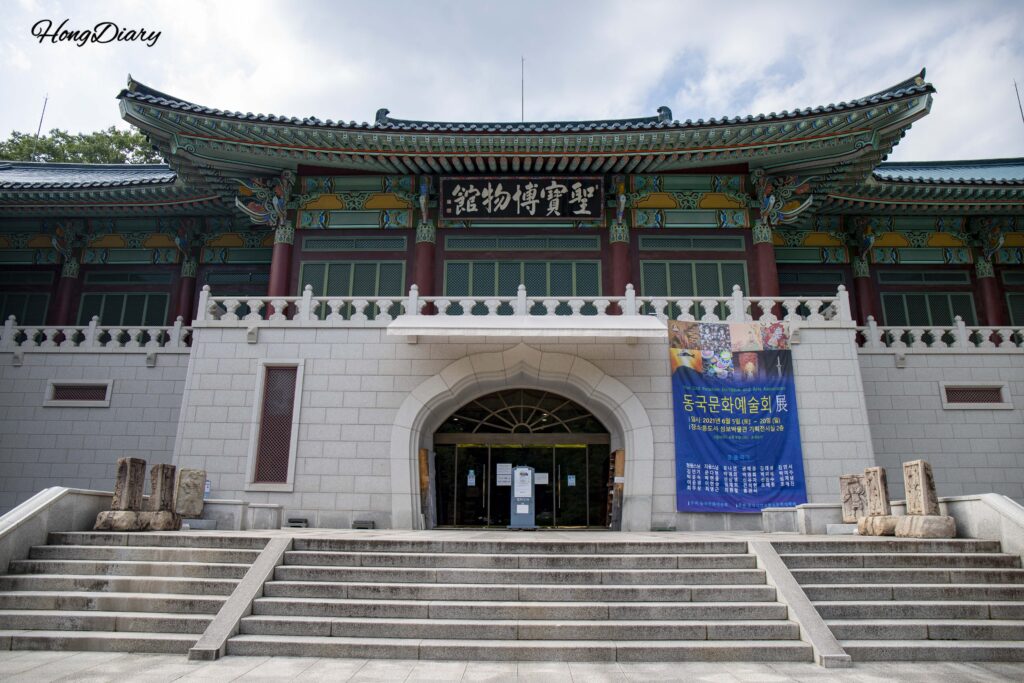
On the way back toward the parking area, you’ll pass the Tongdosa Seongbo Museum. It’s one of the largest Buddhist art museums in Korea, housing over 30,000 items: paintings, sculptures, texts, and ritual objects spanning centuries. Admission is free. Keep in mind that the museum is closed on Mondays.
Photography is not permitted inside, so I can’t show you the collection. But if you have even a passing curiosity about Buddhist art or Korean cultural heritage, it adds an easy 30–40 minutes to your visit and is well worth the stop.
Tongdosa Temple is the kind of place that works best when you aren’t rushing. The walk along the stream, the progression through the gates, the empty hall, the dragon pond, the weight of everything this compound has survived — it builds gradually and rewards you for slowing down.
If you’re spending time in Yangsan beyond Tongdosa, there are a few places nearby that rarely show up on the typical tourist circuit but are worth carving out time for.
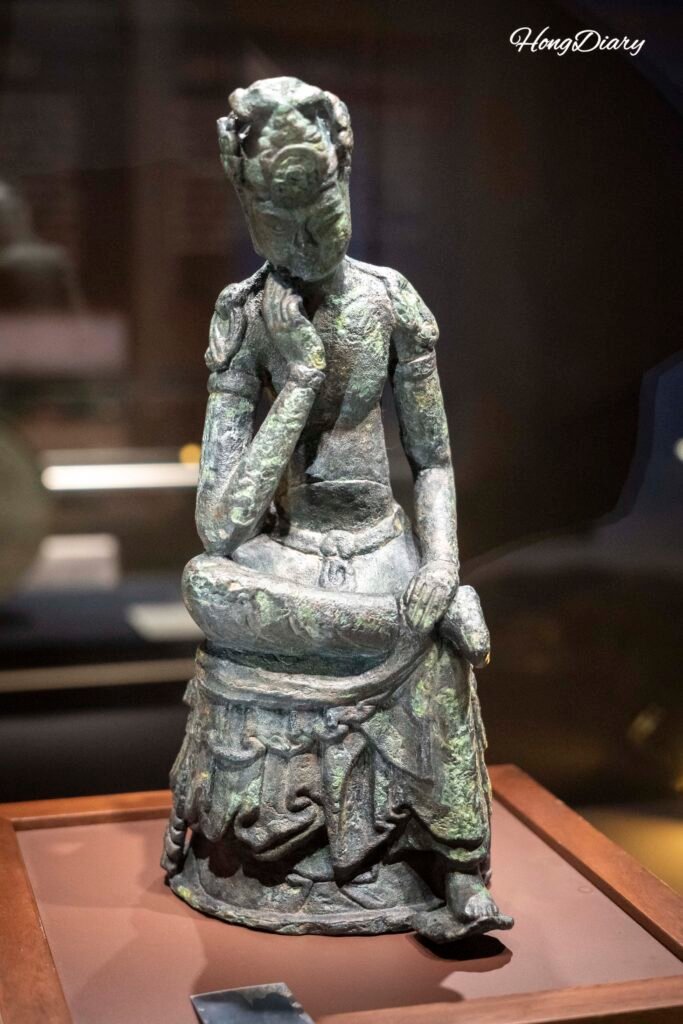
The Yangsan City Museum houses a collection of Gaya-era artifacts that surprised me — gold bird-shaped leg ornaments, a Pensive Bodhisattva statue, and an almost eerie absence of other visitors. It’s the kind of small museum where you get the entire gallery to yourself and leave wondering why nobody talks about it.
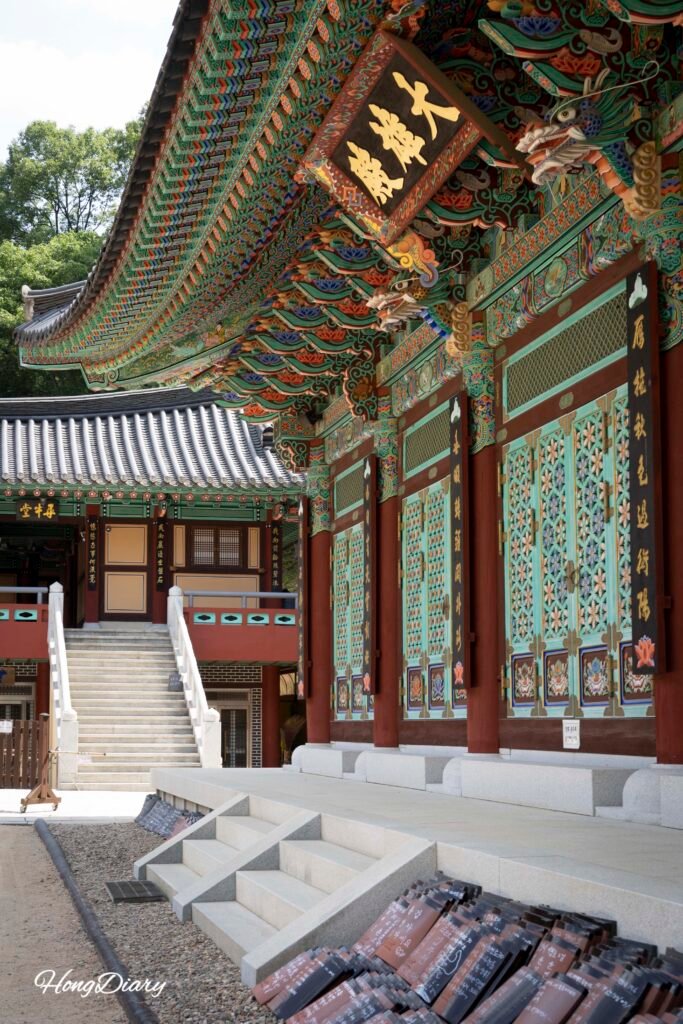
If you’re up for a more active half-day, the trail to Naewonsa Temple follows a forested valley hike that ranks among the most scenic in the Yangsan area. It’s another Buddhist temple, but the mountain setting and the walk to get there make for a completely different kind of experience.
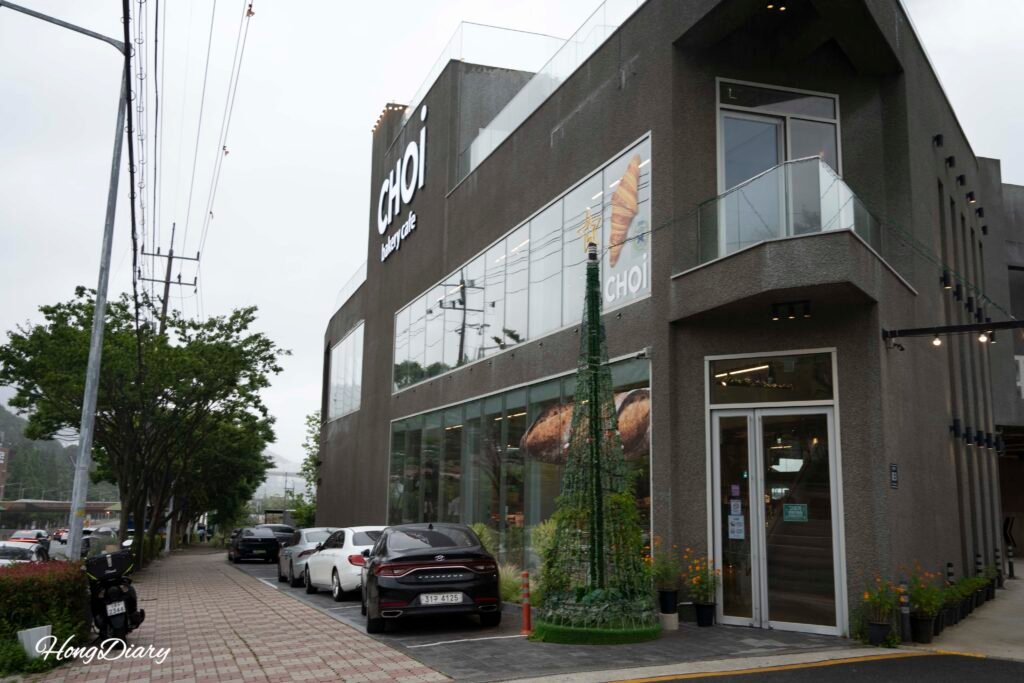
For a caffeine stop between sites, Cafe Choi in Yangsan has built a quiet reputation as a local favorite — the kind of neighborhood spot where the coffee is taken seriously and the space is designed for lingering, not scrolling.
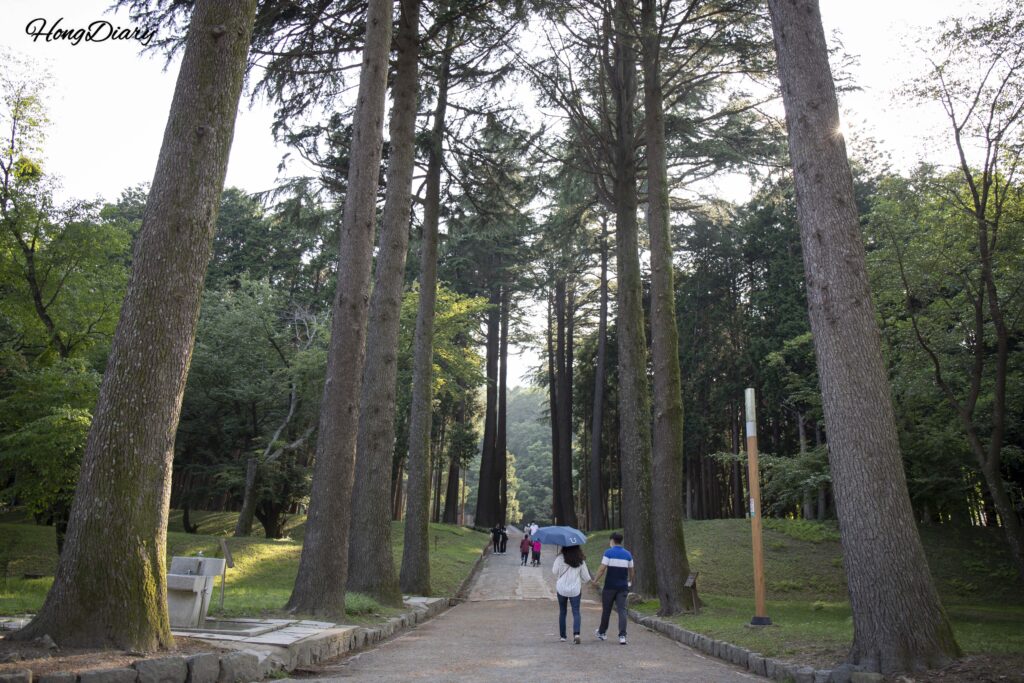
And if time allows for one more, Beopgi Reservoir is a place with an unusual backstory: it was sealed off from the public for 79 years as a protected water source, and the surrounding forest grew into something close to wilderness. The walking path through it feels like stepping into untouched terrain — a sharp contrast to how accessible it actually is from central Yangsan.
Tongdosa Temple on its own is reason enough to make the trip from Busan. But paired with any of these, a full day in Yangsan becomes one of those quiet highlights that stays with you longer than the busier stops on most itineraries.
Frequently Asked Questions About Tongdosa Temple
How do I get to Tongdosa Temple from Busan?
Take Busan Subway Line 1 to Nopo Station, then transfer to an intercity bus at Busan Central Bus Terminal bound for Tongdosa Sinpyeong Terminal. The bus ride takes about 25 minutes and costs ₩2,800 / $2 USD / €2 EUR, with departures roughly every 40 minutes. From the bus terminal, it is a 1.8 km walk (about 30 minutes) to the temple entrance. A taxi from Nopo Station takes approximately 30 minutes and is a convenient alternative if you prefer to skip the walk.
Why does Tongdosa Temple have no Buddha statue in its main hall?
Tongdosa enshrines what are believed to be the actual physical relics of Shakyamuni Buddha — bone fragments, a robe, and a begging bowl — brought from Tang Dynasty China by the monk Jajang in 646 CE. These relics are sealed within the Geumgang Gyedan (Diamond Ordination Platform) directly behind the main hall. Because the Buddha’s real remains are present, there was no theological need to create a sculptural representation. Visitors bow toward a window in the rear wall of the Daeungjeon that frames the ordination platform, rather than toward a statue.
How much does it cost to visit Tongdosa Temple?
Entrance to the temple grounds is free. Parking in the upper lot closer to the temple is ₩6,000 / $4 USD / €3 EUR for a regular car and ₩3,000 / $2 USD / €2 EUR for a compact car. A free parking lot is available near the main road entrance if you are willing to walk a bit farther. The Tongdosa Seongbo Museum, located near the entrance, is also free to visit.
When is the best time to visit Tongdosa Temple?
Each season offers a distinct experience. Early spring (late February to March) draws visitors for the famous red plum blossoms (hongmaehwa), though weekends can be crowded. Autumn (October to November) brings striking foliage along the mountain trails with generally fewer visitors. For the quietest and most reflective visit, weekdays in any season — or winter, when snow occasionally blankets the courtyards — are ideal.
How long should I spend at Tongdosa Temple?
A focused visit to the main compound, including all three courtyards (Harojeon, Jungrojeon, and Sangrojeon), takes about 1.5 to 2 hours. Adding the Seongbo Museum brings the total to approximately 2.5 to 3 hours. If you want to explore one or two of the 19 surrounding hermitages or walk the forest trails, plan for a full half-day.
Can I visit the Geumgang Gyedan (Diamond Ordination Platform)?
Public access to the Geumgang Gyedan is restricted to specific dates and hours to preserve the National Treasure. It is open on the following lunar calendar days: the 1st through 3rd, the 15th, the 18th (Jijang-jae), and the 24th (Gwaneumjae), between 11:00 AM and 2:00 PM. Outside of these windows, visitors can view the platform from behind the Daeungjeon hall but cannot approach it directly.
Is the Seongbo Museum at Tongdosa Temple worth visiting?
Yes. The Tongdosa Seongbo Museum is one of the largest Buddhist art museums in Korea, housing over 30,000 items including Buddhist paintings, sculptures, texts, and ritual objects. Admission is free, and a visit takes roughly 30 to 40 minutes. Photography is not permitted inside. It is located near the temple entrance, making it easy to stop in on your way out. Keep in mind that the museum is closed on Mondays.