
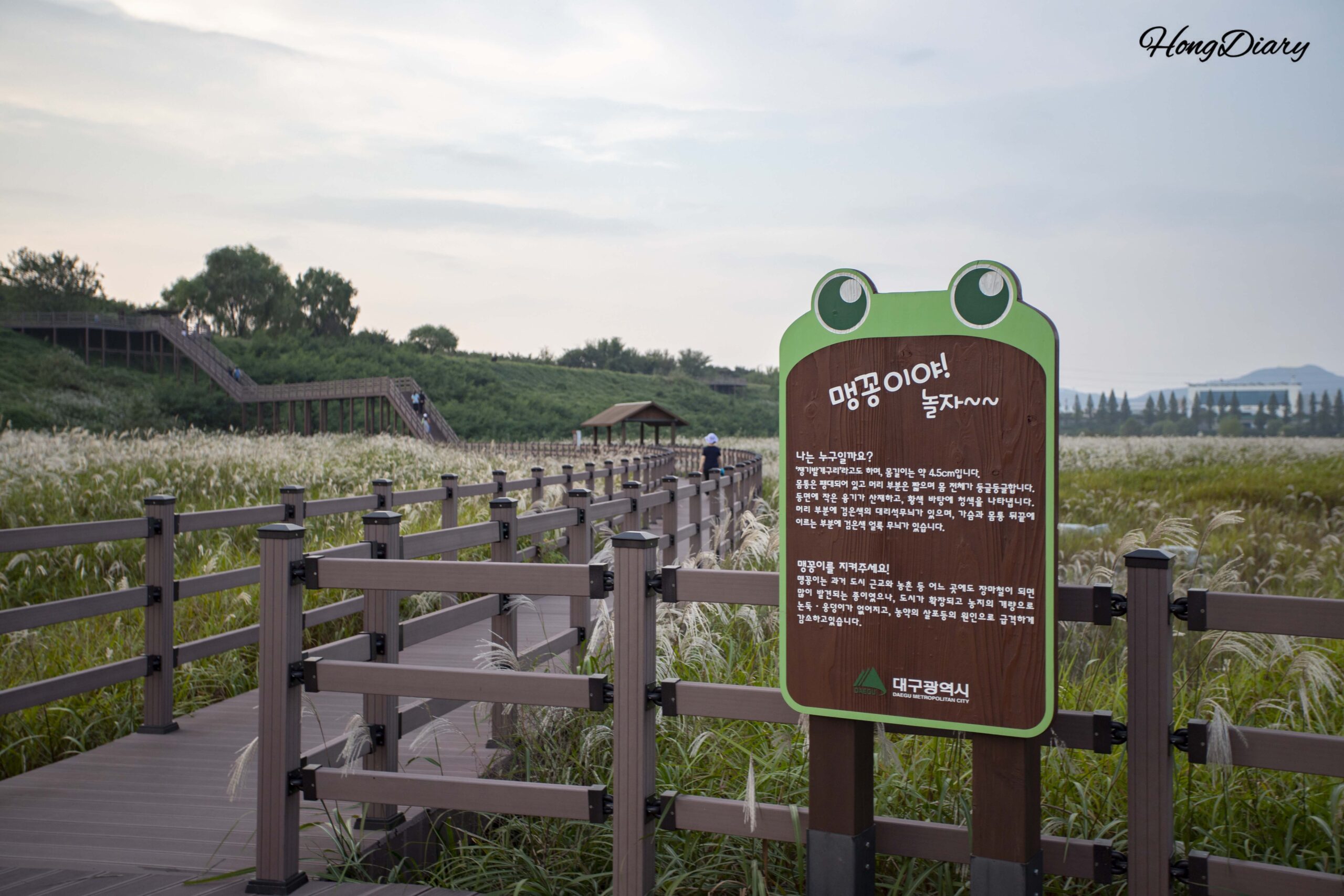
I came to the Dalseong Wetland Eco Learning Center mostly as a detour — a quick stop before heading somewhere else in Daegu. I ended up staying for most of the afternoon, walking 1.8 kilometers past the center to a reservoir I hadn’t planned to visit, watching the sun drop behind a wall of silver reeds I didn’t know existed. Dalseong Wetland sits at the exact point where the Kumho River flows into the Nakdong River, and the area around that confluence turned out to be one of the quietest, most unexpected walks I’ve had in Korea.
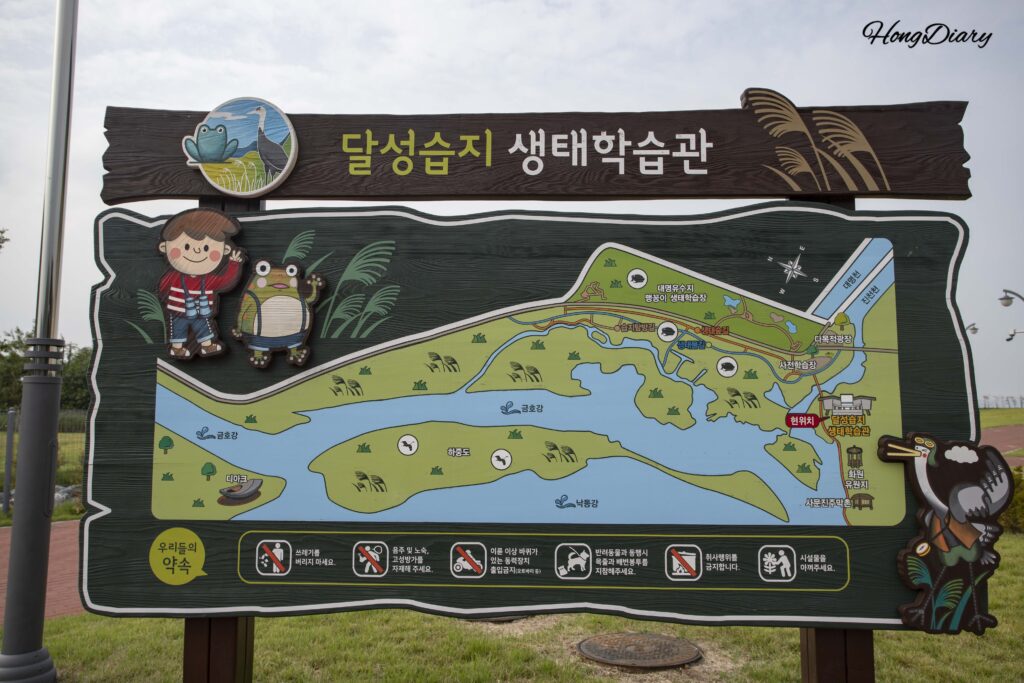
Dalseong Wetland stretches across the floodplain where the Nakdong and Kumho Rivers merge, in the Hwawon-eup area of Dalseong-gun, on the southwestern edge of Daegu. It’s a rare type of floodplain wetland — roughly 3 kilometers long and 600 meters wide — that serves as a habitat for over a dozen endangered species, including eagle owls, leopard cats, otters, and the narrow-mouthed toad. The learning center itself is a short trip from central Daegu: take Subway Line 1 to Hwawon Station (Exit 4), then either catch a local bus (Dalseong #1, three stops, about 5 minutes) or grab a taxi (₩5,000–6,000 / ~$3–4 USD / €3 EUR, roughly 2.5 km).
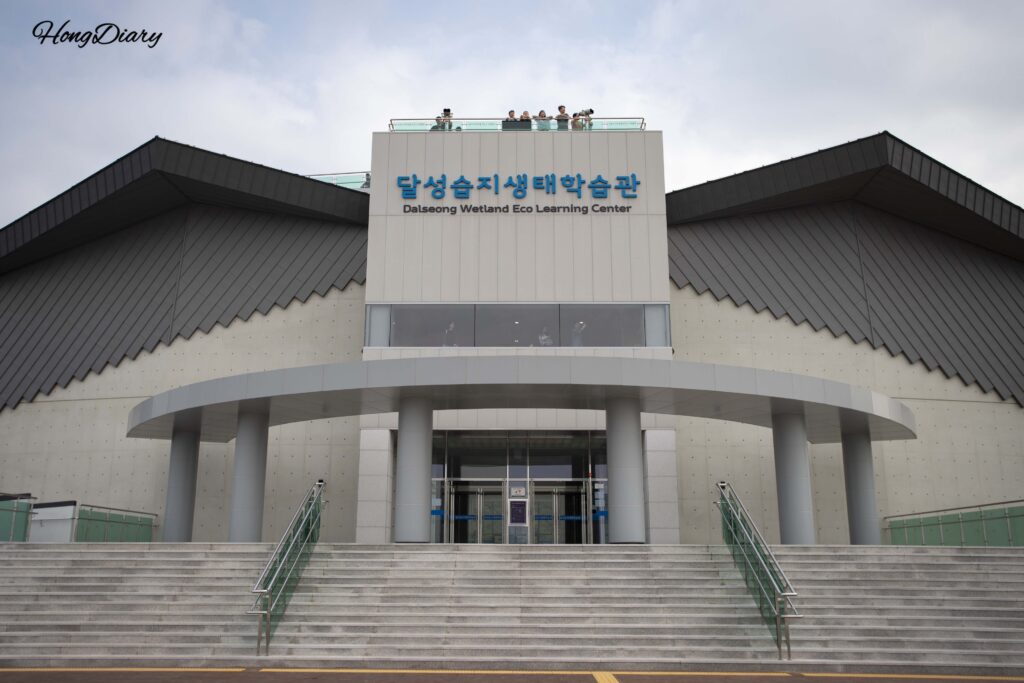
Table of Contents
Basic Information
| Detail | Info |
|---|---|
| Name | Dalseong Wetland Eco Learning Center |
| Address | 88 Gura 1-gil, Hwawon-eup, Dalseong-gun, Daegu |
| Admission | Free |
| Hours | 9:00 AM – 5:30 PM (last entry 5:00 PM), closed Mondays |
| Getting There | Subway Line 1, Hwawon Station Exit 4, then Dalseong #1 bus (3 stops, ~5 min) or taxi (~₩5,000–6,000 / ~$3–4 USD / €3 EUR) |
| Daemyeong Reservoir | 1.8 km walk (~30 min) from the learning center |
| Reservoir Hours | Summer (Mar–Oct): 9 AM – 6 PM / Winter (Nov–Feb): 9 AM – 5 PM |
| Note | All exhibits and programs are in Korean only — no English audio guides or signage |
A note on buses: The Dalseong #1 is a rural-area route, so departures can be infrequent. Check real-time arrivals on Google Map or Naver Map before heading to the stop — otherwise you might end up waiting longer than the bus ride itself. A taxi from Hwawon Station is cheap enough that it’s the safer choice if your schedule is tight.
Inside the Learning Center
The center has exhibition halls on the 2nd and 3rd floors, divided into three main sections: a screening room with a short film introducing the wetland, an ecology exhibition hall focused on the plants and animals living in the wetland, and a Nakdong River hall covering the river’s history and role in the region.
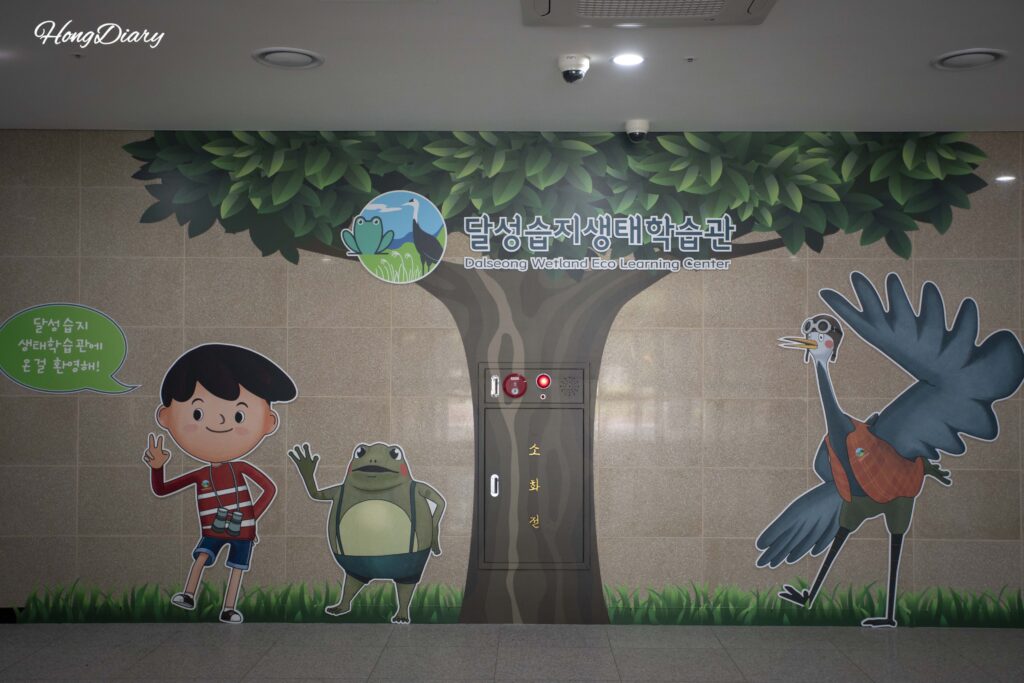
The screening room is a good place to start — it gives you a broad overview before you get into the details. After that, the ecology exhibition is where things get interesting. The wetland looks uniform from the outside, but the exhibits break down the dozens of species that actually live in it: birds, amphibians, fish, insects, and plants, each with models and explanations. I had no idea how much biodiversity was hiding in what looks like a flat stretch of grass and water from the road.
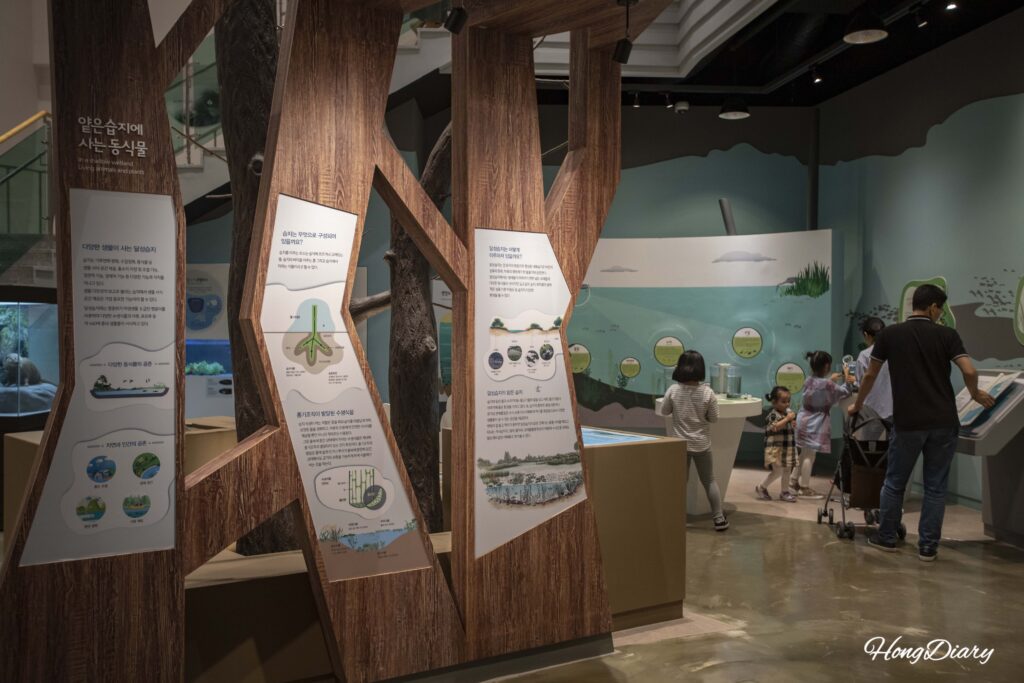
For families with kids, this section is well thought out. There are hands-on displays, animal sound comparisons, and scale models that keep younger visitors engaged — the laughter in the room was constant when I visited. The plant section covers wetland-specific vegetation, and there’s an interactive area where you can learn what technically qualifies as a “wetland” (it’s more specific than you’d think).
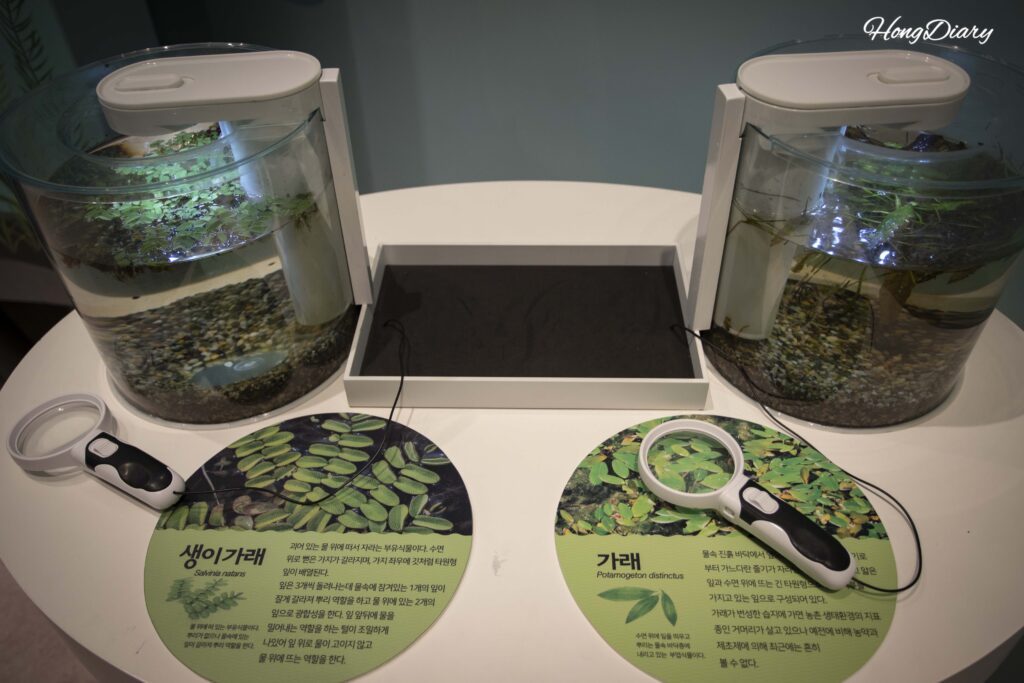
One honest note: everything inside the center — exhibits, signage, programs, guided tours — is in Korean only. If you don’t read Korean, you can still get a lot out of the visual displays and models, but you’ll miss the detailed explanations. It didn’t ruin the experience for me, but it’s worth knowing upfront.
The Four Seasons of Dalseong
One of the more useful exhibits is a seasonal overview of how the wetland changes throughout the year — which birds migrate when, what blooms in which month, how the water levels shift. It’s the kind of display that helps you decide when to come back, or at least appreciate what’s happening outside the window during your visit.
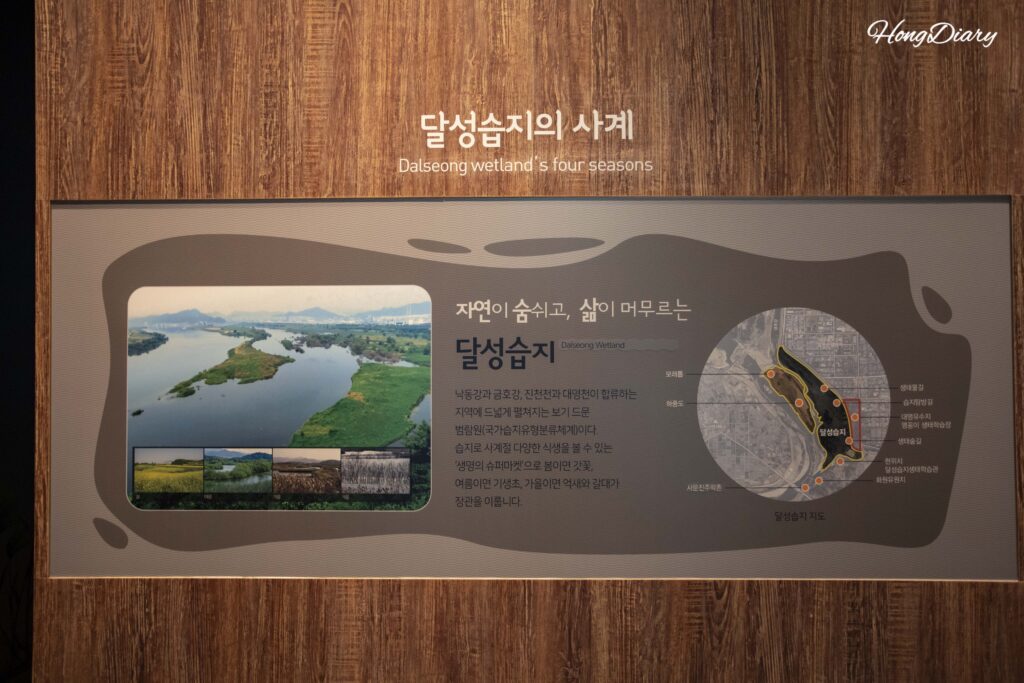
The center also runs experience programs including guided wetland walks and a Saturday ecology exploration team. Details and schedules are posted on the learning center’s official website (Korean only).
The View From the Rooftop
After about an hour inside, I took the stairs to the rooftop observation deck, and that’s when the visit shifted. The wetland I’d just studied through models and screens was suddenly right there — a wide, flat expanse of green and brown stretching out in every direction, with the two rivers curving around it. It’s one thing to learn about a wetland inside a building. It’s another to stand on a roof and see the real thing below you, alive and moving.
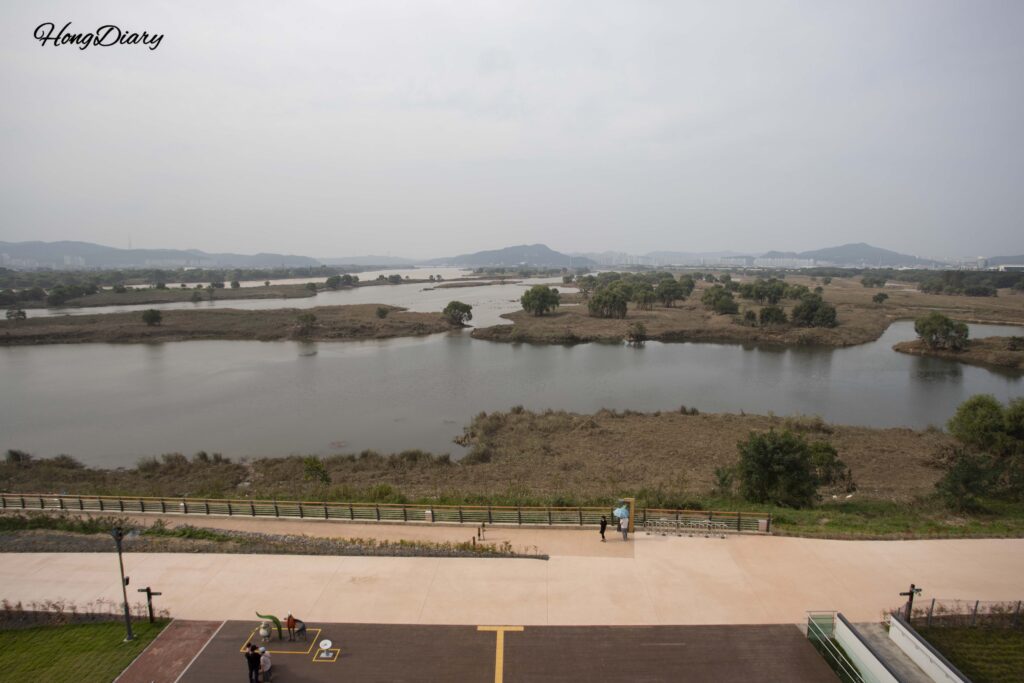
From the rooftop, I could see a wooden boardwalk trail extending toward the Hwawon Recreational Area along the Nakdong River. That trail is what led me to keep walking — I hadn’t planned to go beyond the learning center, but the view made it hard to stop.
Walking to Daemyeong Reservoir
The boardwalk from the learning center connects to the Daemyeong Reservoir eco trail, about a 30-minute walk along a well-maintained deck path. The reservoir sits at the edge of the Daemyeong Wetland, which is known as the largest breeding ground for the narrow-mouthed toad in South Korea — a species classified as Endangered Level II.
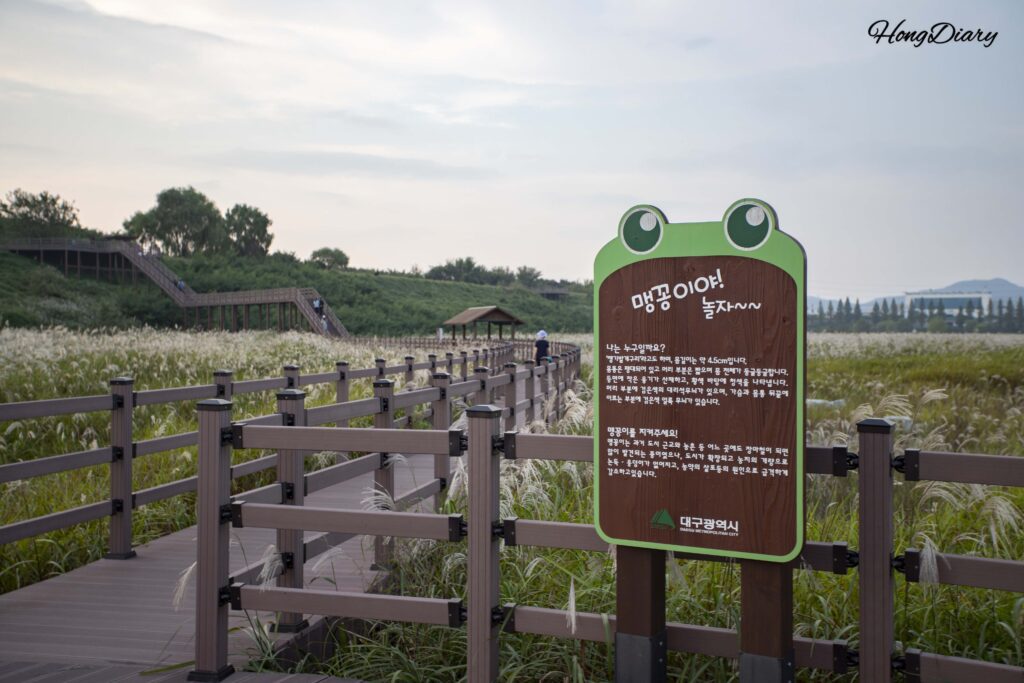
Daegu has been actively working to protect the toads here: road-kill prevention fences have been installed, and rescue operations are conducted during their migration season. The trail itself has restricted nighttime access specifically to protect the habitat (summer hours: 9 AM – 6 PM, winter: 9 AM – 5 PM). When I visited, nobody was enforcing the closing time strictly, but respecting it seems like the right thing to do for a place this ecologically sensitive.
Reeds, Cosmos and Sunset
This is where the walk becomes something else entirely. The deck path opens up into a wide landscape of silver-white reeds swaying in the wind — they stretched out in every direction, catching the late afternoon light. I sat on one of the rest benches along the trail, closed my eyes for a moment, and just listened: insects, wind through the reeds, and somewhere underneath it all, the faint sound of frogs.
I didn’t spot any narrow-mouthed toads myself, but after learning about them at the center, walking through their actual habitat felt like completing a circle. The reed fields alone would have made the walk worthwhile, but there was more: further along the trail, a cosmos flower path lined the edge of the wetland. The flowers were just starting to fade when I visited, but enough remained to add color to the scene. The trail is also marked as a cycling route — I passed several cyclists heading the same direction.
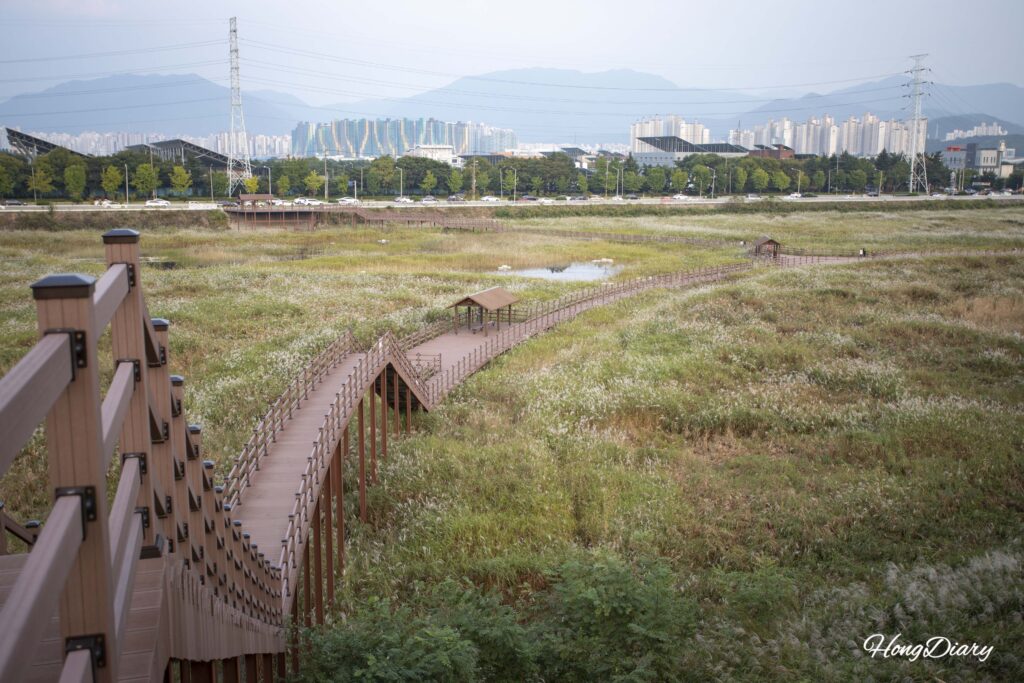
Beyond the main path, side trails lead deeper into the wetland itself. I didn’t venture far since it was getting dark, but even a few steps off the deck path felt like stepping into untouched nature. There are no signs or maps for these side trails, so it’s easy to lose your way — stay on the main deck if you’re unsure.
I hadn’t planned to walk this far. The learning center was supposed to be the whole visit. But standing among the reeds at sunset, in a part of Daegu I didn’t know existed an hour earlier, felt like exactly the kind of accident that makes a trip memorable.
Getting back: You don’t have to retrace your steps. From the bus stop near the Daemyeong Reservoir entrance, take Bus 501 (5 stops, about 15 minutes), get off at the Wolbae Ssangyong Yega Geonneo stop, and walk about 650 meters (~10 minutes) to Jincheon Station on Subway Line 1. It’s a much faster return than walking back the way you came.
Where to Stay in Daegu
If you’re spending more than a day in Daegu, the Dalseong Wetland pairs well with a stay at a hotel that’s connected to the same waterway. Hotel Inter-Burgo Daegu sits right on the Kumho River — the same river that flows into the Nakdong at Dalseong Wetland — and it’s one of the few five-star options in the city with river views, a hot spring pool, and a genuinely impressive buffet.
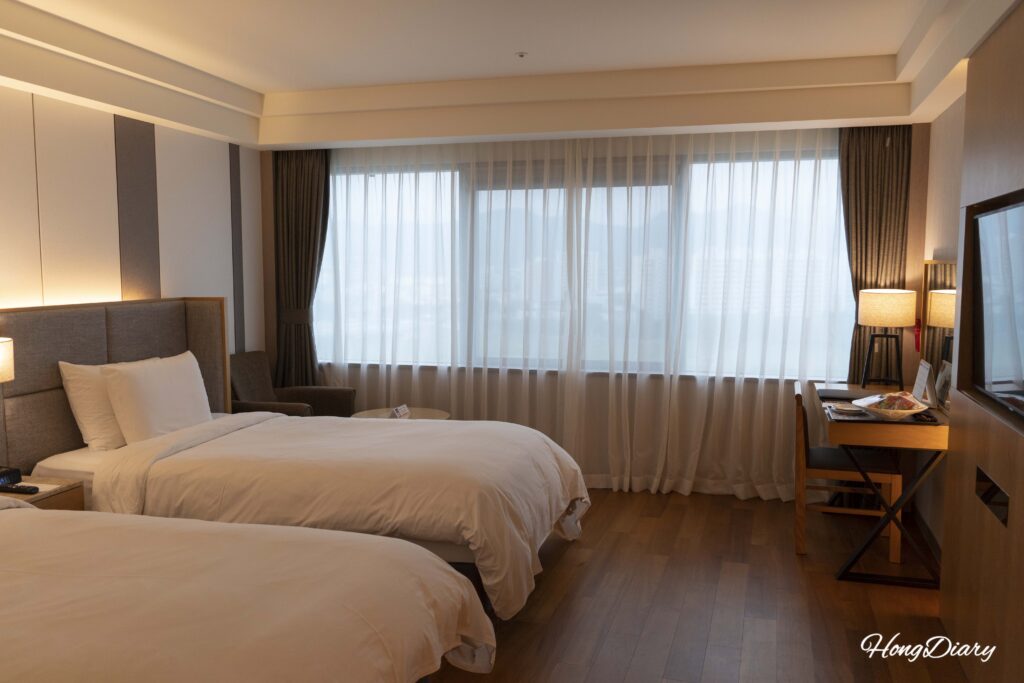
Recommended Read: Hotel Inter-Burgo Daegu: An Honest Review of This Riverside 5-Star — My full review of the rooms, Kumho River views, hot spring pool, and sauna. If you’re looking for a comfortable base while exploring Daegu’s less-known natural side, this hotel is worth considering.
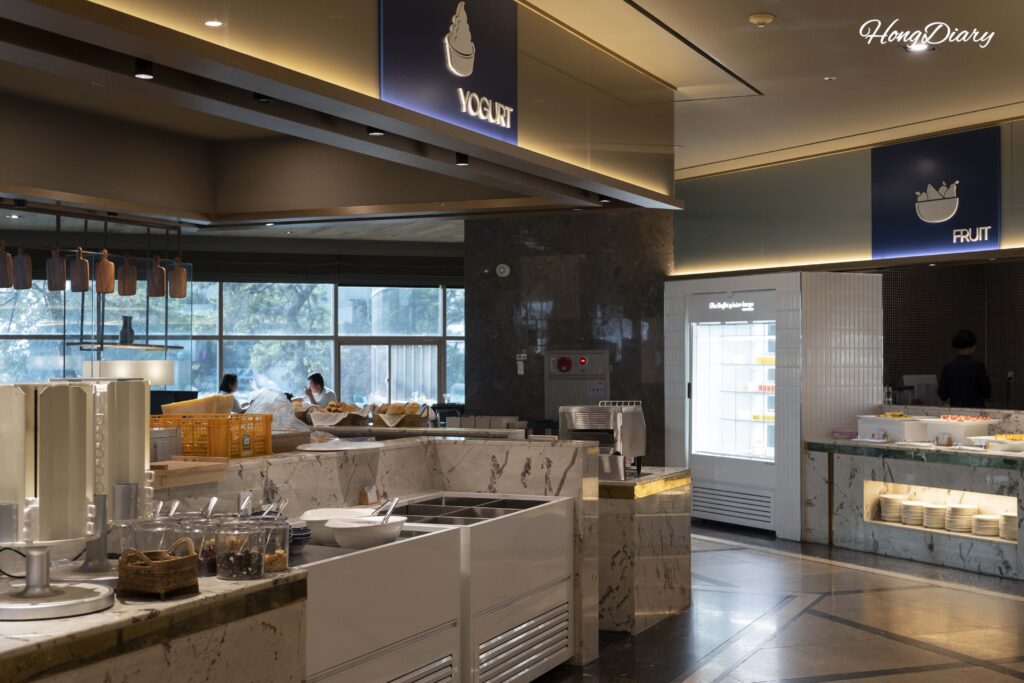
Also Worth Reading: The Buffet at Inter-Burgo Daegu Review — The hotel’s flagship restaurant serves one of the largest premium buffets in Korea. Lobster, sashimi, grilled lamb, unlimited drinks — a detailed breakdown with photos and prices.
Final Thoughts
Dalseong Wetland isn’t a place that makes it onto most Daegu itineraries, and that’s a shame. The learning center is small but thoughtful — especially for families — and the walk to Daemyeong Reservoir turns what could be a 30-minute museum visit into an entire afternoon. The reed fields, the toad habitat, the cosmos flowers, and the sunset over the wetland all feel like they belong to a different version of Daegu than the one you see from Dongdaegu Station.
Autumn is the best time to visit: the reeds are at their fullest, the cosmos are in bloom, and the late-afternoon light makes everything golden. But any season works if you’re curious about what lives at the place where two rivers meet. It’s free, it’s quiet, and it asks for nothing except a little bit of walking.
Frequently Asked Questions
How do I get to the Dalseong Wetland Eco Learning Center?
Take Daegu Subway Line 1 to Hwawon Station and use Exit 4. From there, walk about 200 meters to the Cheonnaeyeongnam Mansion bus stop and take the Dalseong #1 bus (3 stops, roughly 5 minutes). Alternatively, a taxi from Hwawon Station costs around ₩5,000–6,000 (~$3–4 USD / €3 EUR) and covers the 2.5 km distance in a few minutes. Note that the Dalseong #1 bus runs infrequently — check schedules on Google Map or Naver Map before you go. For the return trip, if you walk all the way to Daemyeong Reservoir, you can take Bus 501 from the reservoir area (5 stops, ~15 min) to Jincheon Station on Subway Line 1 instead of walking back.
Is the Dalseong Wetland Eco Learning Center free?
Yes. There’s no admission fee for the learning center, the rooftop observation deck, or the walking trail to Daemyeong Reservoir. The entire experience — center, boardwalk, and reservoir trail — is free.
Are the exhibits available in English?
No. All exhibits, signage, guided tours, and programs at the learning center are currently in Korean only. The visual displays, models, and animal sound exhibits are still engaging without reading Korean, but the detailed explanations will be missed. The official website is also Korean only.
What is Daemyeong Reservoir and how do I get there from the learning center?
Daemyeong Reservoir is a wetland area about 1.8 km (a 30-minute walk) from the learning center, connected by a well-maintained wooden boardwalk. It’s known as the largest breeding ground for the narrow-mouthed toad in South Korea — a species classified as Endangered Level II. The trail passes through extensive reed fields and, in autumn, a cosmos flower path along the wetland edge.
What are the opening hours for the wetland trails?
The learning center is open from 9:00 AM to 5:30 PM (last entry at 5:00 PM) and is closed on Mondays. The Daemyeong Reservoir eco trail has seasonal hours to protect the habitat: summer (March through October) is 9 AM to 6 PM, and winter (November through February) is 9 AM to 5 PM. Nighttime access is restricted.
Is Dalseong Wetland a good place for kids?
Yes. The learning center was designed with children in mind — there are hands-on displays, animal models, sound comparison exhibits, and short films that keep younger visitors engaged. The walk to Daemyeong Reservoir is flat and on boardwalks, making it manageable for kids. Note that some areas along the stream don’t have guardrails.
When is the best time to visit Dalseong Wetland?
Autumn (October through November) is the most scenic: the reeds are at their tallest, cosmos flowers line the trail, and the late-afternoon light creates a golden atmosphere over the wetland. Summer is greener but hotter. Winter is quieter but closes earlier. The learning center is a year-round visit, while the outdoor walk is best timed with the seasons.