
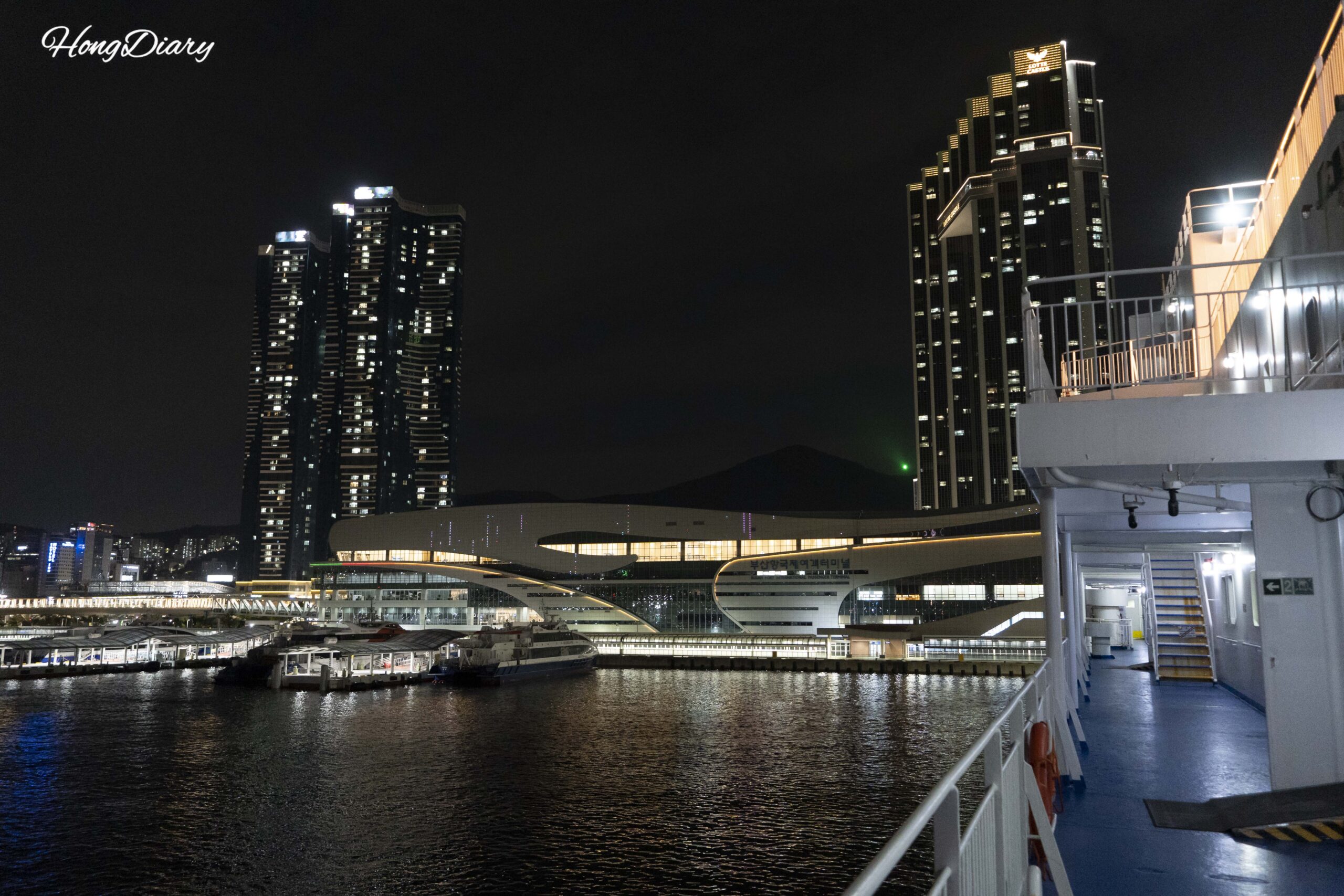
Flying from Busan to Japan takes about an hour. But when you are traveling with a baby and more luggage than most airlines allow, that hour starts to feel like a gamble. I took the Busan to Shimonoseki ferry instead — an overnight crossing that leaves South Korea at 9:00 PM and pulls into western Japan by 8:00 AM. Our ship was the Seonghee, one of two vessels running this route daily under Pukwan Ferry (called Kampu Ferry on the Japanese side).
This route crosses the Korea Strait between Busan, South Korea’s largest port city on the southeastern coast, and Shimonoseki, a harbor town sitting at the western tip of Honshu, Japan’s main island. Pukwan Ferry has operated this daily crossing since 1969 — over five decades of accident-free service — making it one of the oldest continuously running international ferry lines in East Asia. The Seonghee (in service since 2002, South Korea’s first international car ferry) and the Hamayuu take turns on alternating days.
Table of Contents
Basic Info at a Glance
| Detail | Info |
|---|---|
| Route | Busan International Ferry Terminal → Shimonoseki Port |
| Operator | Pukwan Ferry (Korea) / Kampu Ferry (Japan) — same company, different names |
| Ships | Seonghee and Hamayuu (alternating daily) |
| Departure | 9:00 PM |
| Arrival | Next morning, 8:00 AM (approximately 11 hours) |
| Ticket counter closes | 5:30 PM |
| Boarding | 6:10 – 6:30 PM (hard cutoff at 6:30 PM) |
| Booking | pukwan.co.kr (Korean, English, Japanese available) |
Prices in this article are converted at approximately $1 USD ≈ ₩1,400 / €1 EUR ≈ ₩1,575 (as of September 2026). Rates may fluctuate.
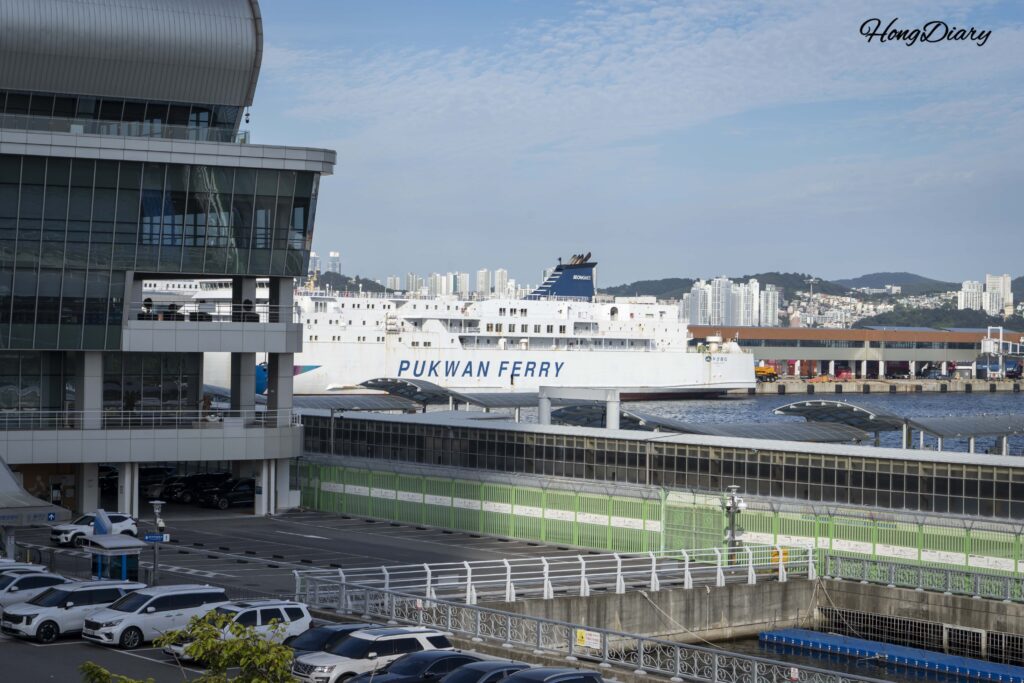
Boarding the Seonghee
At the Busan International Ferry Terminal, Pukwan Ferry’s check-in counter is on the 3rd floor. Once the passport check and ticketing are done during check-in, tuck your passport back into your bag — you will only need your boarding pass to board.
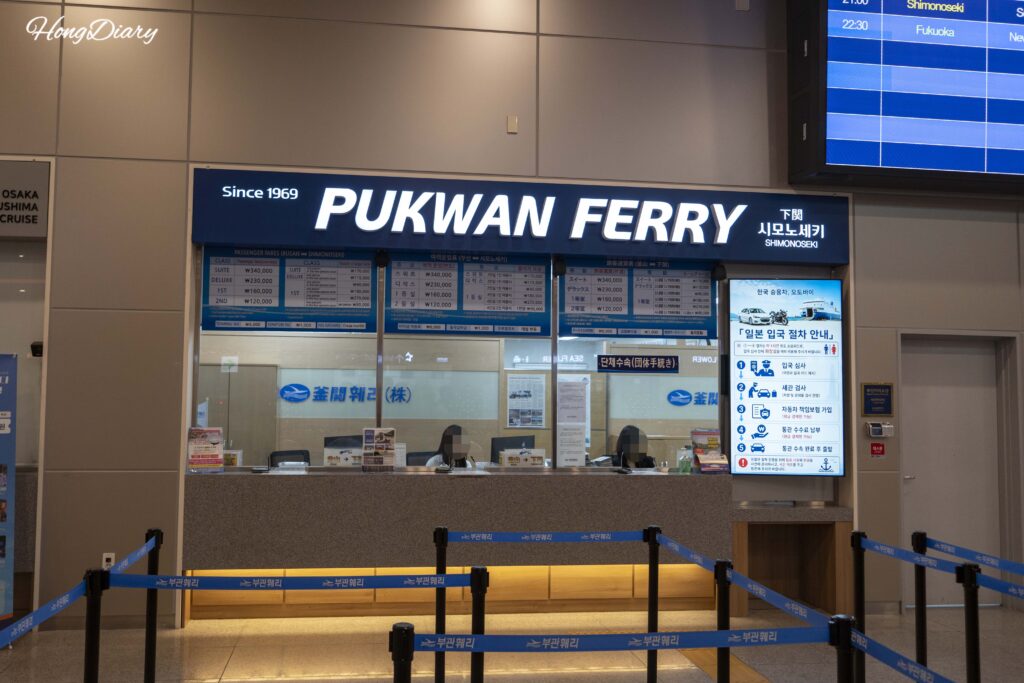
At the boarding gate, staff will hand you two documents: a Japan Entry Card and a Customs Declaration Form. The customs form asks for standard information about what you are bringing into Japan. Solo travelers fill one out individually. Families can submit a single form completed by one adult — the back side only needs filling if you are carrying goods above Japan’s duty-free limits, which most visitors will not hit. Write SEONGHEE as the ship name on the form.
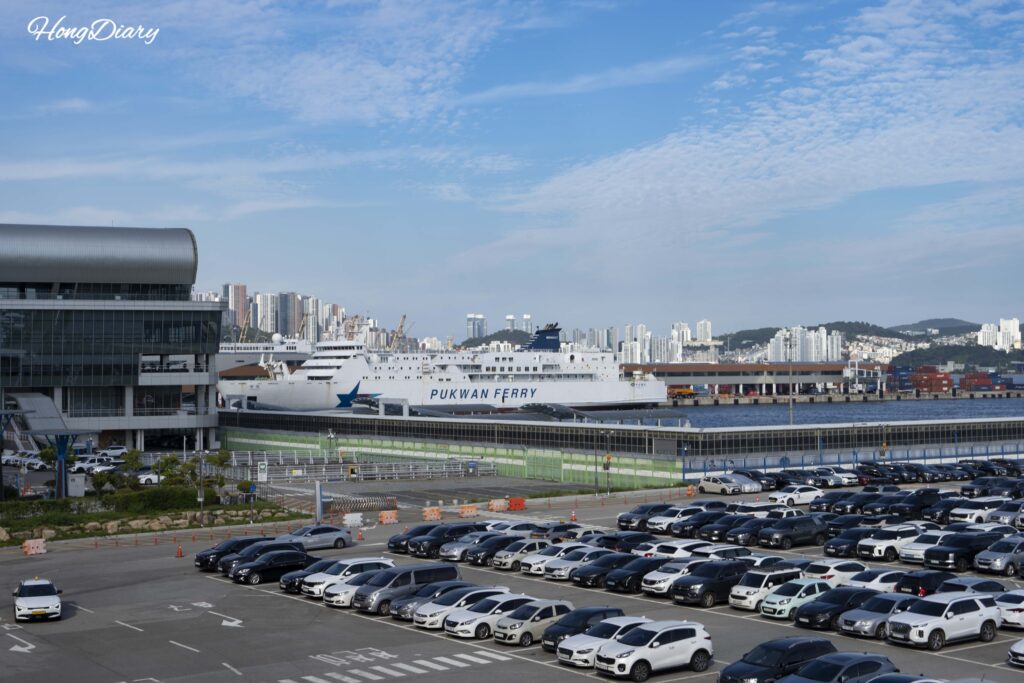
For a full walkthrough of the terminal — from navigating the building layout and registering on Visit Japan Web (Japan’s digital entry system) to luggage allowances for each ferry company — I covered all of it separately: What I Wish I Knew Before My First Time at Busan Ferry Terminal.
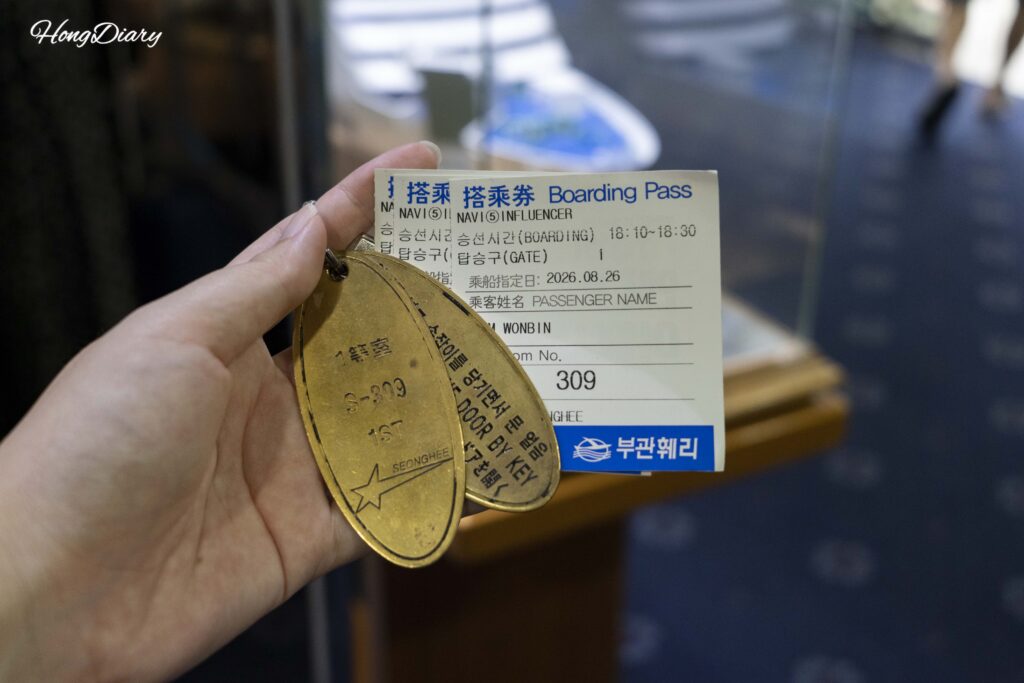
Once on board, head to the information desk on Deck 4 (1F) with your boarding pass and they will hand you the key to your cabin.
The 4-Person Korean-Style Cabin: An Honest Look
I booked a 4-person hwasil — a traditional Korean-style room(Ondol) with no beds. Instead of bunks, you unroll futons (padded floor mattresses) from a storage compartment and sleep directly on the smooth flooring surface. If you have never stayed in a traditional Korean-style room, think of it as a compact floor-sleeping setup with a thin but supportive mattress and a firm pillow.
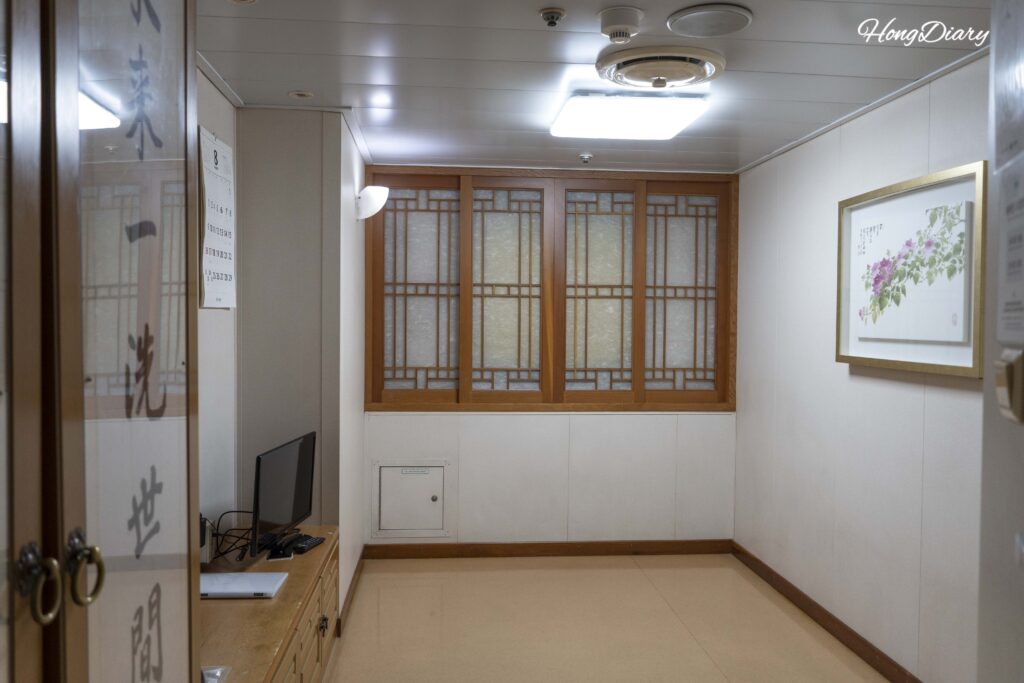
This type of cabin made sense for our family because there is no risk of a toddler rolling off an upper bunk, and everyone can spread out on the same surface. The room was compact but workable for two adults and one baby. Four sets of futons and pillows were neatly stored in the closet, along with life jackets (with illustrated instructions on how to wear them) and in-cabin slippers for the bathroom area.
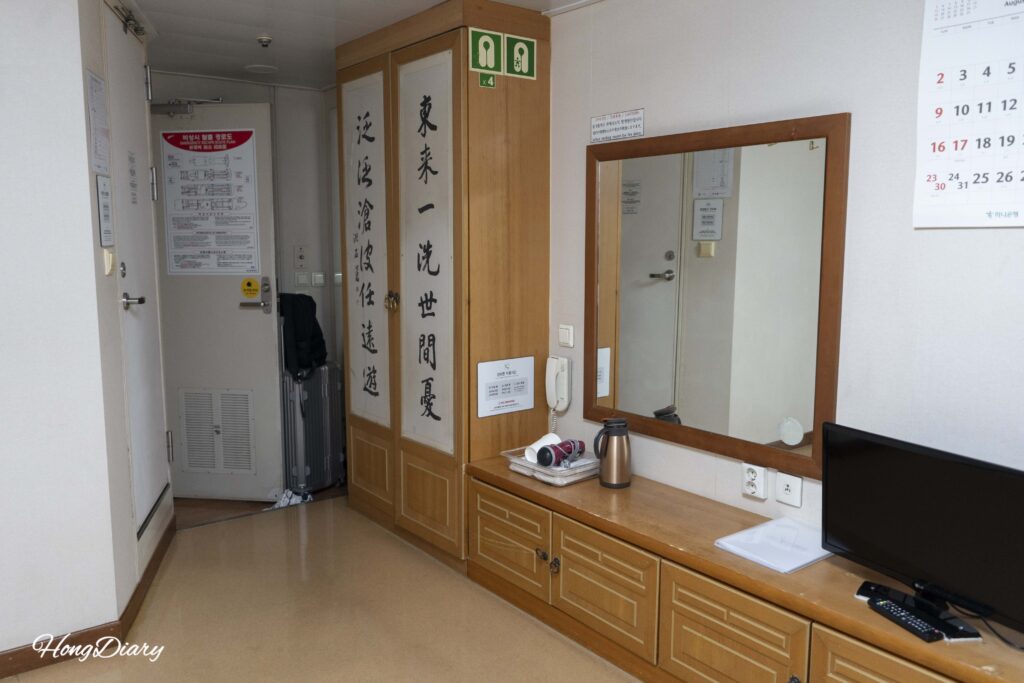
What is provided in the cabin:
| Item | Notes |
|---|---|
| Hair dryer | Wall-mounted |
| Thin towels | Provided, but very thin — better suited for hands and face than a full shower dry |
| Paper cups | For drinking water |
| Private bathroom | Toilet and shower inside the cabin (no need to use shared facilities) |
| Power outlets | Both 110V and 220V available — bring your own adapter if needed |
| Small TV | 2–3 channels; signal drops once the ship reaches open sea |
| Life jackets | Stored in the bedding closet, with wearing instructions posted |
| Slippers | For in-cabin use |
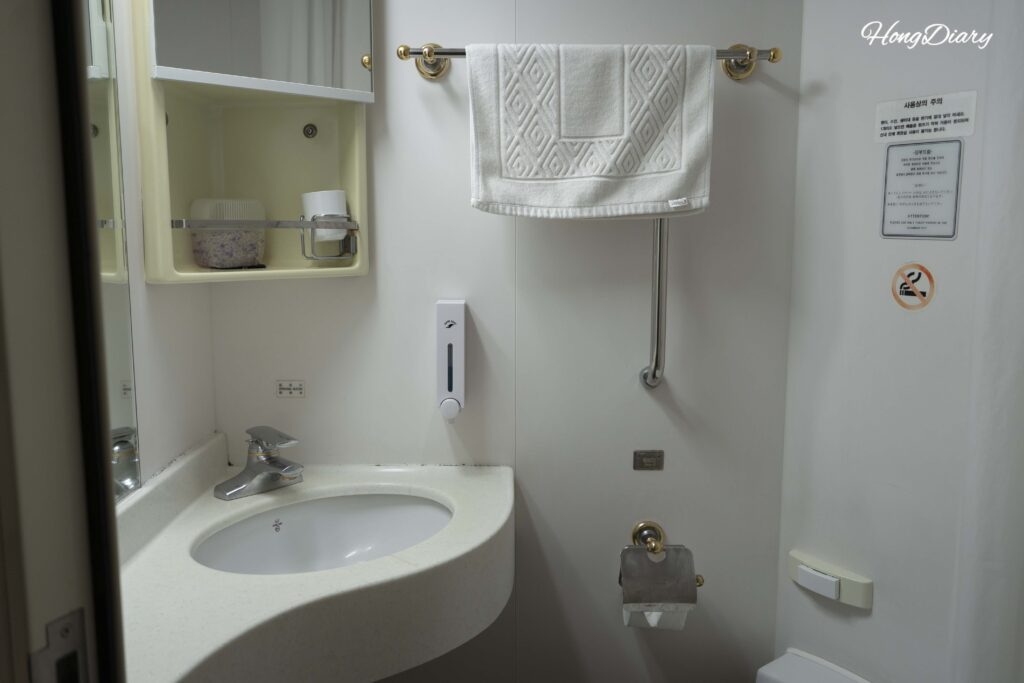
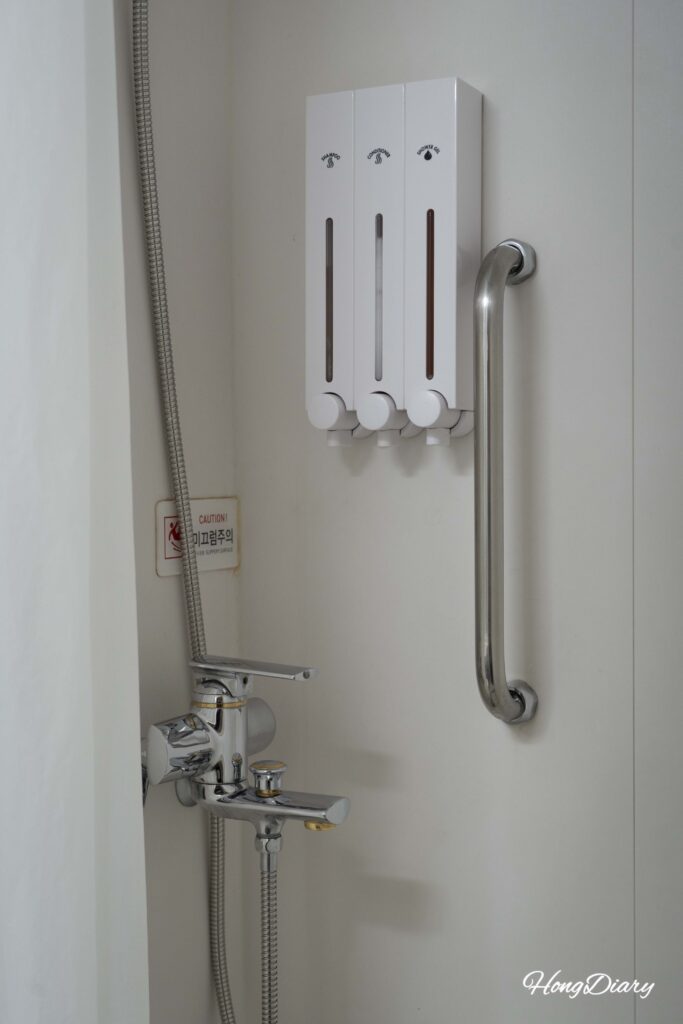
What is no longer provided: Toothbrush and toothpaste kits were available in past years but have been discontinued. Bring your own toiletries. I also recommend packing a full-sized towel — the ones on board are too thin for drying off properly after a shower.
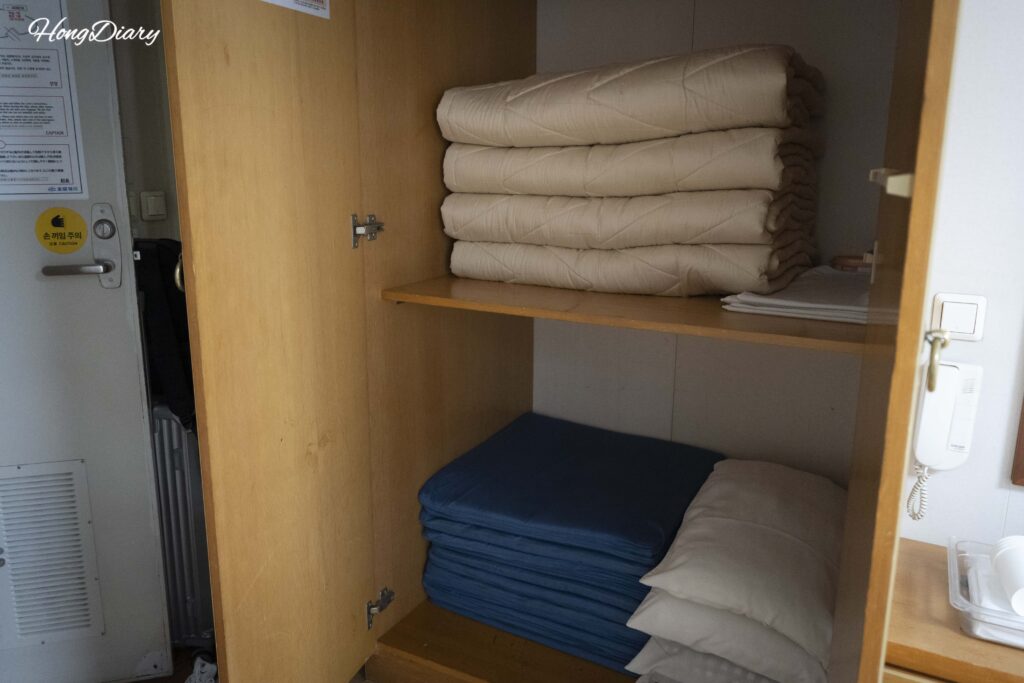
My honest take: The private bathroom is a real advantage over shared dormitory-style cabins, and the Korean-Style(Ondol) setup works well for families with small children. But the Seonghee has been sailing since 2002, and this cabin type shows its age. We found stray hairs on the floor and had to wipe down the room before unpacking. If you are not traveling with young kids who need floor space, I would recommend a 1st Class bed-type cabin instead — the small upgrade in comfort makes a real difference on an overnight crossing.
Cabin Classes and Fares
Both the Seonghee and Hamayuu offer four cabin tiers. The fares below are the standard published rates per person.
| Class | One-Way | Round-Trip |
|---|---|---|
| Suite | ₩340,000 ($243 USD / €216 EUR) | ₩680,000 ($486 USD / €432 EUR) |
| Deluxe | ₩230,000 ($164 USD / €146 EUR) | ₩460,000 ($329 USD / €292 EUR) |
| 1st Class | ₩160,000 ($114 USD / €102 EUR) | ₩320,000 ($229 USD / €203 EUR) |
| 2nd Class | ₩120,000 ($86 USD / €76 EUR) | ₩240,000 ($171 USD / €152 EUR) |
Discounts:
| Category | Discount |
|---|---|
| Infants (under 1 year) | Free |
| Children (ages 1–11) | 50% off the one-way fare for the same class |
| Travelers with disabilities | 20% off one-way fare (valid ID required) — call 051-464-2700 to arrange |
Children under 18 must be booked into the same cabin class as their accompanying guardian.
Private Room Surcharges
If your group does not fill a private cabin to its full capacity, a per-person surcharge is added on top of the base fare. This applies to 1st Class and above.
| Cabin Type | Surcharge (from Busan) | Surcharge (from Shimonoseki) |
|---|---|---|
| Suite, 2-person room, 1 guest | ₩170,000 ($121 USD / €108 EUR) | ¥17,000 |
| Deluxe, 2-person room, 1 guest | ₩115,000 ($82 USD / €73 EUR) | ¥11,500 |
| 1st Class, 2-person room, 1 guest | ₩90,000 ($64 USD / €57 EUR) | ¥9,000 |
| 1st Class, 3-person room, 1 guest | ₩180,000 ($129 USD / €114 EUR) | ¥18,000 |
| 1st Class, 4-person room, 1 guest | ₩270,000 ($193 USD / €171 EUR) | ¥27,000 |
| 1st Class, 4-person room, 2 guests | ₩90,000 per person ($64 USD / €57 EUR pp) | ¥9,000 per person |
Room surcharges are a one-way, per-person fee and do not qualify for child or disability discounts.
What to Know Before Booking a Shared 2nd Class Cabin
If you are considering the most affordable option — a shared 2nd Class dormitory cabin — there are a few things worth knowing upfront.
Towels are not provided in shared cabins. Bring your own or purchase one at the onboard GS25 convenience store.
Lights follow a fixed schedule. Cabin lights are turned off at 10:30 PM and switched back on at 5:00 AM — you cannot adjust this individually. Private cabins (1st Class and above) have independent light controls, so this only affects shared rooms.
Expect noise. Shared 2nd Class cabins often fill with organized tour groups, and late-night socializing and drinking are common. If you are a light sleeper, a pair of earplugs can go a long way — or consider upgrading to a private 1st Class room for a more restful night.
Deck Layout
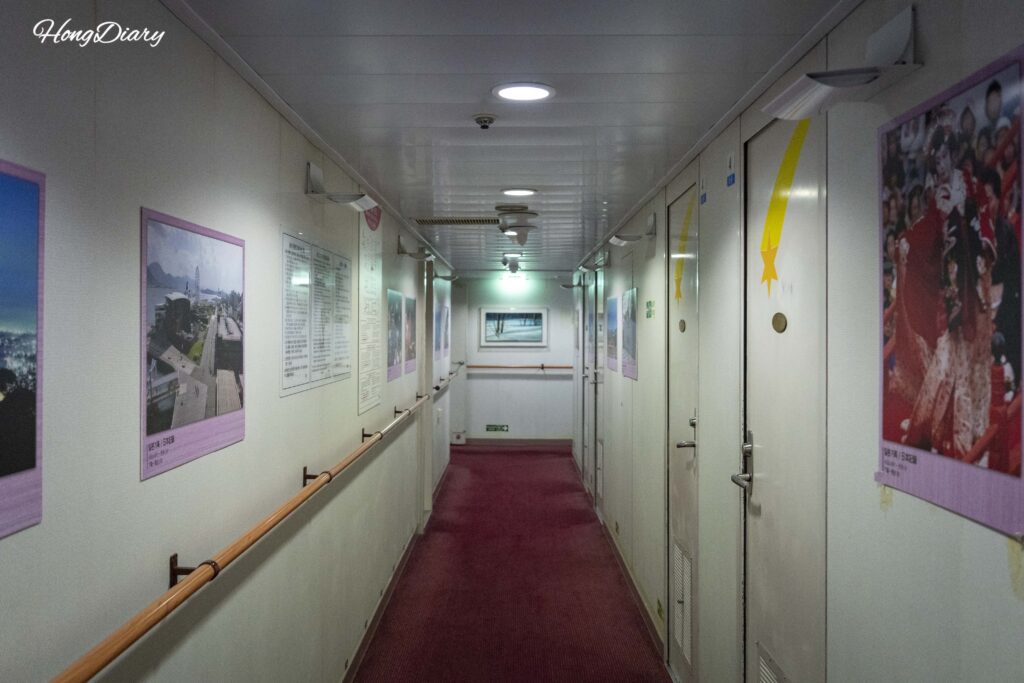
The Seonghee has three passenger decks. Knowing the layout helps you find everything faster once you are on board.
| Deck | Floor | What You Will Find |
|---|---|---|
| 6 Deck | 3F | Suite (321–322), Deluxe (311–318), 1st Class (301–310), 2nd Class (132–135), Multi Hall Laon (lounge) |
| 5 Deck | 2F | 1st Class (201–238), Restaurant Andamiro, Cafe Bao, Grill |
| 4 Deck | 1F | Information Desk, 2nd Class (101–131), Duty-Free Shop, GS25 Convenience Store, Grand Bath, Karaoke, Game Room, Smoking Room, Laundry Room |
The ship has an elevator serving all three passenger decks, which is helpful if you are hauling heavy suitcases or traveling with a stroller. Note that it may be shut down or have limited operating hours depending on sea conditions.
What Is on Board
The Seonghee packs in more facilities than you might expect from an 11-hour overnight ferry. Here is what is available — along with the payment quirks and hour restrictions that caught me off guard.
Restaurant Andamiro
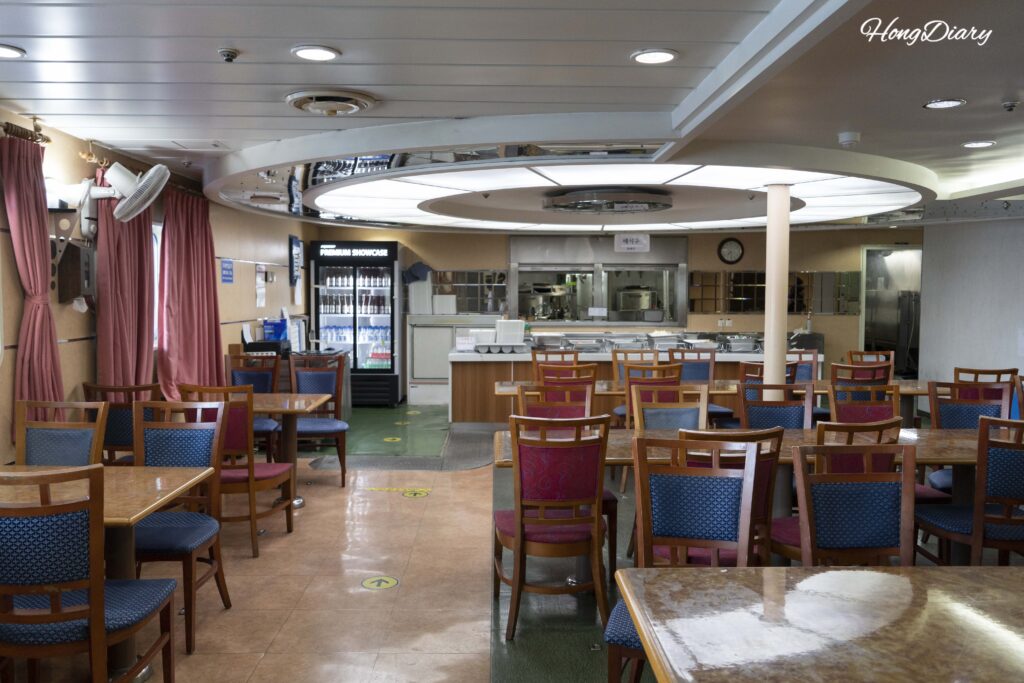
Located on Deck 5 (2F), Andamiro is the only sit-down restaurant on board. The menu is limited but changes slightly depending on which direction you are sailing.
| Meal | Menu | Price | Hours |
|---|---|---|---|
| Breakfast | Miyeokguk set — a warm Korean seaweed soup served with rice and small side dishes | ₩8,000 ($6 USD / €5 EUR) | 6:30 – 7:30 AM (last order 7:20 AM) |
| Dinner (Busan → Shimonoseki) | Jeyuk-bokkeum set — stir-fried spicy pork with rice and sides | ₩10,000 ($7 USD / €6 EUR) | 7:00 – 8:00 PM (last order 7:50 PM) |
| Dinner (Shimonoseki → Busan) | Kimchi-jjigae set — a hearty fermented-cabbage stew with rice | ₩10,000 ($7 USD / €6 EUR) | 7:00 – 8:00 PM (last order 7:50 PM) |
| Instant ramen (mild or spicy) | Korean-style cup ramen | ₩6,000 ($4 USD / €4 EUR) | Same as above |
The menu above reflects what was available during my trip, but items may rotate at the company’s discretion — sometimes additional items appear on the kiosk that are not listed on the official website.
Payment: A kiosk inside the restaurant accepts cards. If paying cash, only Korean won bills are accepted — and ₩50,000 bills do not work. If you only have Japanese yen, exchange it at the information desk on Deck 4 first.
House rules: Outside food and alcohol are both prohibited inside the restaurant. If you brought your own meals aboard, take them to the Multi Hall on Deck 6 (3F) instead.
GS25 Convenience Store
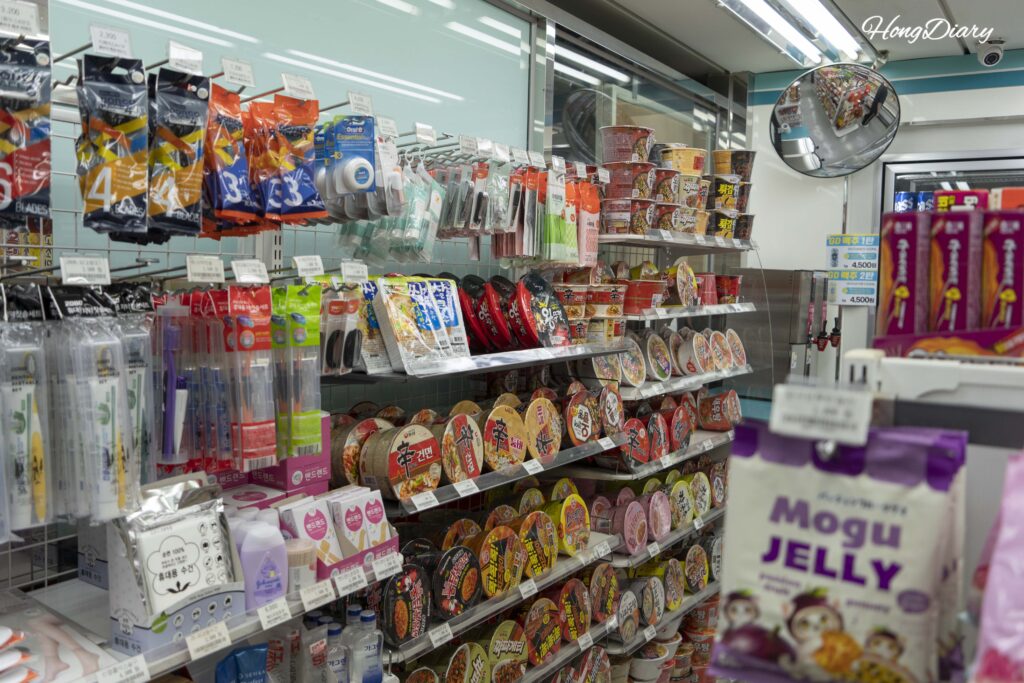
GS25 is one of South Korea’s biggest convenience store chains, and the Seonghee has a small branch on Deck 4.
| Detail | Info |
|---|---|
| Evening hours | 7:00 – 10:30 PM |
| Morning hours | 6:00 – 8:00 AM (may close by 7:45 AM as docking preparations begin) |
| Payment | Cash only — no cards accepted. Accepted currencies and methods can vary by sailing, so read the note below |
| What they sell | Cup ramen, chips, dried squid, sausages, kimchi, other Korean snacks |
| Prices | About ₩500 ($0.36 USD / €0.32 EUR) higher per item than what you would pay at a convenience store onshore |
A note on payment: The convenience store’s accepted payment methods tend to change between sailings. On some trips it accepts both Korean won and Japanese yen (excluding ¥1 and ¥5 coins); on others, only Korean won works and yen is refused. Cards have never been accepted here. If you run into a currency issue, the information desk on Deck 4 offers currency exchange — so it is not a dealbreaker, but I recommend bringing at least a small amount of Korean won cash and some Japanese yen to avoid any hassle.
If you need to heat up food, use the microwave in the Multi Hall on Deck 6 (3F). Leftover liquids (ramen broth, etc.) can be poured out at the beverage-room sinks located on each deck.
Tip: I ordered delivery food to the terminal before boarding and brought it on the ship. If you are looking to save a few thousand won, buying snacks and instant noodles at a land-based convenience store before you board is the move.
Duty-Free Shop
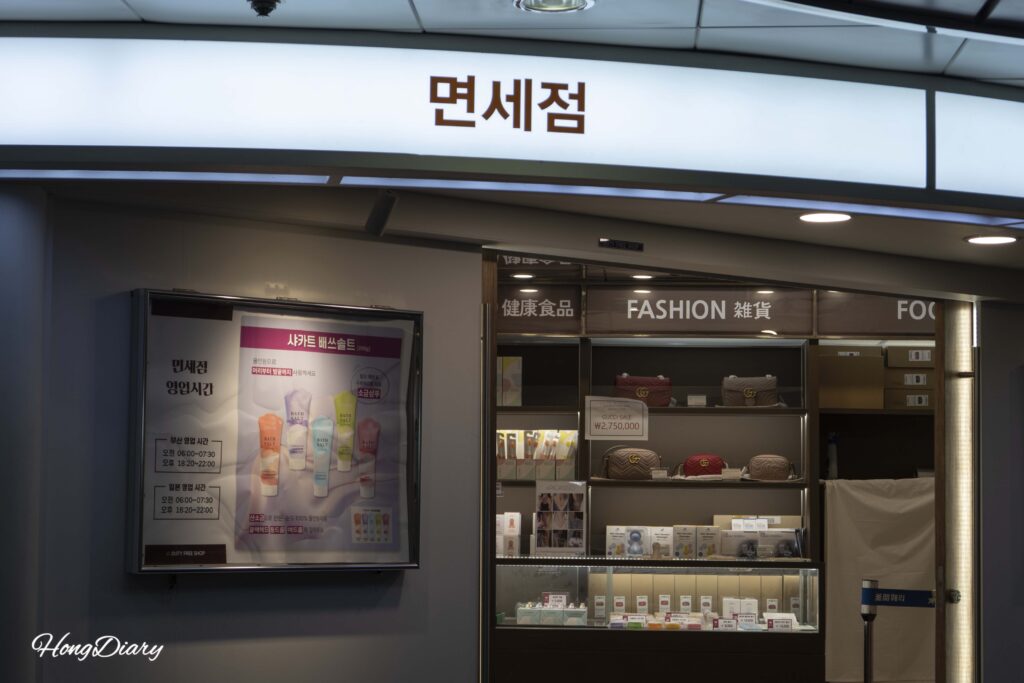
A compact duty-free counter on Deck 4 sells cigarettes, liquor, and a small selection of other items. Do not expect a wide range — this is more of a kiosk than a full shop.
| Detail | Info |
|---|---|
| Evening hours (after boarding) | 6:20 – 10:00 PM |
| Morning hours (before arrival) | 6:00 – 7:00 AM |
| Payment | Cards accepted until 8:00 PM only. After that, cash (Korean won or Japanese yen) |
Grand Bath
The Seonghee has a free communal bath on Deck 4, similar to a Japanese sento (a public bathhouse with washing stations and a shared soaking tub). No photos were taken for privacy reasons, but the bath is small, well-maintained, and entirely free to use.
| Session | Hours |
|---|---|
| Evening | 6:00 – 10:00 PM |
| Morning | 5:30 – 8:00 AM |
It gets packed around 9:00 PM right after dinner, so your best bet is to go immediately after boarding or early the next morning around 6:00 AM. Bathing while the ship gently rocks takes some getting used to — it felt slightly dizzying in the morning — but soaking in a tub in the middle of the Korea Strait is the kind of experience that makes ferry travel feel like more than just transit.
Karaoke, Game Room, and Photo Spots
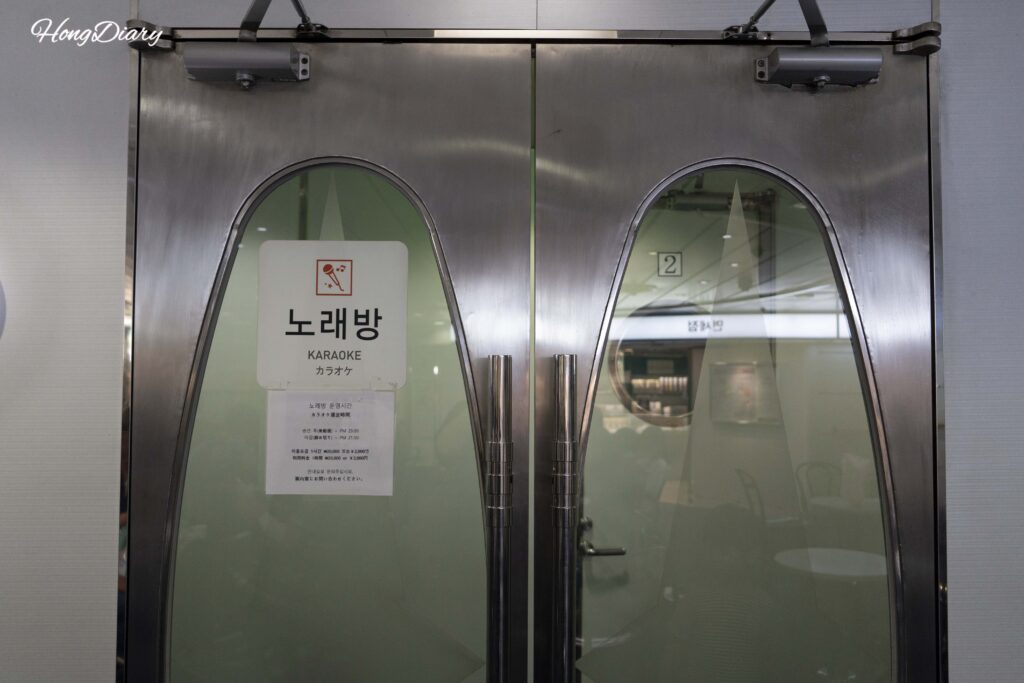
A private karaoke room is available on Deck 4. Ask at the information desk to book and pay — a staff member will unlock the room for you. The rate is ₩20,000 per hour ($14 USD / €13 EUR) or ¥2,000 per hour.
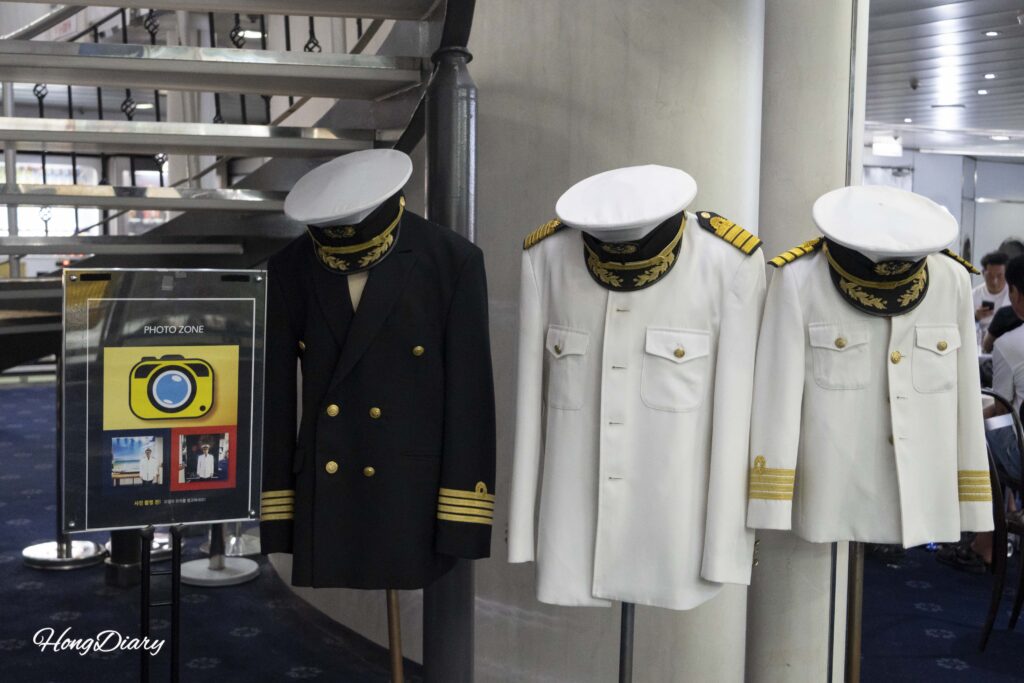
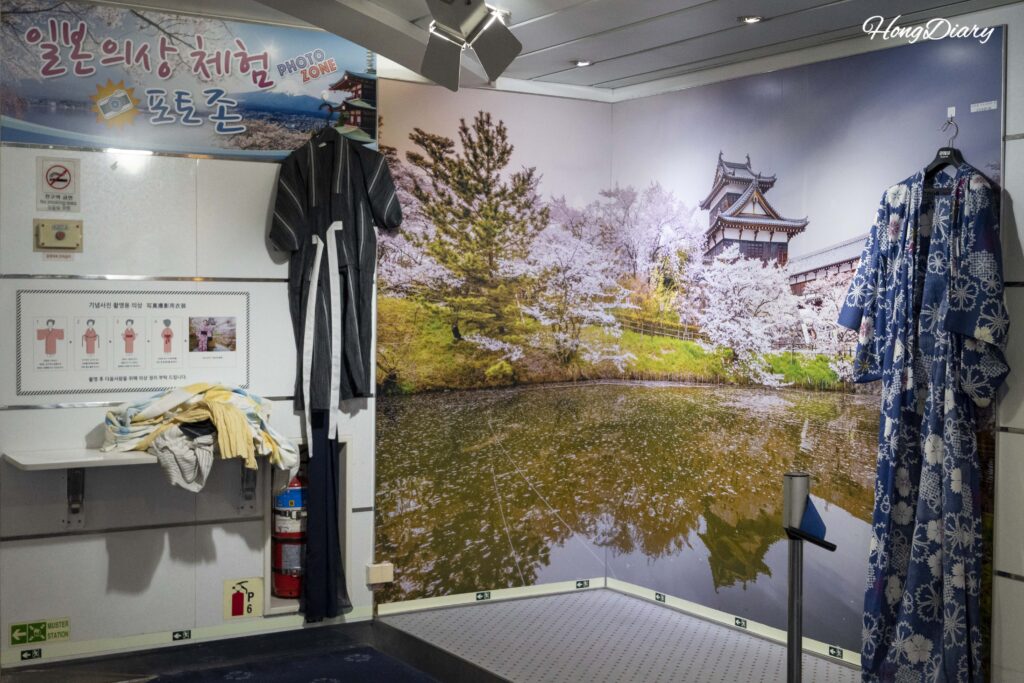
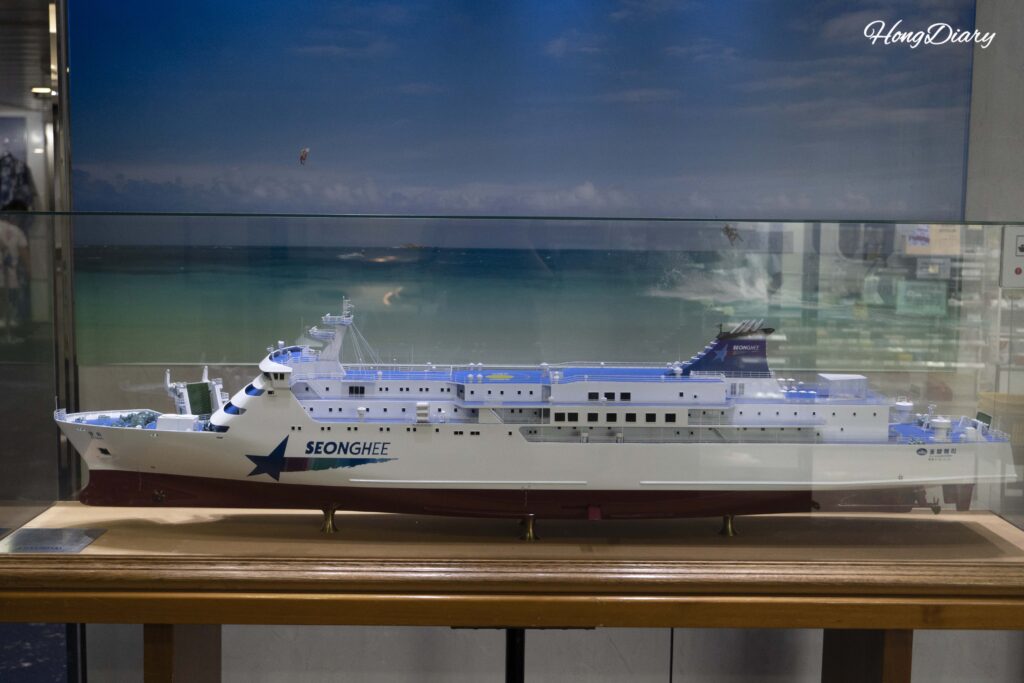
Also on Deck 4, there are a couple of free photo zones worth a quick stop. One lets you try on a ship captain’s uniform (available in both black and white), and another has a traditional Japanese outfit (yukata-style) you can wear for photos. Nearby, a scale model of the Seonghee is displayed behind glass — a small but charming detail for ship enthusiasts.
Vending Machines
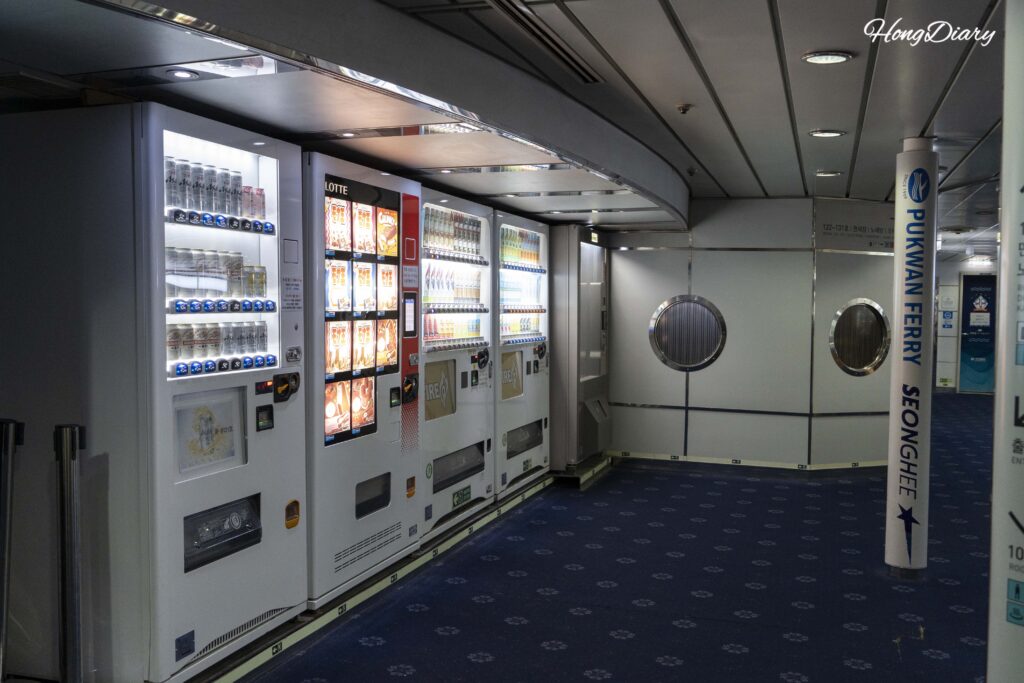
Vending machines on Deck 4 stock canned beer, ice cream bars, and various soft drinks. They accept Japanese yen only — no Korean won, no cards. Make sure you have some yen coins and small bills ready before boarding.
Onboard Facilities: Quick Reference
| Facility | Deck | Evening Hours | Morning Hours | Payment |
|---|---|---|---|---|
| Restaurant Andamiro | 2F | 7:00 – 8:00 PM | 6:30 – 7:30 AM | Kiosk (card OK); cash KRW only (no ₩50,000) |
| GS25 Convenience Store | 1F | 7:00 – 10:30 PM | 6:00 – 8:00 AM | Cash only (accepted currencies vary) |
| Duty-Free Shop | 1F | 6:20 – 10:00 PM | 6:00 – 7:00 AM | Card until 8:00 PM, then cash |
| Grand Bath | 1F | 6:00 – 10:00 PM | 5:30 – 8:00 AM | Free |
| Karaoke | 1F | Ask at info desk | — | ₩20,000/hr or ¥2,000/hr |
| Multi Hall Laon | 3F | 6:30 – 9:30 PM | 6:00 – 8:00 AM | Bring your own food |
| Vending Machines | 1F | Anytime | Anytime | JPY only |
Sailing Into the Night
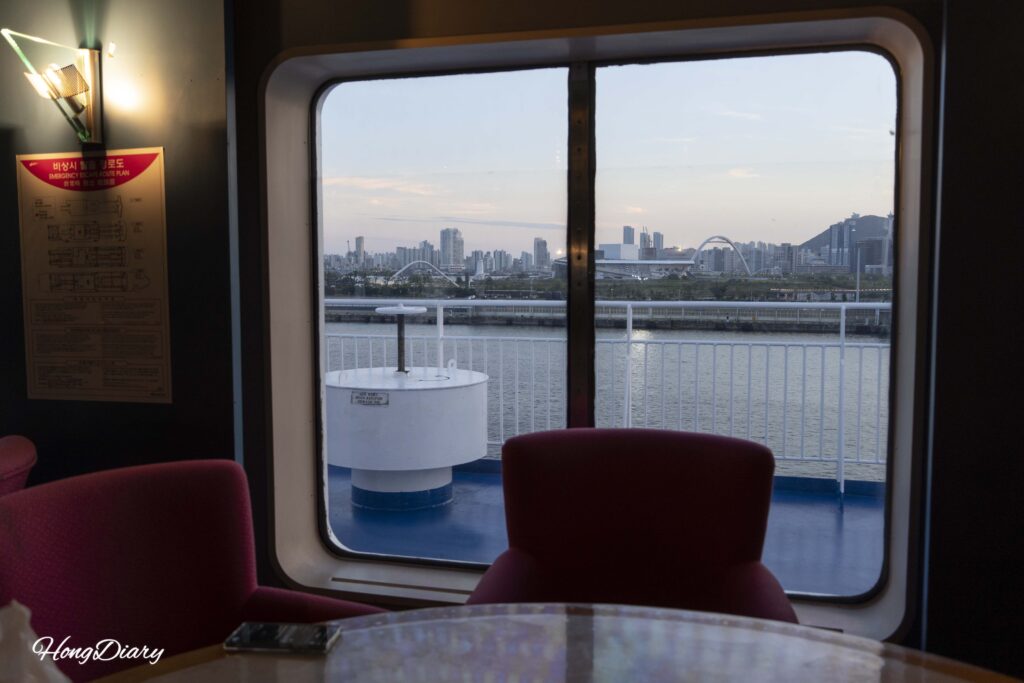
Before the 9:00 PM departure, I had dinner in the Multi Hall Laon on Deck 6 (3F) — a lounge area with rows of tables where you can eat food you brought aboard. The view from the window seats is the highlight: the Busan International Ferry Terminal in the foreground, high-rise buildings across the harbor, and the sun setting behind Bukhang Waterfront Park. It was one of the most quietly beautiful moments of the trip.
That said, the lounge was occupied by a large tour group who were drinking and getting progressively louder. There is no staff managing the area, so if a group claims the space, there is not much you can do. We finished up and left. Not a dealbreaker, but worth knowing — especially if you are traveling with kids and expecting a quiet dinner.
The Seonghee pulled away from the dock at 9:00 PM sharp. If there is one thing worth staying up for, it is the view from the outer deck right around departure.
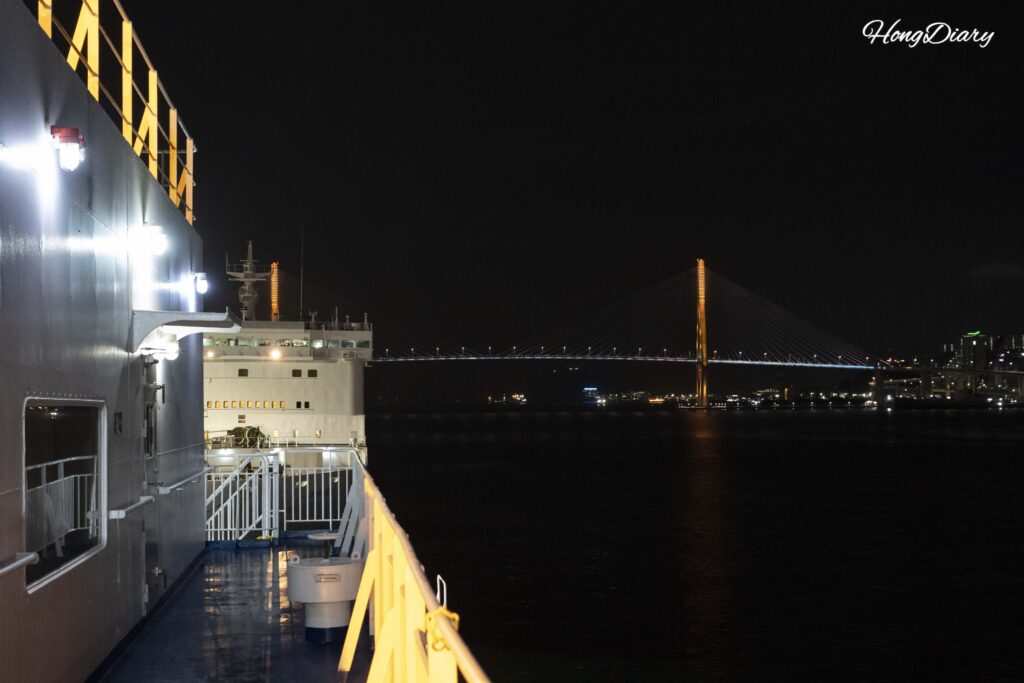
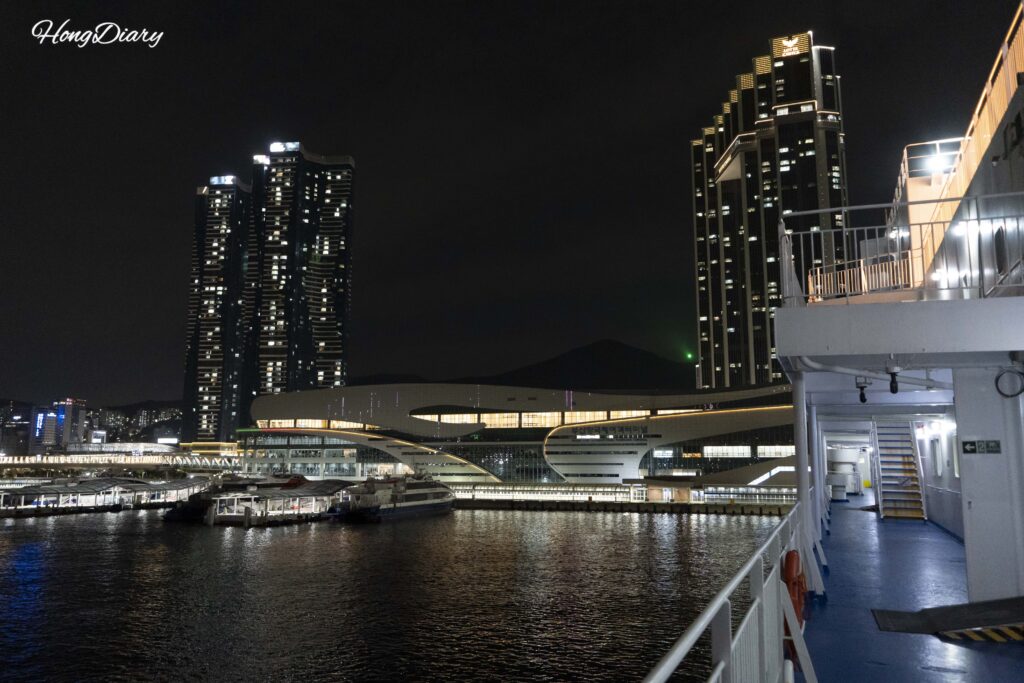
Between 9:00 and 9:30 PM, you will sail under the Busan Harbor Bridge — lit up and reflected across the water, with the city skyline glowing behind the terminal. After that 30-minute window, the view turns to open sea and nothing but darkness, so set a reminder if you are already in your cabin.
The outer deck may be closed or have restricted access depending on the weather and sea conditions that night. Smoking is prohibited on the deck — use the designated smoking room on Deck 4 (1F).
After the bridge, we grabbed ice cream from the vending machines, bought chips from the convenience store, and wandered the ship for a while before putting our toddler to bed. Even though we had not technically arrived in Japan yet, the evening already felt like the start of the trip.
Morning: Waking Up in Japan
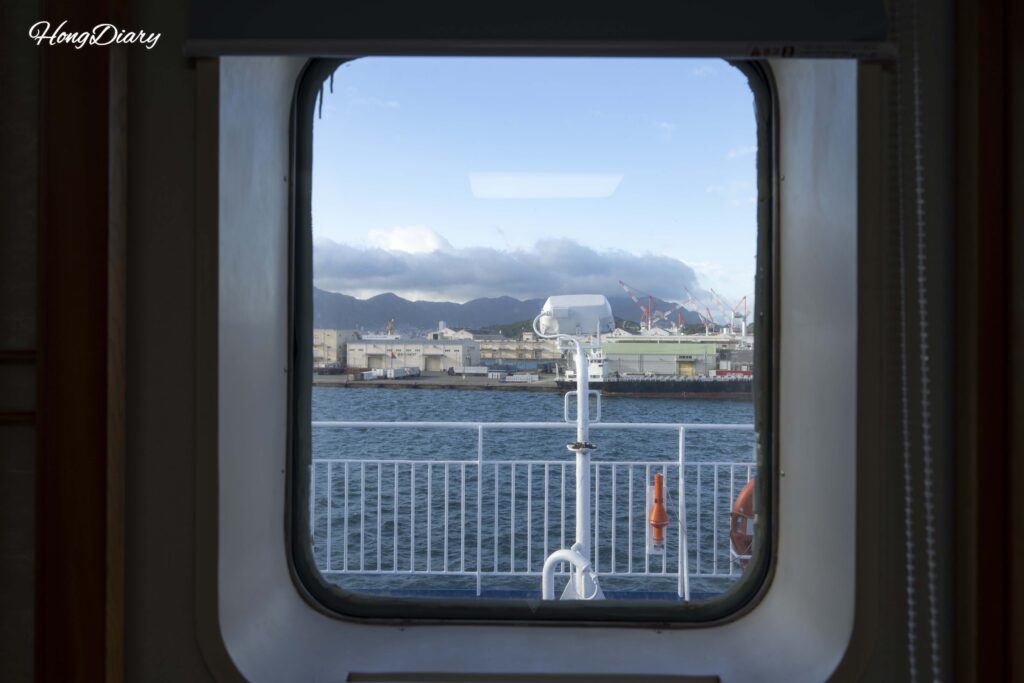
Sometime around 7:00 AM, I pulled back the curtain and there it was — Shimonoseki’s coastline, slowly filling the cabin window. After a night at sea, seeing land again hit differently than I expected.
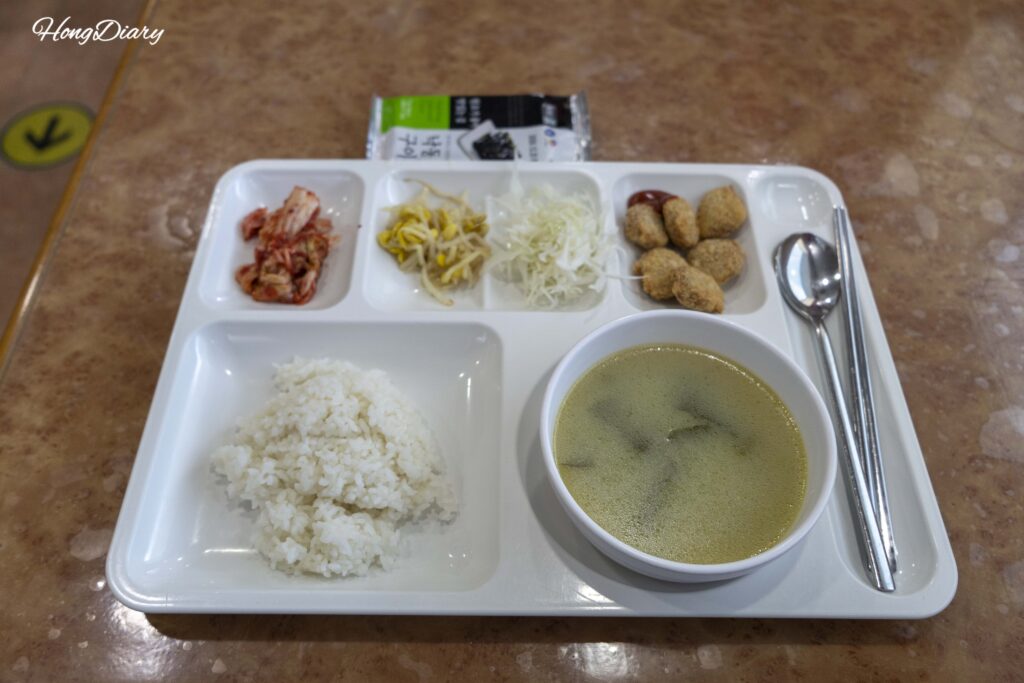
We went straight to the restaurant for breakfast. The only option was the miyeokguk set — Korean seaweed soup with steamed rice and a few small side dishes — for ₩8,000 ($6 USD / €5 EUR). It was simple, better than expected, and exactly the kind of warm, savory meal you want on a chilly morning after a night of gentle rocking.
Disembarkation tips you should know:
| Step | Details |
|---|---|
| Return cabin key | Bring it to the information desk on Deck 4 by 7:20 AM — they announce this repeatedly, but do not wait until the last minute |
| Line up on Deck 4 | Head to 1F and join the disembarkation line. Some passengers place their suitcases in the queue early in the morning to hold their spot — this is common |
| Disembarkation order | Individual travelers generally disembark before organized tour groups, so you should not have to wait long |
How Much Does the Busan to Shimonoseki Ferry Really Cost?
Beyond the ticket price, there are mandatory port and terminal fees that you pay separately at each departure port on the day you sail. Here is a realistic breakdown for one adult doing a round-trip in 2nd Class during the off-season:
| Cost Item | Amount |
|---|---|
| Round-trip ticket (off-season promo, shared 2nd Class cabin) | ₩120,000 ($86 USD / €76 EUR) |
| Terminal fees, departure tax, fuel surcharge, tourism tax (Busan departure) | ₩26,000 ($19 USD / €17 EUR) |
| Port fees (Shimonoseki departure) | ¥5,520 (approximately $37 USD / €33 EUR) |
| Approximate round-trip total | ₩198,440 ($142 USD / €126 EUR) |
A few things to keep in mind:
The ₩120,000 round-trip fare above is a promotional rate — this particular promo was on sale in October 2026 for sailings between December 1 and 28, 2026 in shared 2nd Class cabins. Similar promotions appear regularly on the official Pukwan Ferry website, so check the announcements page before booking.
Terminal and port fees are not included in the ticket price. You pay them separately at each port on the day you board — Korean won at Busan, Japanese yen at Shimonoseki. These amounts change monthly, so always confirm the latest figures on the official site’s notice board.
In my experience, booking through the official website almost always gives you the lowest price. Occasionally, booking platforms like Klook run coupons or flash sales that shave a small amount off — but the difference is usually marginal.
Before you commit, compare the ferry fare with flights for the same travel dates. The ferry is at its best value during the off-season with promo pricing; during peak periods, budget airlines between Busan and Fukuoka can be both faster and cheaper.
Who Should Take This Ferry?
After taking the Busan to Shimonoseki ferry round-trip with my family, here is my honest assessment.
It is a solid choice if you are traveling with young children and want to skip the unpredictability of flying, are carrying heavy luggage (the base allowance is 30 kg per person), are touring by bicycle, or can travel during the off-season when promo fares bring the round-trip below ₩150,000 ($107 USD / €95 EUR). Beyond the practical benefits, the crossing itself adds something to the trip — the communal bath, the night view of Busan Harbor Bridge, waking up to Shimonoseki through your cabin window. These are the kinds of moments that do not happen when you fly.
You are probably better off flying if you are traveling during peak season, when ferry prices approach or exceed airfare, or if your schedule cannot accommodate an overnight.
This review covers the Seonghee, one of the two ships on the Busan to Shimonoseki ferry route. I will be sharing a closer look at the Hamayuu — the other vessel on this line — in an upcoming post, along with a direct cabin-by-cabin comparison between the two ships.
Frequently Asked Questions (FAQ): Busan to Shimonoseki Ferry(Seonghee)
How long does the Busan to Shimonoseki ferry take?
The overnight crossing takes approximately 11 hours. The ferry departs Busan at 9:00 PM and arrives in Shimonoseki the following morning at around 8:00 AM. Ticket sales close at 5:30 PM and boarding ends at 6:30 PM, so plan to arrive well before that.
How much does the Busan to Shimonoseki ferry cost?
Standard one-way fares range from ₩120,000 ($86 USD / €76 EUR) for 2nd Class to ₩340,000 ($243 USD / €216 EUR) for a Suite cabin. Off-season promotional round-trip fares can go as low as ₩120,000 ($86 USD / €76 EUR) for shared 2nd Class cabins. On top of the ticket price, travelers must pay terminal and port fees separately at each departure port — approximately ₩26,000 ($19 USD / €17 EUR) from Busan and ¥5,520 (approximately $37 USD / €33 EUR) from Shimonoseki.
Prices are converted at $1 USD ≈ ₩1,400 / €1 EUR ≈ ₩1,575 as of September 2026 and may fluctuate.
What is the difference between the Seonghee and the Hamayuu?
Both ships sail the same Busan–Shimonoseki route and alternate days, so which one you board depends on your travel date. The Seonghee has been in service since 2002 and was South Korea’s first international car ferry. It offers Korean-Style floor cabins (called hwasil) alongside bed-type rooms. Both ships feature similar facilities — a restaurant, convenience store, communal bath, karaoke room, and duty-free shop — but their interior layouts and cabin finishes differ. You can check which ship operates on your travel date through the official Pukwan Ferry website at pukwan.co.kr.
Can I bring my own food and drinks on the ferry?
Yes, you can bring outside food and beverages aboard. However, you cannot eat them in the restaurant (Andamiro on Deck 5). All personal food must be consumed in the Multi Hall Laon on Deck 6 (3F), which is open from 6:30 to 9:30 PM in the evening and 6:00 to 8:00 AM in the morning. Alcohol purchased from the onboard vending machines can be enjoyed in the Multi Hall, your cabin, or the open seating area on Deck 4.
Is there a shower or bath on the Busan to Shimonoseki ferry?
Yes. Private cabins (1st Class and above) come with their own bathroom including a shower, so you do not need to use shared facilities. In addition, the Seonghee has a free communal bath on Deck 4 — similar to a Japanese sento (public bathhouse) with washing stations and a soaking tub. The bath is open from 6:00 to 10:00 PM in the evening and 5:30 to 8:00 AM in the morning. It tends to get crowded around 9:00 PM, so going right after boarding or early in the morning is recommended.
What documents and forms do I need for the ferry to Japan?
You will need a valid passport for check-in at the terminal. At the boarding gate, the crew provides two forms: a Japan Entry Card and a Customs Declaration Form. Solo travelers complete one form each. Families traveling together can fill out a single customs form under one representative adult — the reverse side is only needed if you are carrying goods above Japan’s duty-free limits. Write SEONGHEE as the ship name on the customs form. Japan also uses Visit Japan Web, a digital pre-entry registration system — completing it before your trip can speed up the arrival process at Shimonoseki.
Is the Busan to Shimonoseki ferry suitable for families with babies or young children?
It is a practical option for families. The 4-person Korean-Style cabin (hwasil) uses floor-level futon bedding, which eliminates the risk of a child falling from an upper bunk and gives everyone room to spread out. Each private cabin has its own bathroom. The ship also has a free communal bath, a convenience store for late-night snack runs, and vending machines with ice cream and drinks. The main trade-off is that the Seonghee is an older vessel — expect some wear in the Korean-Style cabins — and the communal areas like the Multi Hall can get noisy when large tour groups are on board.