
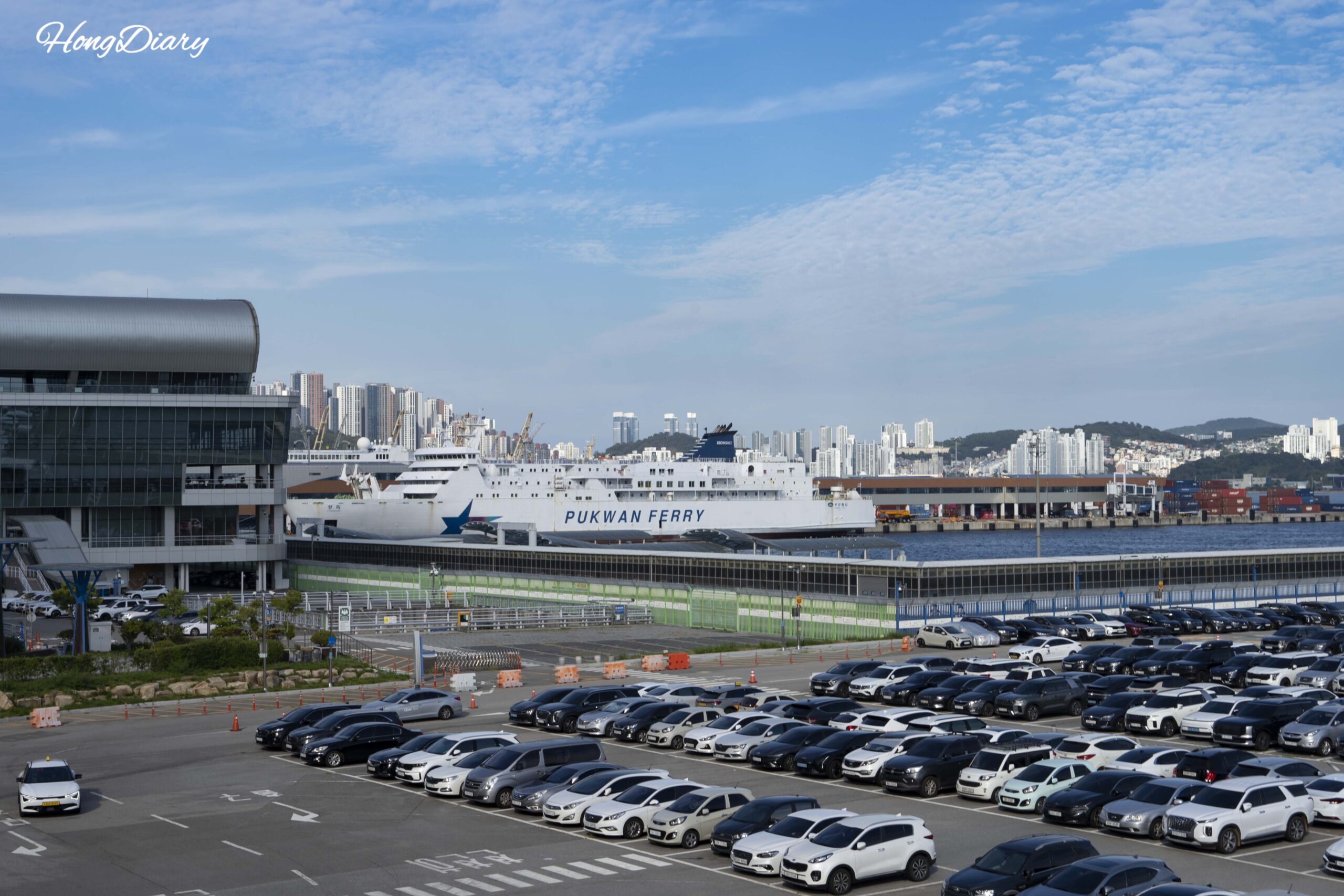
If you are planning to travel from South Korea to Japan without flying, the ferry from Busan is one of the best ways to do it. Three overnight routes connect Busan directly to Shimonoseki, Fukuoka, and Osaka, and they all depart from one place: Busan Port International Passenger Terminal, commonly known as the Busan ferry terminal. I have taken this ferry several times a year for the past few years, most recently with my husband and toddler on the Pukwan Ferry (also known as Kampu Ferry) to Shimonoseki. This Busan ferry terminal guide covers everything I have learned from those trips — the stuff that would have saved me a lot of confusion the first time around.
Table of Contents
Busan Ferry Terminal at a Glance
| Basic Info | Details |
|---|---|
| Official Name | Busan Port International Passenger Terminal |
| Address | 206 Chungjang-daero, Dong-gu, Busan |
| Operating Hours | 6:30 AM – 7:30 PM daily (hours may shift with sailing schedules) |
| Access from Busan Station | Exit 9 or 10 → covered skywalk → approx. 10 min on foot |
| Key Floors | 2F: Arrivals, currency exchange, tourist info / 3F: Departures, ticket counters, restaurants |
| Ferry Destinations | Shimonoseki, Fukuoka (Hakata), Osaka, plus domestic one-night cruises |
Prices converted at approximately $1 USD ≈ ₩1,400 / €1 EUR ≈ ₩1,575 (as of September 2026). Rates may fluctuate.
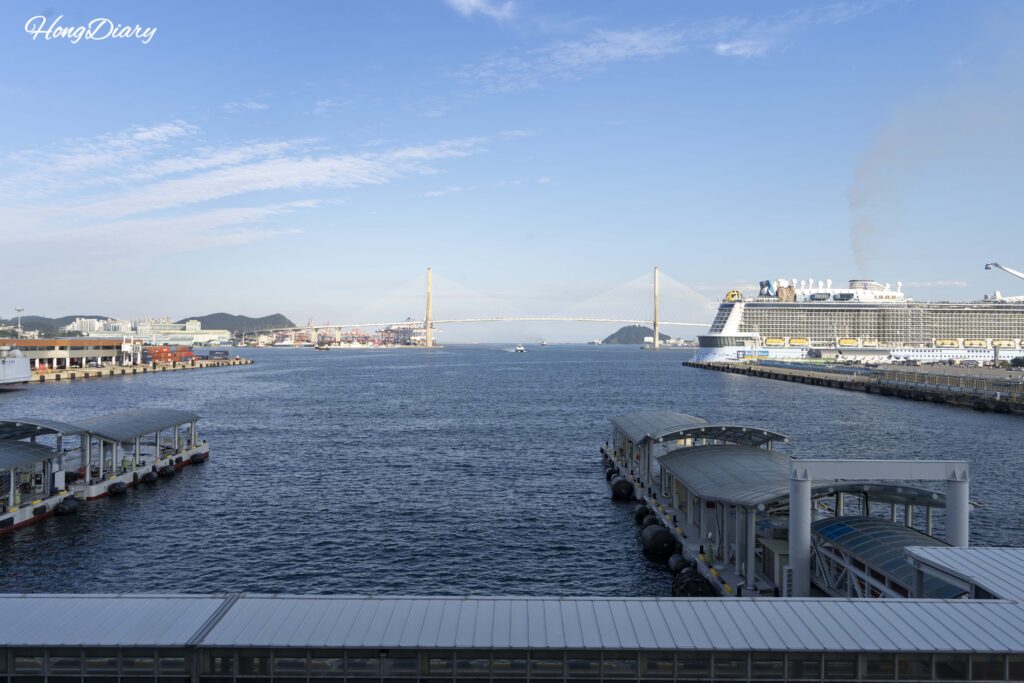
The terminal sits in the Dong-gu district of Busan, right behind Busan Station, which serves as the city’s main KTX high-speed rail hub. Busan itself is South Korea’s second-largest city and the country’s southernmost major port, making it the natural maritime gateway between the Korean Peninsula and the Japanese archipelago. The current building opened in August 2015, replacing the old coastal terminal with a modern five-story structure that handles all international passenger ferry traffic — right in the urban core, surrounded by the port’s working waterfront and the sweeping arch of Busan Harbor Bridge overhead.
How to Get to Busan Ferry Terminal from Busan Station
Getting to the terminal from Busan Station is simple, and you do not need a taxi or a bus. Head to the 2nd floor of Busan Station and look for Exit 9 or 10 at the rear of the building. You will see a covered pedestrian skywalk stretching out toward the port — there are no stairs to deal with, which is a big deal when you are dragging luggage.
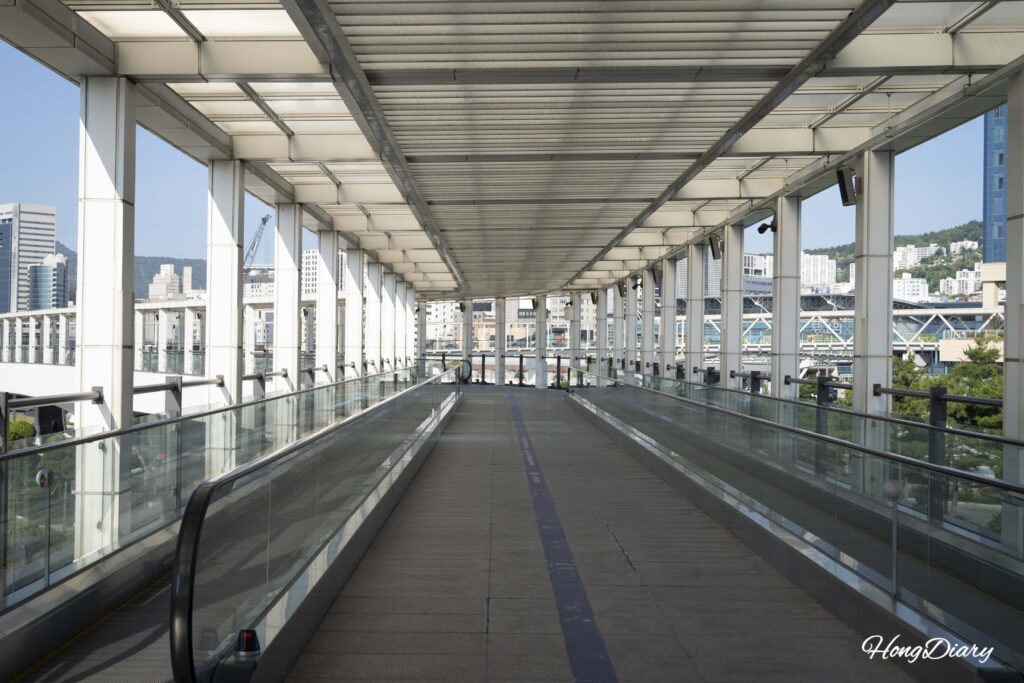
The skywalk also has moving walkways installed along sections of the route, so even heavy bags are manageable. The walk takes roughly 10 minutes at a normal pace with a suitcase. Along the way, you get a wide view of the port: container cranes, docked vessels, and Busan Harbor Bridge framing the scene. If your sailing is in the late afternoon or evening, the light over the harbor can be quite nice from up here.
As the terminal gets closer, you can start spotting the ferries themselves at the berths. When I walked over for my Shimonoseki trip, the Pukwan Ferry vessel was already docked and clearly visible, along with a couple of other ships heading in different directions.
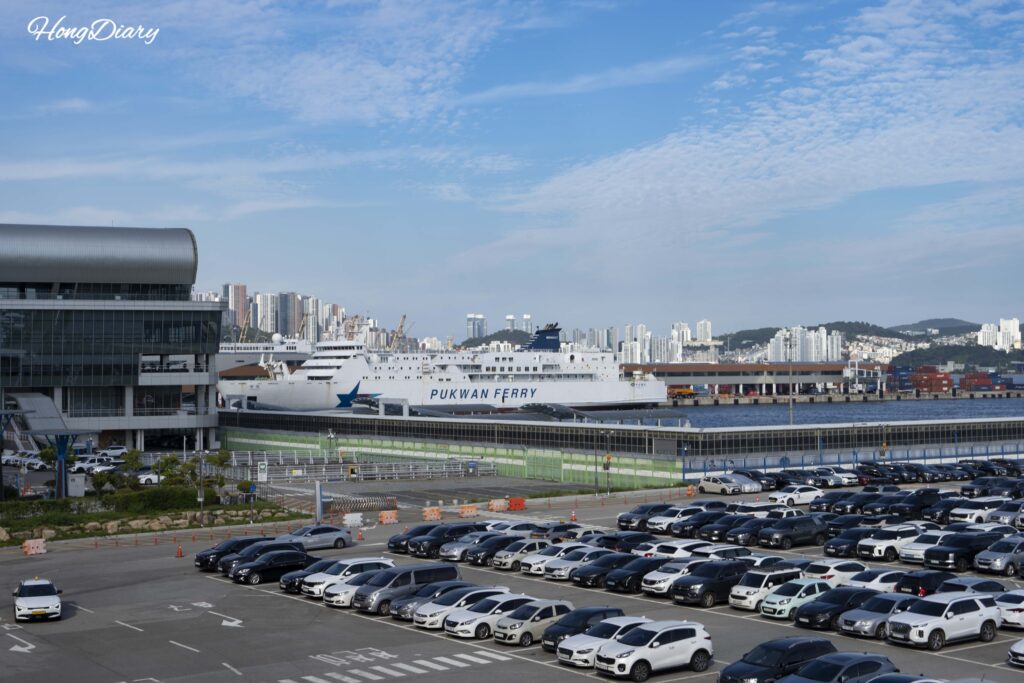
Since Busan Station is connected to both the KTX network and Busan Metro Line 1, you can reach the terminal from virtually anywhere in the country by public transit alone. If you are flying into Gimhae International Airport, a light rail or bus to Busan Station plus this 10-minute walk puts you at the ferry terminal in roughly an hour to an hour and ten minutes total. There is also an outdoor parking lot at the terminal if you are driving, but parking fees add up fast on multi-day trips — most travelers I have seen come by train.
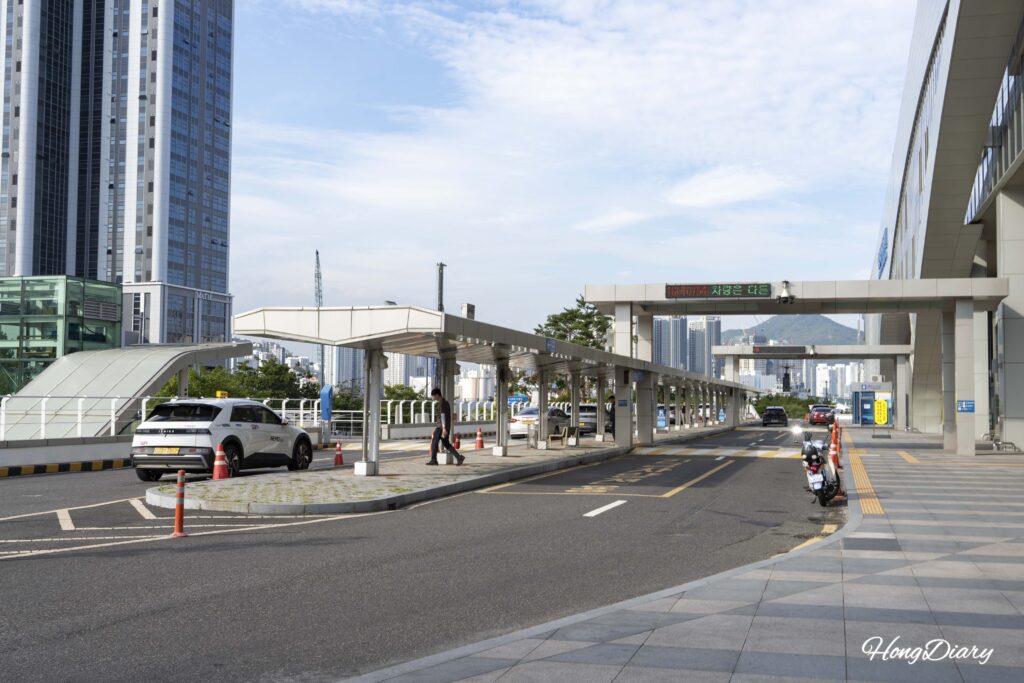
Inside the Terminal: A Floor-by-Floor Breakdown
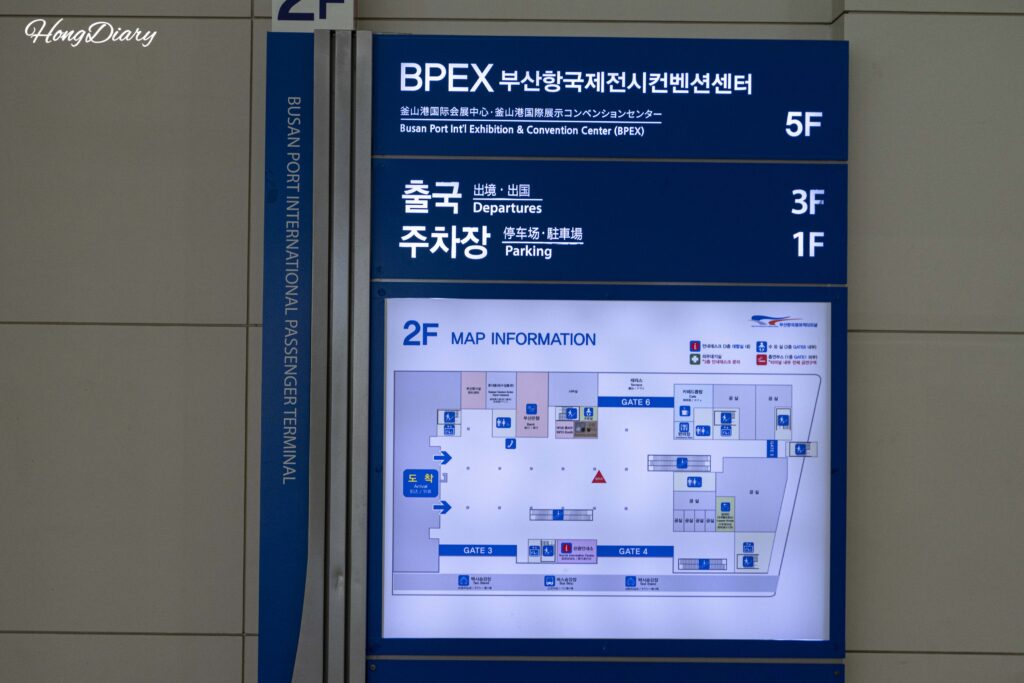
The building is clean, spacious, and newer than you might expect for a ferry terminal. If you have only ever used small port facilities in other parts of Asia, the scale here might surprise you. The two floors you will actually use are the 2nd floor (arrivals) and the 3rd floor (departures). There are digital information kiosks on each floor with maps in multiple languages, so you can orient yourself quickly without wandering.
2nd Floor: Arrivals, Currency Exchange, and Essentials
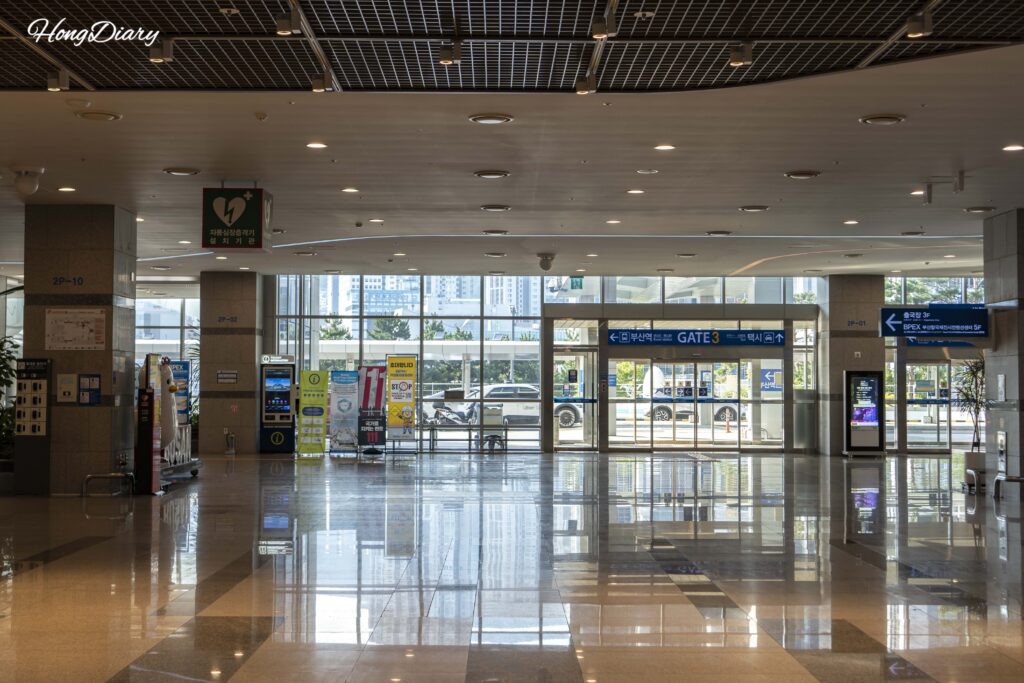
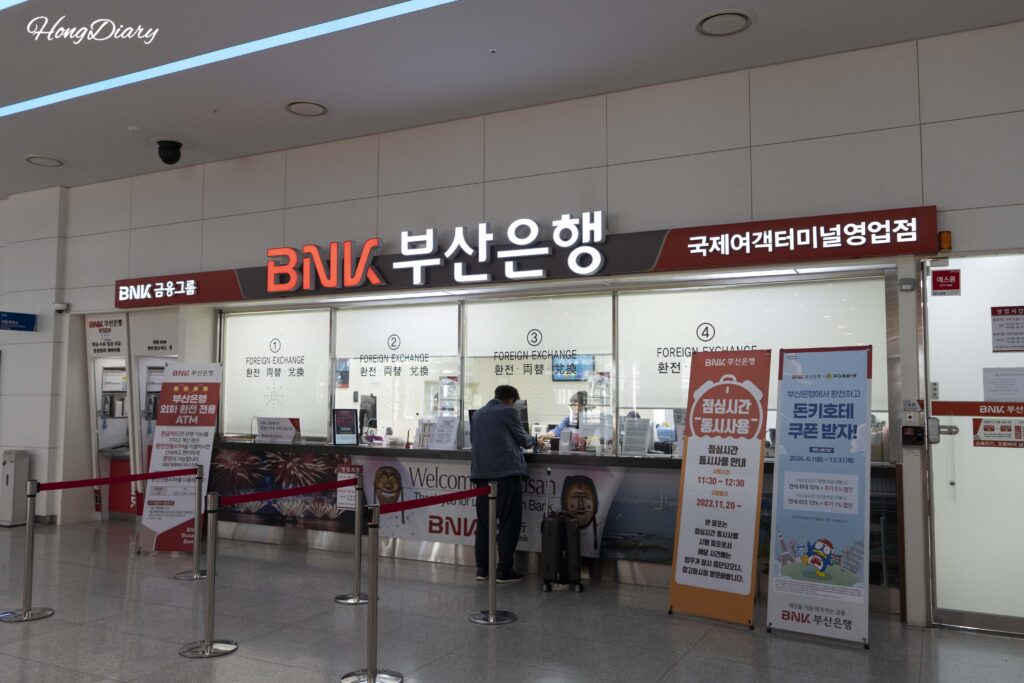
The 2nd floor is centered around the arrivals hall, but even if you are departing, there are a few useful things here. A Busan Bank branch handles currency exchange, and there is a dedicated currency exchange ATM nearby if you prefer to skip the counter line.
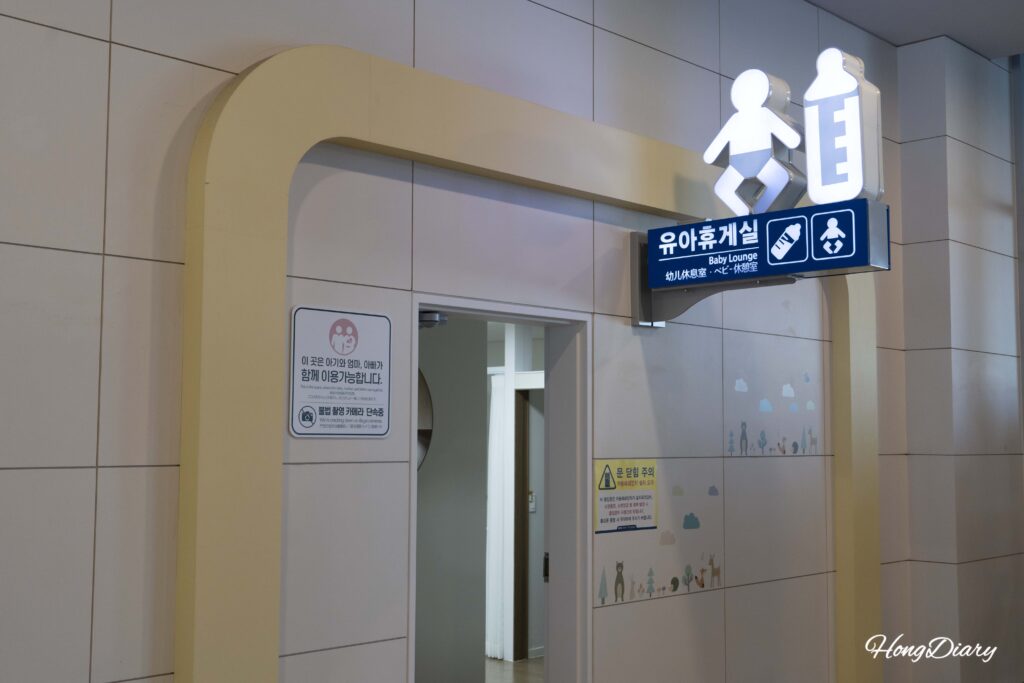
A CU convenience store (one of Korea’s major chains, similar to 7-Eleven) is located on this floor and stays open during terminal hours.(The former 7-Eleven has closed, and since September, a Korean convenience store brand, CU, has been operating in its place.) If you are traveling with an infant or toddler, there is a nursing room near Gate 6 on this floor — it is a proper room with seating and facilities, not just a curtained corner.
Both the 2nd and 3rd floors have outdoor terraces that overlook the harbor. The 2nd-floor terrace tends to be quieter and less crowded than the one upstairs, so if you want a calm spot to sit and watch the ships while waiting, head here rather than the 3rd floor.
3rd Floor: Departures, Ticket Counters, and Everything Else
Take the escalator up to the 3rd floor and you are in the departure zone. This is where all the action happens: ticket counters for each ferry company, the immigration checkpoint, restaurants, a pharmacy, a cafe, and another CU convenience store.
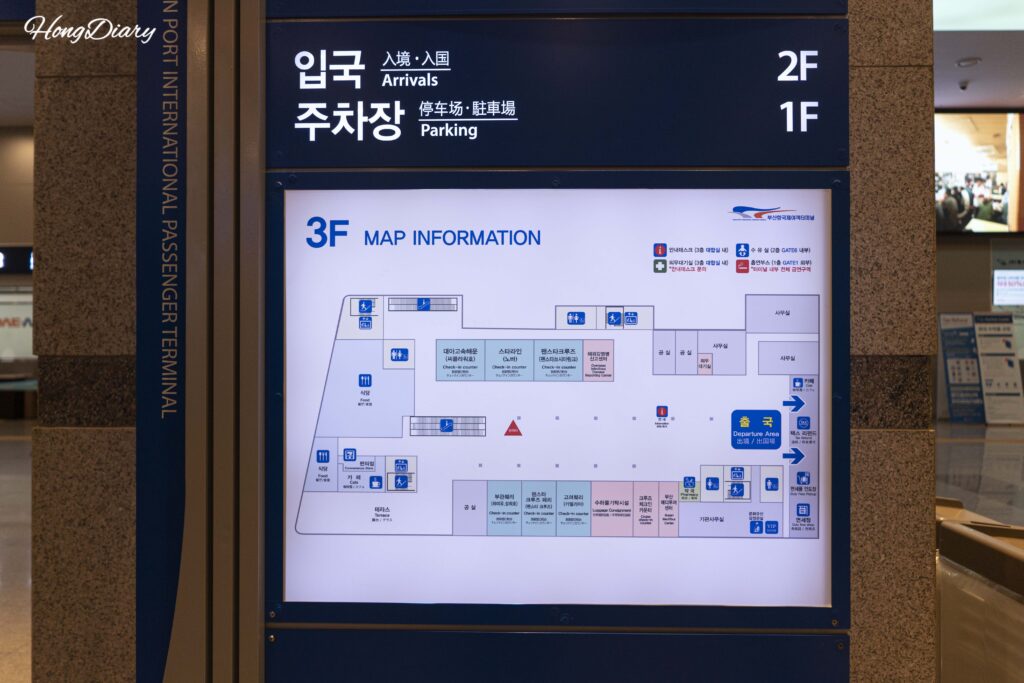
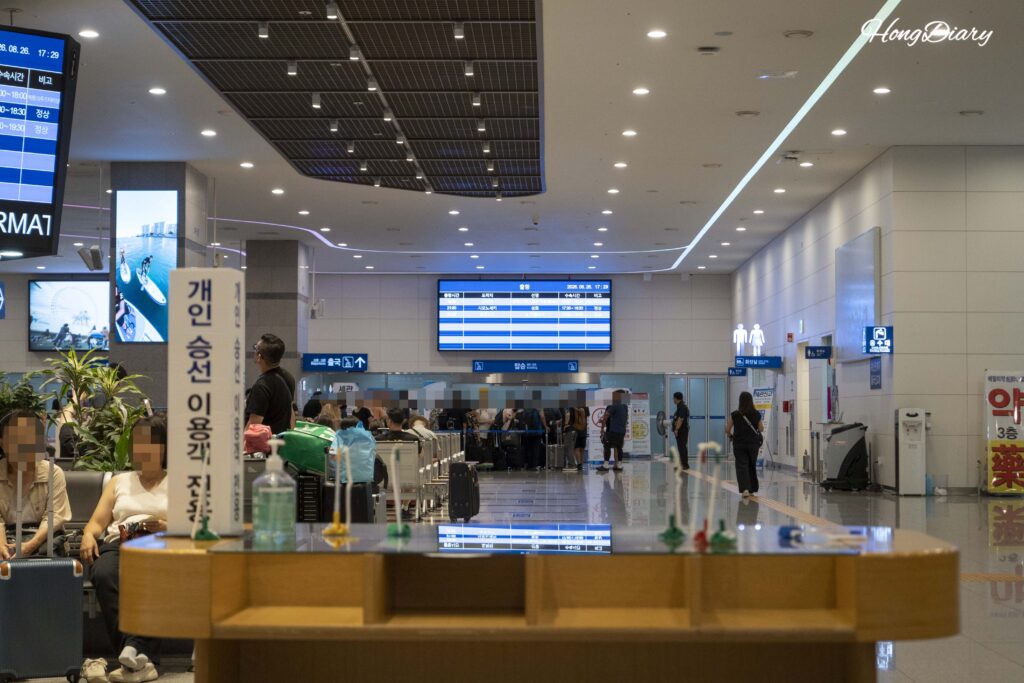
The first thing you will notice is the volume of people, especially during peak travel seasons. Each ferry company has its own counter here — Pukwan Ferry for Shimonoseki, Koryo Ferry (Camellia Line) for Fukuoka, Panstar for Osaka. Pick the right one, have your passport ready, and purchase or pick up your ticket. The boarding pass you receive here is what you need to board; your passport will already be verified during check-in, so once you are past this point, just keep the boarding pass handy.
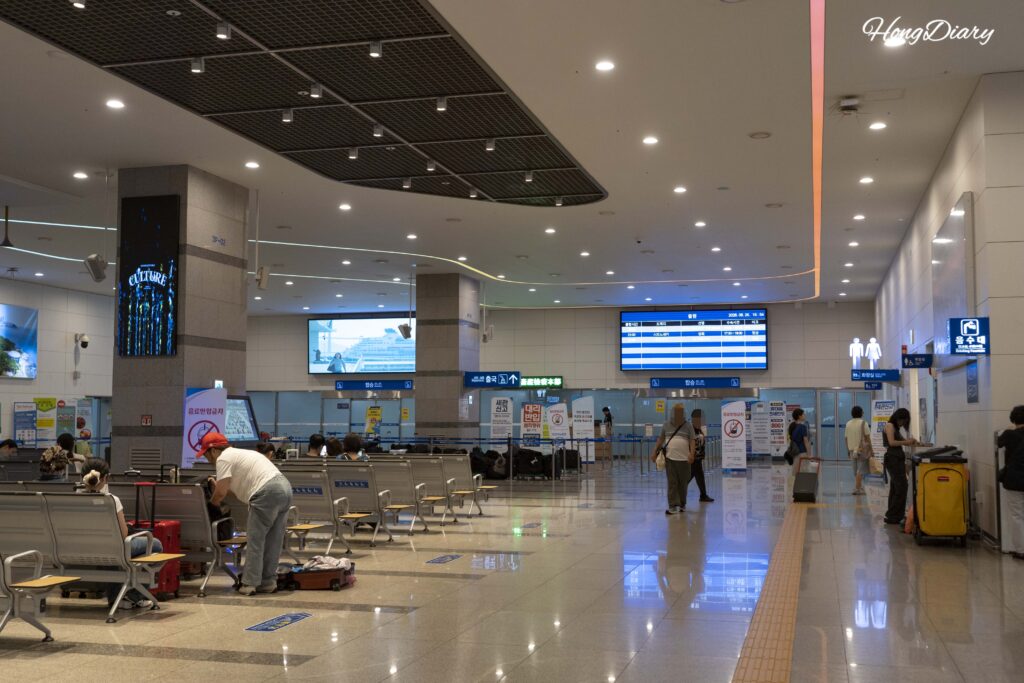
If you get seasick easily, there is a pharmacy on the 3rd floor called Sae Busan Pharmacy. They sell a motion sickness kit — one liquid dose plus one tablet — for ₩5,000 (~$3.60 / €3.20). You can also buy motion sickness tablets at any pharmacy in Busan for around ₩4,000 (~$2.85 / €2.55), but those are tablet-only. From personal experience, the combo kit at the terminal pharmacy works better, and it saves you the trouble of hunting for a pharmacy elsewhere before your trip.
Where to Eat (and What to Bring on Board)
This is the section I wish someone had written for me before my first ferry trip.
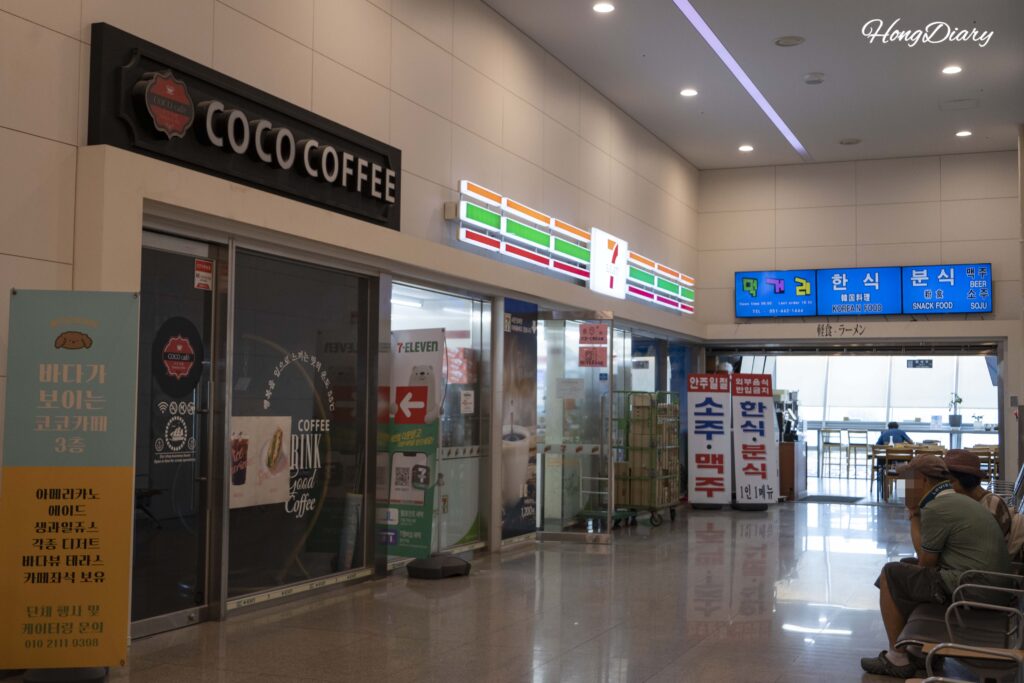
On the 3rd floor, there is a casual Korean restaurant called Meokgeori (the name roughly translates to “eatery” or “food spot”). You order through a self-service kiosk that supports English and Japanese, and one order per person is required. The menu covers a solid range of Korean comfort food:
| Menu Item | Price (KRW) | USD | EUR |
|---|---|---|---|
| Ramen | ₩5,000 | ~$3.60 | ~€3.20 |
| Shrimp or Kimchi Fried Rice | ₩9,000 | ~$6.45 | ~€5.70 |
| Udon | ₩8,000 | ~$5.70 | ~€5.10 |
| Korean Soup or Stew (Gukbap, Jjigae) | ₩10,000 | ~$7.15 | ~€6.35 |
| Dumplings, Fish Cake, and Sides | Varies | — | — |
| Soju, Beer, and Other Drinks | ₩6,000 | ~$4.30 | ~€3.80 |
Two items on the menu — both types of fried rice and the steamed dumplings (mandu) — can be packed for takeout and brought onto the ferry. Takeout prices are slightly higher: ₩9,500 (~$6.80 / €6.05) for fried rice and ₩10,500 (~$7.50 / €6.65) for dumplings. The restaurant is open from 6:00 AM to 7:00 PM daily and only closes when international sailings are cancelled due to weather.
There is also a more formal sit-down restaurant called Jeongjin Home Food right next to the escalator on the 3rd floor, but in my experience it has always been closed whenever I visited. Its posted hours are 6:30 AM to 2:30 PM, which means most evening ferry passengers will never see it open.
A cafe on the 3rd floor connects to the terrace, and another CU convenience store is nearby, so grabbing a last-minute snack or coffee before departure is easy enough.
The Real Move: Order Delivery to the Terminal
Here is something that surprised me the first time I saw it, and it completely changed how I prepare for ferry trips. You can order food delivery directly to the terminal gates.
South Korea’s food delivery apps — Baedal Minjok (often called “Baemin”) and Coupang Eats — work like Uber Eats or DoorDash, but they have historically been tricky for foreign visitors because they required a Korean phone number and payment method. That has changed: both apps are now available on the App Store and Google Play, and they accept international credit cards and Apple Pay for guest orders (no Korean registration needed).
Set your delivery address to 206 Chungjang-daero, Dong-gu, Busan, 2nd Floor, Gate 3 or Gate 4 (Busan Port International Passenger Terminal), and your food will arrive right at the terminal. If that feels complicated, you can also just grab takeout from restaurants around Busan Station — most of them offer packaging for to-go orders.
The reason this matters: most ferry operators on these routes allow outside food on board. Look around the waiting area before boarding and you will see passengers sitting with boxes of fried chicken, kimbap (Korean rice rolls), pizza, and all sorts of food they have brought along for the voyage. I learned this the hard way on an earlier trip — I boarded empty-handed, assuming the onboard restaurant would be enough, and ended up eating curry from the ship’s cafeteria alone while watching other passengers share fried chicken with their groups. It was a lonely meal.
So this time, for the Shimonoseki trip, I ordered food through the delivery app in advance and brought it on board for the family. If you are traveling with friends or family, bringing your favorite Korean food onto the ferry is part of the experience — think of it as a farewell meal with Korean flavors before arriving in Japan the next morning.
One popular move among regular ferry passengers: a well-known local pizzeria called Ijae-mo Pizza sits right outside Busan Station, and a lot of people grab a box there before walking over to the terminal.
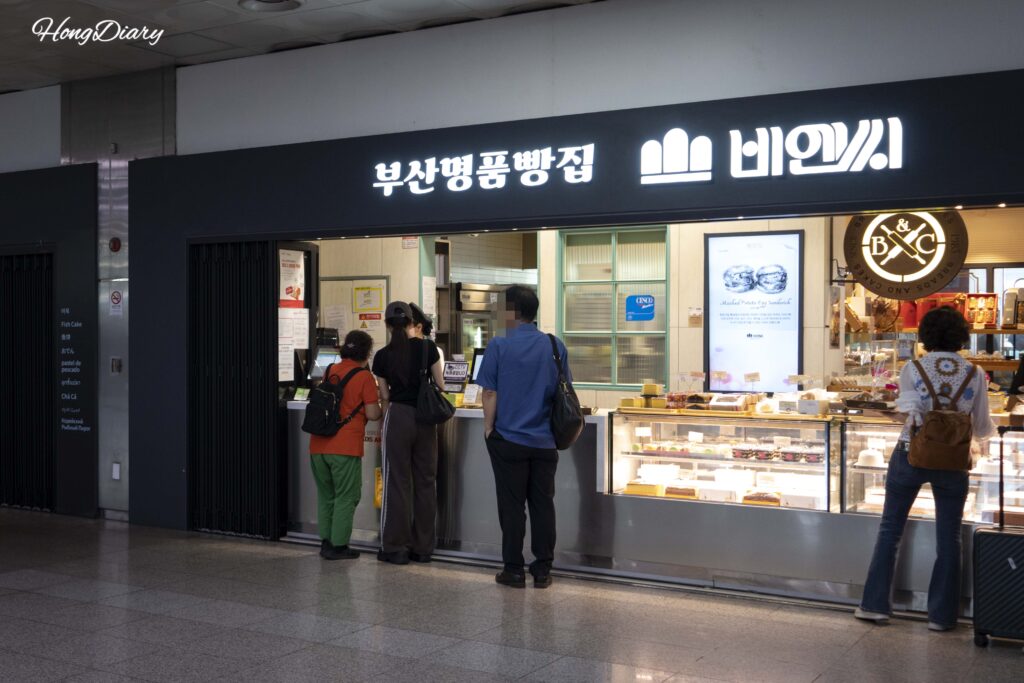
If you are arriving at Busan Station with time to spare before your departure, the station’s 2nd floor has a 40-year-old local bakery called B&C where you can pick up fresh bread and pastries for the ride — a quick, easy option if you just want something light for the evening.
Ferry Routes and Schedules: Shimonoseki, Fukuoka, Osaka
Three international ferry routes currently operate from Busan ferry terminal, all heading to Japan. There is also a domestic one-night cruise that stays within Korean waters. Here is a snapshot of each route:
| Destination | Operator | Vessel | Frequency | Departs Busan | Arrives | Duration |
|---|---|---|---|---|---|---|
| Shimonoseki | Pukwan Ferry | Seong Hee (KR) / Hamayuu (JP) | Daily | 9:00 PM | 8:00 AM next day | ~11 hrs |
| Fukuoka (Hakata) | Koryo Ferry | New Camellia (JP) | Daily | 10:30 PM | 7:30 AM next day | ~9 hrs |
| Osaka | Panstar Line | Panstar Miracle | Sun, Tue, Thu | 3:00–4:00 PM | 8:30–9:00 AM next day | ~18 hrs |
| One-Night Cruise (domestic) | Panstar Line | Panstar Miracle | Most Saturdays (except 3rd Sat) | 4:30–5:00 PM (seasonal) | Returns next day | 1 night |
All three Japan-bound routes are overnight sailings. You board in the evening, sleep on the ship, and wake up in Japan. The one-night cruise run by Panstar Miracle is a round-trip that stays within the Korea Strait — it departs most Saturday afternoons (except the third Saturday of each month) and returns the next day, which is a fun option if you want the ferry experience without actually going anywhere.
Shimonoseki Route (Pukwan Ferry)
- Ticket deadline: 5:30 PM
- Check-in: 6:10 PM – 6:30 PM (hard cutoff at 6:30 PM)
- Departure: 9:00 PM
- Arrival in Shimonoseki: 8:00 AM next day
- Languages supported on website: Korean, English, Japanese
- Book at: pukwan.co.kr
Two vessels rotate on this route — the Seong Hee (Korean-flagged) and the Hamayuu (Japanese-flagged). The route has been in operation since 1905, originally as part of the railway connection between the two countries, which is why Shimonoseki Station is practically adjacent to the ferry terminal on the Japanese side, just like Busan Station is here.
Fukuoka (Hakata) Route (New Camellia)
- Ticket deadline: 7:00 PM
- Departure hall entry: 7:00 PM – 7:30 PM
- Boarding: From 7:40 PM
- Departure: 10:30 PM
- Arrival at Hakata Port: 7:30 AM next day
- Languages supported on website: Korean, English
- Book at: koreaferry.kr
This is the only ferry currently running between Busan and Fukuoka. The older high-speed hydrofoil service (JR Kyushu Queen Beetle) was discontinued in late 2024, so all sailings are now overnight on the New Camellia.
Osaka Route (Panstar)
- Sunday departure: Ticketing 1:00 PM – 2:15 PM / Check-in by 2:30 PM / Departs 3:00 PM / Arrives 8:30 AM next day
- Tuesday & Thursday departure: Ticketing 2:00 PM – 3:00 PM / Check-in by 3:15 PM / Departs 4:00 PM / Arrives 9:00 AM next day
- Languages supported on website: Korean, English, Japanese
- Book at: panstarcruise.com
The Osaka route is the longest at roughly 18 hours, which means you get a full afternoon and evening on the ship before arriving the next morning. If you book a round trip, check the return schedule separately — departure days and times differ by direction.
A note on schedules: These times were accurate as of my most recent trip, but ferry companies occasionally adjust them. Always confirm directly on each operator’s website before your travel date.
Booking and Pricing Tips
During off-peak seasons, booking directly through the ferry company’s official website listed above typically gives you the lowest fare. Occasionally, platforms like Klook or Trip.com offer discount coupons that can beat the direct price, so it is worth comparing. Whichever way you book, be aware that the ticket price usually does not include the fuel surcharge and port taxes — those are paid separately at the terminal on the day of departure. The exact surcharge fluctuates monthly, so check the ferry company’s website for the latest figure.
As a reference, when I took the Pukwan Ferry to Shimonoseki, the port tax on the Korean side was ₩26,000 (~$18.5 / €16.5) per person paid at departure, and the port tax on the Japanese side was ¥5,520 (~$37 / €33) per person paid when leaving Shimonoseki for the return trip.
Boarding Process and What to Prepare
Battery and Electronics Restrictions
Ferry operators enforce battery restrictions for fire safety, similar to airlines:
| Battery Type | Limit |
|---|---|
| Under 100 Wh (up to ~27,000 mAh) | Up to 5 units allowed |
| 100–160 Wh (~27,000–43,000 mAh) | Up to 2 units allowed |
| Over 160 Wh | Not allowed on board |
Electric bicycles, electric scooters, and e-kick scooters are prohibited entirely. Charging options on board vary by ship and cabin type — private cabins typically have outlets, but shared dormitory-style rooms often have few or none, so if you are in a shared room, board with your devices fully charged. The terminal’s departure waiting area does have seats with built-in Korean-style power outlets (Type C/F, 220V) — more on that below.
Luggage Rules
All three ferry companies operating from Busan allow carry-on baggage up to 30 kg and a maximum combined dimension (length + width + height) of 200 cm — essentially the size of a standard large suitcase. There is no separate checked baggage service; you carry your own bags on and off the ship and store them in your cabin or at your seat.
Bringing a Bicycle
If you are cycling between Korea and Japan, you will need to check your bicycle as oversized luggage at the ferry counter. Fees vary by operator:
| Operator (Route) | Standard Bicycle | Tandem / Non-Folding |
|---|---|---|
| Pukwan Ferry (Shimonoseki) | ₩20,000 (~$14.30 / €12.70) | ₩40,000 (~$28.60 / €25.40) |
| New Camellia (Fukuoka) | ₩20,000 (~$14.30 / €12.70) | ₩25,000 (~$17.85 / €15.90) |
| Panstar (Osaka) | ₩20,000 — folding (~$14.30 / €12.70) | ₩40,000 — standard (~$28.60 / €25.40) |
Electric bicycles are not allowed on any of the three routes. Bicycle space is also subject to availability on the day of departure, so it is not guaranteed even if you pay.
The Suitcase Queue: A Korean Ferry Culture Thing
This one deserves its own explanation because it will confuse you if you are not expecting it.
When you enter the departure waiting area after clearing immigration, you will see rows and rows of suitcases lined up — without their owners standing next to them. This is not abandoned luggage. Korean passengers place their bags in a queue to “hold their spot” in the boarding line, then walk away to shop at the duty-free store or sit somewhere more comfortable. The idea is to board early enough to grab the best shared-room spots (near power outlets) or to claim a table in the common lounge areas.
This practice is somewhat controversial even among Korean travelers — some consider it inconsiderate, while others see it as just how things work at the ferry terminal. Officially, your cabin or seat assignment is already determined by your ticket type, so physically racing to board first only really matters if you booked a shared dormitory-style room and want a specific bunk.
If you booked a private cabin, there is no advantage to rushing. I usually wait until the crowd thins out and then board at a relaxed pace. The same applies when disembarking in Japan — some passengers start queuing with their bags as early as dawn, but immigration lines at the Japanese ferry port are generally shorter than what you would face at a busy airport terminal, so sleeping in an extra 30 minutes is almost always the better call.
Using Visit Japan Web for Ferry Travel
Most travelers assume that Visit Japan Web — Japan’s official digital immigration registration system — only works for air travel. It actually works for ferry arrivals too, but the form is designed around flights, so a few fields require workarounds.
Here is how to fill it out:
- Go to the Visit Japan Web portal: English version or Japanese version
- When the form asks for your airline, select ZZ : OTHER AIRLINE
- For flight number or vessel name, type the name of your ship in all caps:
- Shimonoseki → HAMAYUU or SEONGHEE (depending on which vessel is running that day)
- Fukuoka → NEWCAMELLIA
- Osaka → PANSTARMIRACLE
- For departure city, enter Busan
- Complete the rest of the form as normal (passport info, travel dates, etc.)
Once submitted, you will receive a QR code. Show it to the immigration officer at the Japanese ferry port — the process is the same as at an airport. This saves you from filling out the paper immigration arrival card on the ship.
Important: The customs declaration form (a separate document listing the items you are bringing into Japan) still has to be filled out on paper. The crew will hand out blank forms during the voyage, and you submit them to customs upon arrival in Japan. Only the immigration portion is handled digitally through Visit Japan Web; the customs paperwork remains a pen-and-paper process.
That covers the Japan side. If you are also entering South Korea by ferry — either on this trip or a future one — there is a separate digital registration you will need.
e-Arrival Card: Entering South Korea by Ferry
If you are arriving in South Korea by ferry — whether on a one-way trip from Japan or returning from a round trip — you need to know that the country eliminated paper arrival cards entirely on January 1, 2026. All foreign visitors must now register their entry online through the e-Arrival Card system before arriving.
Who Needs It
Every foreign traveler entering South Korea, regardless of nationality or visa status. Even if your passport qualifies for visa-free entry (as is the case for most Western countries on tourist stays), you still need to submit the e-Arrival Card.
When and How to Apply
- Earliest submission: 3 days before your arrival date in Korea (the arrival date counts as day one)
- Validity: You must enter the country within 72 hours of submitting the form
- Cost: Completely free
- Official site: https://www.e-arrivalcard.go.kr/ (English version available)
Steps
- Go to the official site and switch to the English version
- Enter your passport information, travel details, and your accommodation address in Korea
- In the flight/vessel field, type the name of your ship (for example: HAMAYUU, SEONGHEE, NEWCAMELLIA, or PANSTARMIRACLE)
- For the departure city, enter the Japanese port city you are sailing from
- Submit the form
At immigration, you only need to show your passport — no QR code is required. That said, saving a screenshot of the confirmation page is a good idea just in case.
Watch Out for Fake Sites
The e-Arrival Card is free. If at any point during the application you are asked to enter credit card details or any form of payment, you are on a phishing site. The only official site is e-arrivalcard.go.kr.
Customs Is Separate
The e-Arrival Card only covers immigration. The customs declaration (listing items you are bringing into the country) is still done on paper. Forms are distributed on the ferry during the voyage or available near the immigration area upon arrival.
Duty-Free Shopping: Is It Worth It?
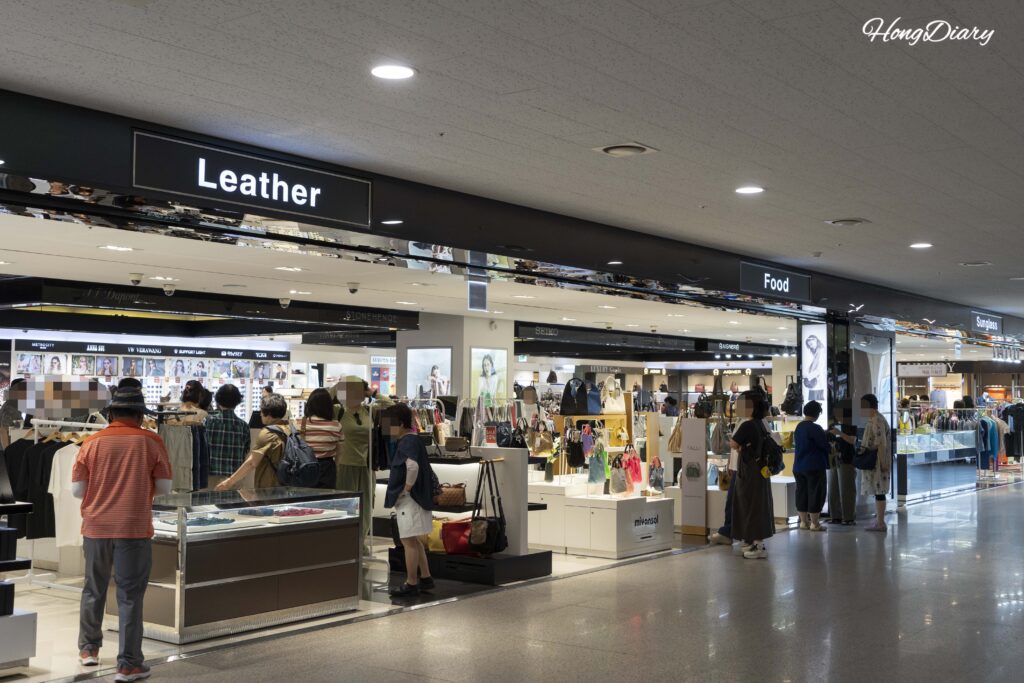
After passing through the immigration checkpoint on the 3rd floor, you enter the duty-free zone. I expected a small kiosk-style setup, but the duty-free shop here is bigger than I anticipated — not airport-level, but a proper retail space with shelves of liquor, tobacco, cosmetics, and accessories.
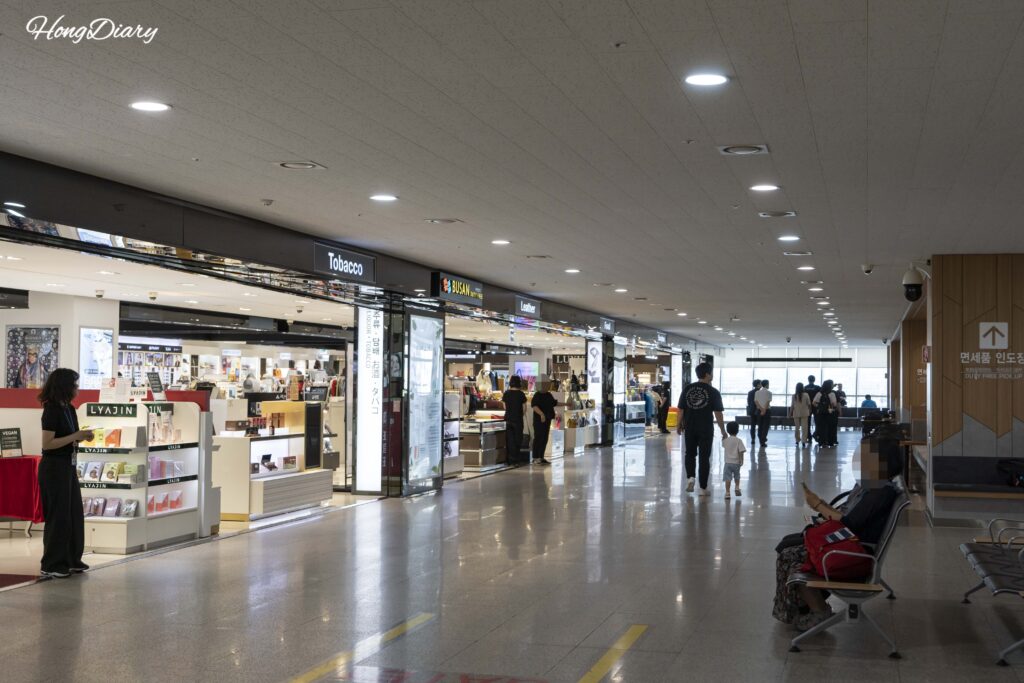
That said, the selection leans heavily toward budget brands. If you are hoping to find luxury goods or major international labels at deep discounts, this is not the place. Most items are comparable in price to what you would find at discount shops in Busan proper, and the markups on cosmetics and snacks are not especially competitive compared to downtown duty-free stores like Lotte or Shinsegae.
The one category where the terminal duty-free does offer real savings is alcohol. Whiskey and spirits here tend to be ₩20,000–30,000 (~$14–21 / €13–19) cheaper than retail prices in the city. If you are buying liquor as a gift or for personal use, it is a reasonable deal.
But here is the real tip: the duty-free shop on the ferry itself is usually another ₩5,000–10,000 (~$3.60–7.15 / €3.20–6.35) cheaper than the terminal’s duty-free. So if you are planning to buy alcohol, wait until you are on board and check the ship’s shop first. The selection is smaller, but the prices tend to be the best available.
The terminal duty-free is open from 7:00 AM to 8:00 PM year-round. Photography is not allowed inside the store.
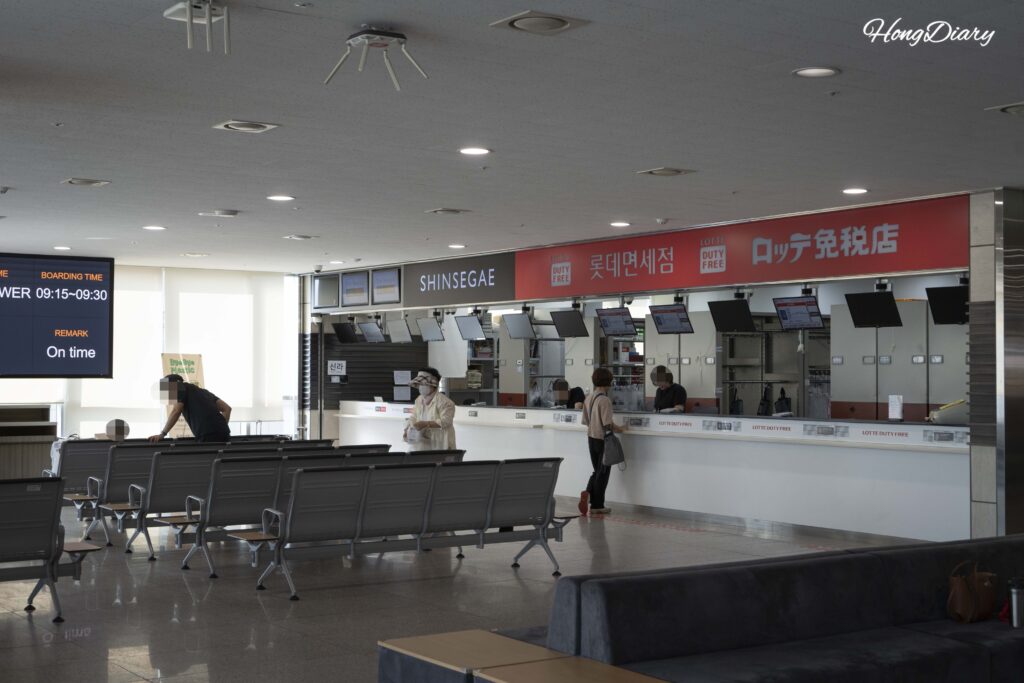
The Departure Waiting Area
Once you are past immigration and the duty-free zone, you are in the final waiting area before boarding. There is no convenience store here, but a small cafe called Coffee Maru sells drinks and light food:
| Item | Price (KRW) | USD | EUR |
|---|---|---|---|
| Coffee | ₩4,000–7,000 | ~$2.85–5.00 | ~€2.55–4.45 |
| Tea, Fruit Ade (citrus drinks), Smoothie | ₩4,500–7,000 | ~$3.20–5.00 | ~€2.85–4.45 |
| Bottled Water | ₩1,000 | ~$0.70 | ~€0.65 |
| Egg Sandwich | ₩6,500 | ~$4.65 | ~€4.15 |
Menus are available in Korean, English, and Japanese.
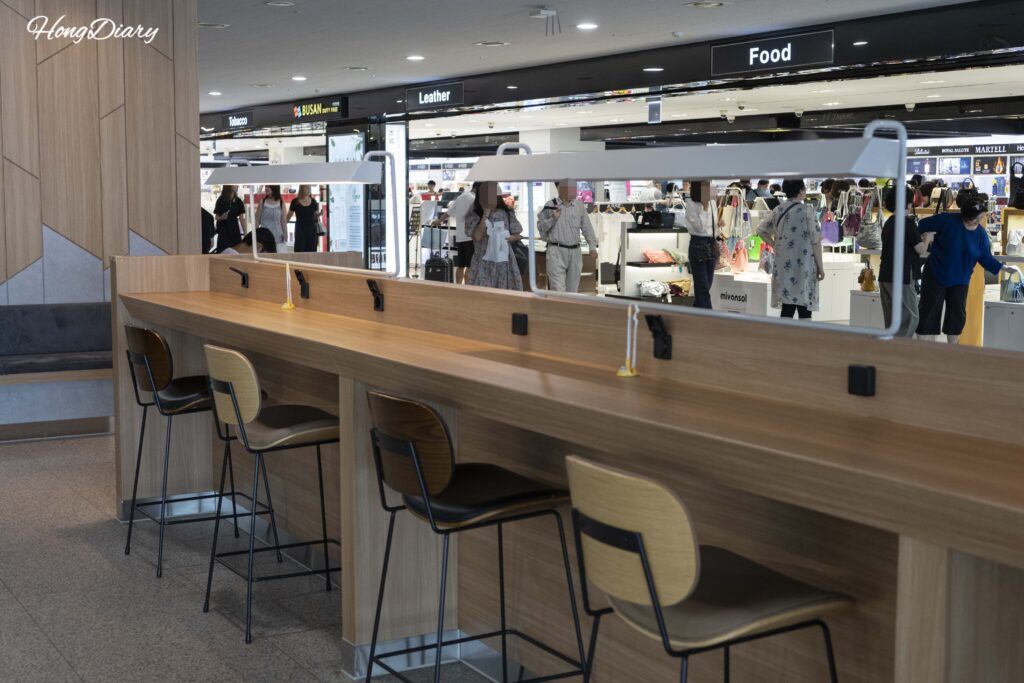
The waiting area has rows of seats, some with individual Korean-standard power outlets (Type C/F, 220V) built into the armrests. If you need to top off your phone or laptop before boarding, look for these — they are not at every seat, but there are enough to find one if you look around. Remember, charging on the ship is limited, so this is your last reliable chance to plug in.
The wait here honestly goes faster than you would think. Between browsing the duty-free, grabbing a coffee, and watching the boarding queue form, the time passes quickly — especially if you have a child to keep entertained.
Before You Board: Making the Most of Your Wait
If you arrive at Busan Station well before your ferry’s check-in window opens, you have some options within easy walking distance.
The terminal itself has terraces on both the 2nd and 3rd floors where you can sit outside and watch the port activity. The 3rd-floor terrace has a better view but gets more crowded; the 2nd floor is usually calmer and just as pleasant.
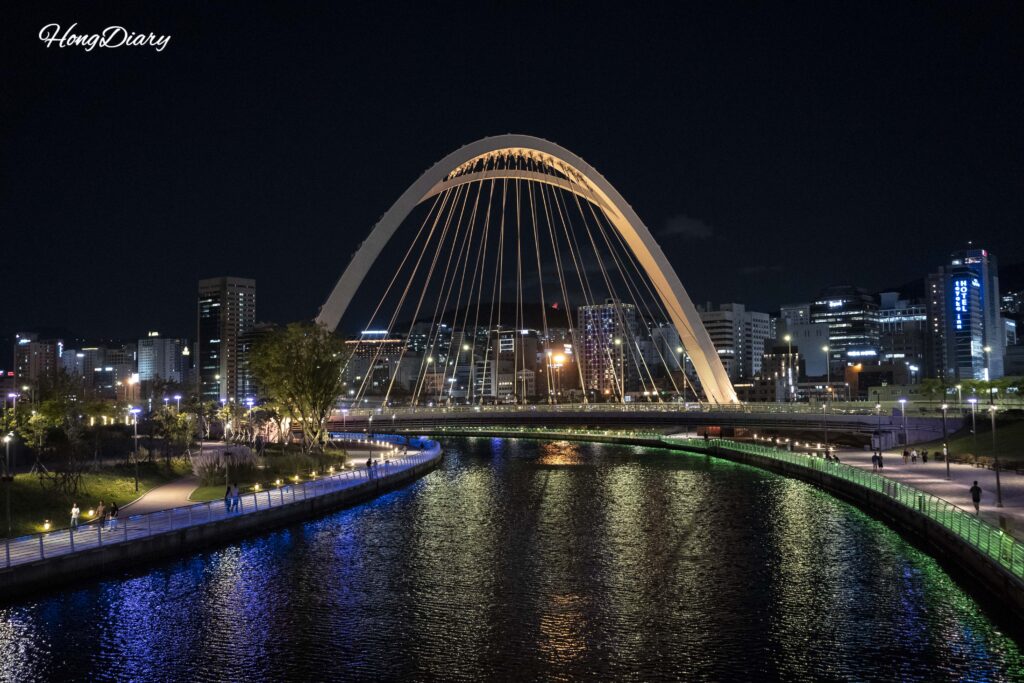
For a longer stretch of free time, the Busan North Port Waterfront Park is only about an eight-minute walk from the terminal. It is a well-maintained public park along the harbor — a good place to stretch your legs and take a quiet walk before spending the night on a ship.
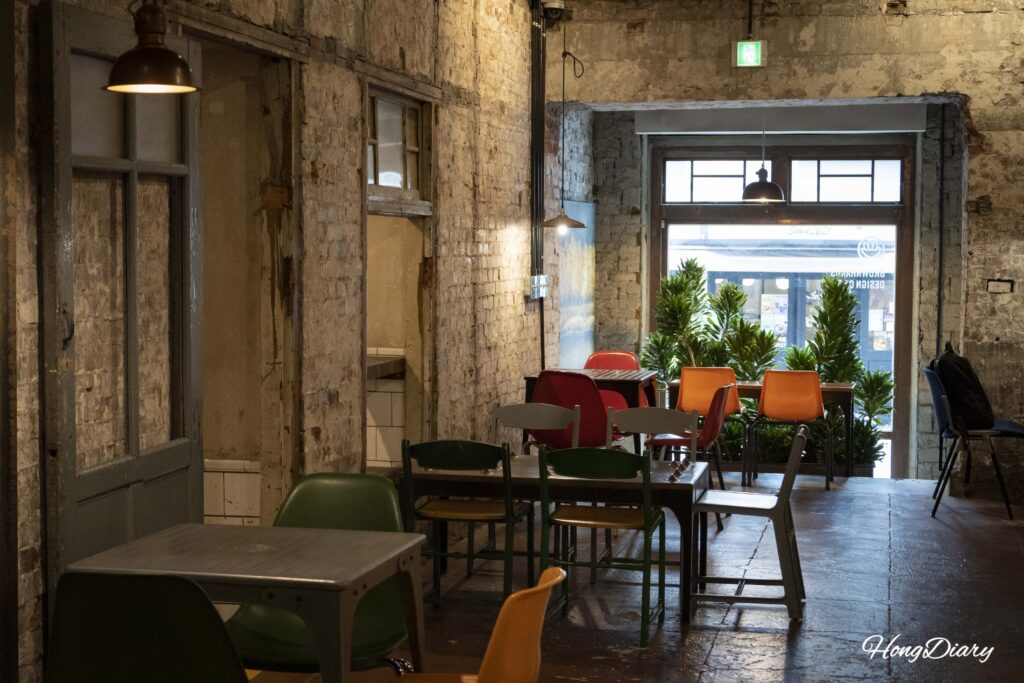
If you have a few hours and want to settle into a unique atmosphere, Brown Hands Baekje is a cafe housed inside a converted 1920s hospital building, roughly four minutes on foot from Busan Station.
The architecture alone makes it worth the visit, and it is a comfortable spot to kill time with a coffee before heading to the terminal.
Whether this is your first ferry crossing or your tenth, the Busan ferry terminal is one of those transit points that rewards you for showing up prepared. Know which floor to go to, bring food for the ship, skip the suitcase queue if you have a private cabin, and register on Visit Japan Web before you arrive. Do those things, and the whole process — from Busan Station to your bunk on the ship — feels effortless. The crossing itself is the easy part: you fall asleep in Korea and wake up in Japan, with nothing but open water in between.
Common Questions About Busan Ferry Terminal
How do I get from Busan Station to Busan ferry terminal?
Head to the 2nd floor of Busan Station and take Exit 9 or 10 at the rear of the building. A covered pedestrian skywalk with moving walkways connects the station directly to Busan Port International Passenger Terminal. The walk is flat (no stairs), fully sheltered, and takes about 10 minutes with luggage. No taxi or bus is needed.
What are the ferry routes from Busan to Japan, and how long do they take?
Three overnight routes currently operate from the Busan ferry terminal. Pukwan Ferry sails daily to Shimonoseki (departs 9:00 PM, arrives 8:00 AM, ~11 hours). The New Camellia runs daily to Fukuoka’s Hakata Port (departs 10:30 PM, arrives 7:30 AM, ~9 hours). Panstar sails to Osaka on Sundays, Tuesdays, and Thursdays (departs 3:00–4:00 PM, arrives 8:30–9:00 AM the next day, ~18 hours). All three are overnight crossings — you sleep on the ship and arrive in Japan the following morning.
Can I bring outside food onto the ferry?
Yes. All three ferry operators on the Busan–Japan routes allow passengers to bring outside food on board. Many regular passengers order fried chicken, kimbap (Korean rice rolls), pizza, or other takeout and bring it onto the ship. You can order from Korean food delivery apps like Baedal Minjok or Coupang Eats (similar to Uber Eats or DoorDash) — both now accept international credit cards and Apple Pay — directly to the terminal at 206 Chungjang-daero, Dong-gu, Busan, 2nd Floor, Gate 3 or 4. If you prefer to eat inside the terminal before boarding, a Korean restaurant called Meokgeori on the 3rd floor serves ramen for ₩5,000 ($3.60 / €3.20), fried rice for ₩9,000 ($6.45 / €5.70), udon for ₩8,000 ($5.70 / €5.10), and Korean soups or stews for ₩10,000 ($7.15 / €6.35). Two types of fried rice and steamed dumplings can be packed as takeout for the ferry.
Does Visit Japan Web work for ferry arrivals, or is it only for flights?
Visit Japan Web works for ferry arrivals. When filling out the form, select “ZZ : OTHER AIRLINE” as the airline, and type the vessel name in the flight/vessel field — for example, HAMAYUU or SEONGHEE for Shimonoseki, NEWCAMELLIA for Fukuoka, or PANSTARMIRACLE for Osaka. Enter Busan as your departure city. The QR code you receive is accepted by immigration at Japanese ferry ports. However, the customs declaration form still needs to be completed on paper and submitted separately upon arrival. Separately, if you are entering South Korea by ferry, you will need to complete the e-Arrival Card — a free online immigration declaration — at least three days before arrival at e-arrivalcard.go.kr (if any site asks for payment information during the process, it is a phishing page).
Are there extra fees beyond the ferry ticket price?
Yes. Ferry ticket prices typically do not include port taxes or fuel surcharges, which are paid separately at the terminal on the day of departure. The exact amount fluctuates monthly, but as a reference, the Korean departure tax for the Shimonoseki route was ₩26,000 ($18.5 / €16.5) per person, and the Japanese departure tax on the return was ¥5,520 ($37 / €33) per person. The surcharge amount varies by route and changes monthly, so always check the ferry operator’s website for the current figure before your trip.
Is the duty-free shop at Busan ferry terminal worth visiting?
The terminal’s duty-free shop is larger than expected but focuses mostly on budget brands — cosmetics and accessories are not significantly cheaper than what you would find in downtown Busan. The exception is alcohol: spirits and whiskey are typically ₩20,000–30,000 ($14–21 / €13–19) cheaper than regular retail. However, the duty-free shop on board the ferry itself tends to be another ₩5,000–10,000 ($3.60–7.15 / €3.20–6.35) cheaper still, so if you are buying liquor, waiting until you are on the ship usually gets you the best price. The terminal duty-free is open from 7:00 AM to 8:00 PM year-round, and photography is not permitted inside.
What are the luggage and power bank restrictions for the ferry?
Each passenger can bring carry-on luggage up to 30 kg with combined dimensions (length + width + height) of 200 cm or less — roughly the size of a standard large suitcase. There is no checked baggage service; you carry and store your own bags on the ship. For portable batteries, those under 100 Wh (approximately 27,000 mAh) are allowed up to five units per person, batteries between 100–160 Wh (approximately 27,000–43,000 mAh) up to two units, and anything over 160 Wh is prohibited. Electric bicycles, e-scooters, and electric kick scooters are also banned from all ferries. Standard bicycles can be checked for a fee of ₩20,000–40,000 (~$14.30–28.60 / €12.70–25.40) depending on the operator and bicycle type.
Prices converted at approximately $1 USD ≈ ₩1,400 / €1 EUR ≈ ₩1,575 (as of September 2026). Rates may fluctuate.