
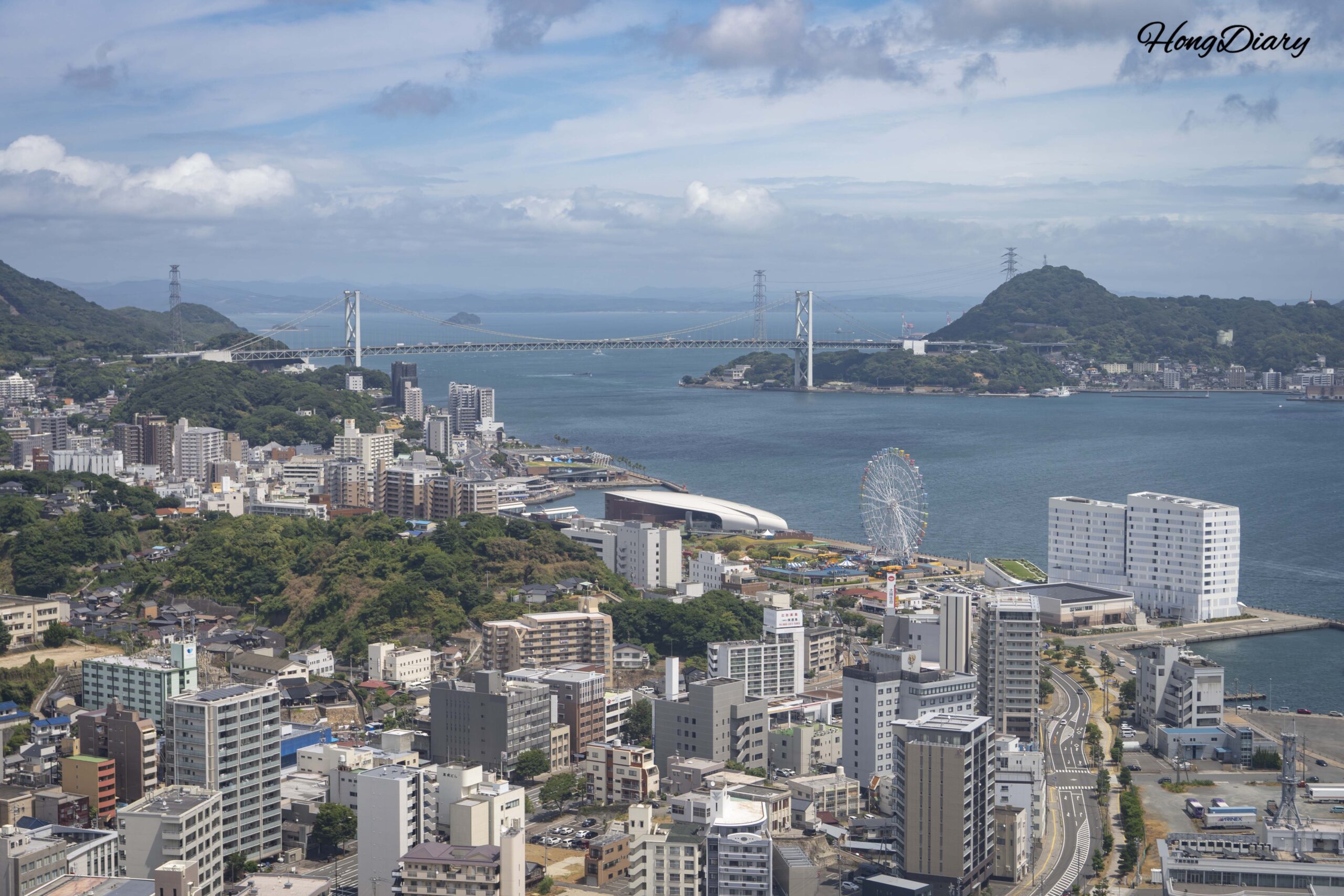
I wasn’t planning to visit Kaikyo Yume Tower (海峡ゆめタワー) that afternoon. After a morning at Karato Market — Shimonoseki’s famous seafood market where you can build your own sushi tray on weekends, I took the 25-minute bus ride back to Shimonoseki Station (下関駅), grabbed a coffee, and started thinking about where to go next. I wanted somewhere quiet — and then I noticed the tower through the cafe window, its rounded glass top catching the afternoon light.
Shimonoseki sits at the western tip of Honshu, Japan’s main island, facing Kyushu across the narrow Kanmon Strait (関門海峡). The two islands are connected by the Kanmon Bridge (関門橋) overhead and a pedestrian tunnel below, making this port city a natural crossing point between Japan’s two largest landmasses.
Table of Contents
Kaikyo Yume Tower: Essential Visitor Information, Hours, and Admission Fees
| Detail | Information |
|---|---|
| Name | Kaikyo Yume Tower (海峡ゆめタワー) |
| Address | 3-3-1 Buzendacho, Shimonoseki, Yamaguchi 750-0018, Japan (〒750-0018 山口県下関市豊前田町3丁目3-1) |
| Hours | 9:30 AM – 9:30 PM (last entry at 9:00 PM) |
| Closed | 4th Saturday of January |
| Admission | Adults: ¥750 (~$4.75 / €4.24) · High schoolers & seniors 65+: ¥380 (~$2.41 / €2.15) · Children (middle school & under): ¥350 (~$2.22 / €1.98) |
| Parking | 2-hour complimentary parking voucher for tower visitors |
| Official Website | yumetower.jp |
Prices converted at approximately $1 USD ≈ ¥158 / €1 EUR ≈ ¥177 (as of October 2026). Rates may fluctuate.
How to Get to Kaikyo Yume Tower
From Shimonoseki Station’s east exit, the walk takes about 10 minutes — roughly 600 meters along a flat, straightforward route. You’ll pass through the port-side residential streets and Kaikyo Yume Plaza (海峡ゆめ広場), a small open square that serves as a rest area for locals, before reaching the tower complex.
If you’re arriving on the overnight Kampu Ferry from Busan, South Korea, Shimonoseki Port International Terminal (下関港国際ターミナル) is within easy walking distance of the station — making the tower one of the most effortless first stops you can make after stepping off the boat.
I’d recommend walking rather than taking a bus or taxi. The streets around the station have a particular stillness — quieter than the busy market area near Karato, more residential, with the unhurried pace of a mid-sized Japanese port town. It sets the mood for what you’re about to see upstairs.
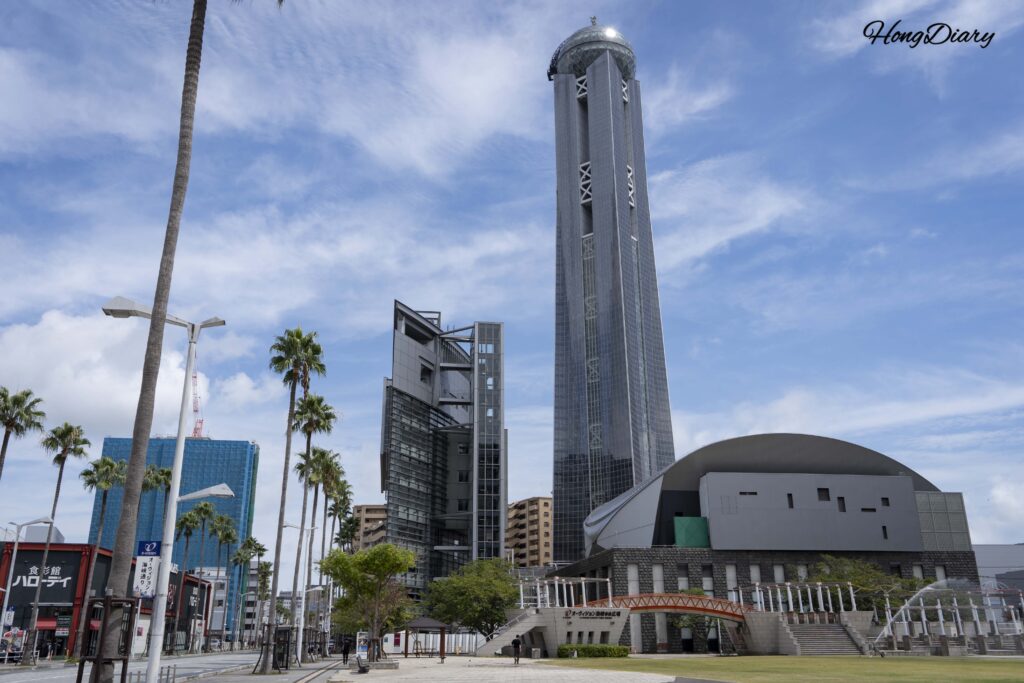
Once you reach the base, getting to the entrance is a little less obvious than you might expect. You have two options:
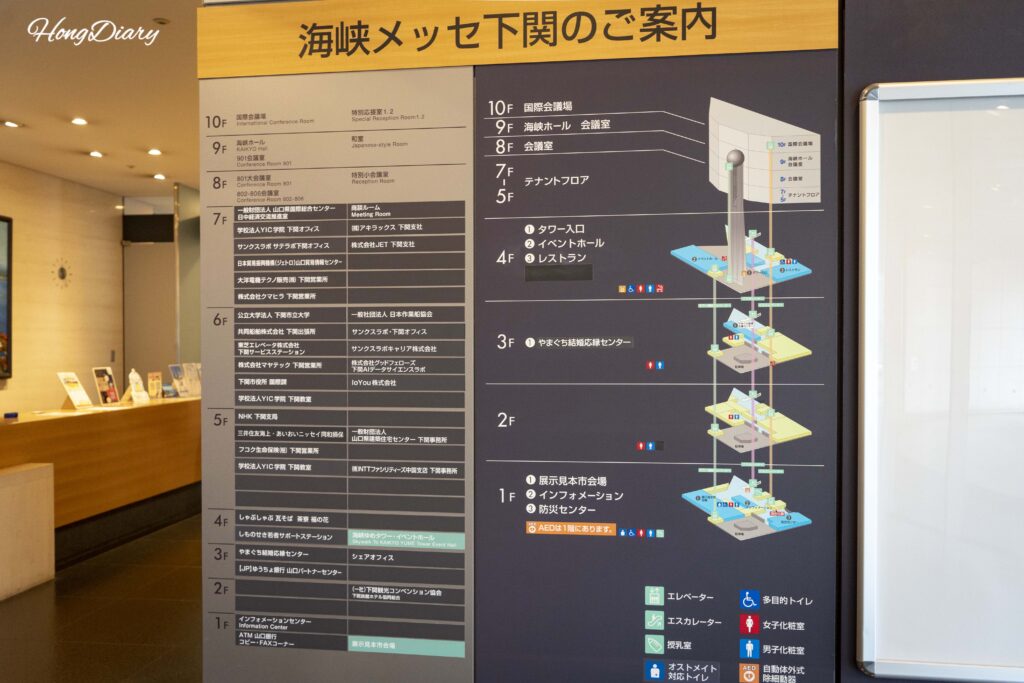
Option A — Through the International Trade Building: Enter the building adjacent to the tower, take the elevator or escalator to the 4th floor, walk through a corridor past conference rooms and a restaurant, then exit through a glass door to reach the tower entrance outdoors.
Option B — Outdoor stairs: Climb the staircase on the station-facing side of the building directly up to the 4th-floor entrance level.
Either way, the actual tower entrance is on the 4th floor, outdoors and separate from the main building.
Tickets and Discounts: How to Save on Admission
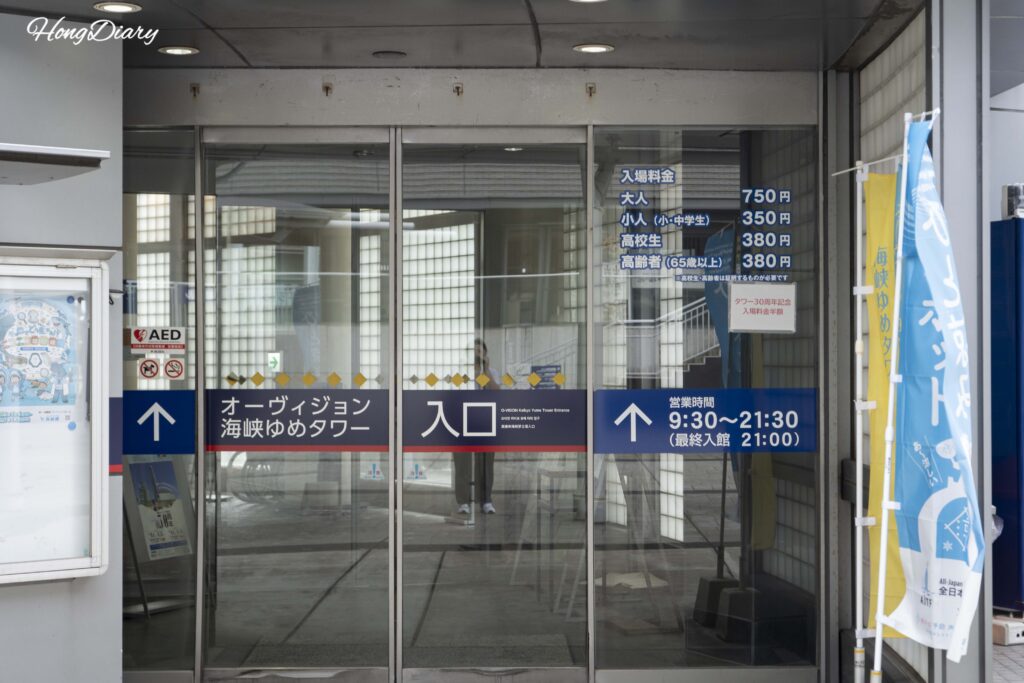
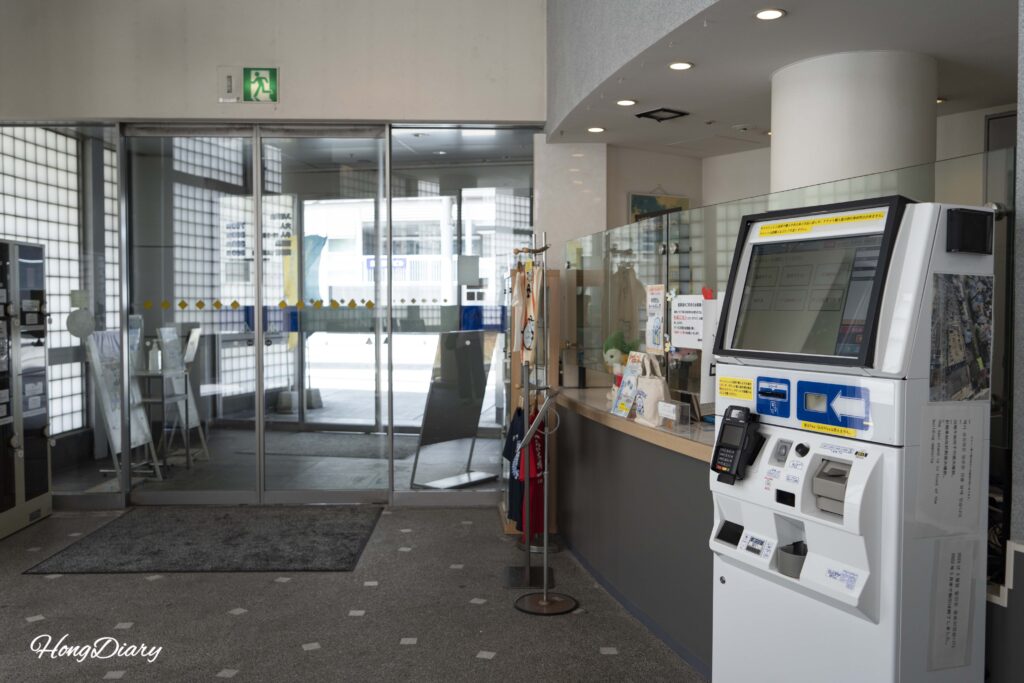
At the 4th-floor entrance, you’ll find a ticket vending machine and a staff member who can walk you through the process. The machines now accept credit cards — a relatively recent change, as they used to be cash-only.
A note for international visitors: Kaikyo Yume Tower previously offered a 20–50% passport discount for foreign tourists. This discount has been discontinued. Several older reviews online still mention paying ¥300 instead of ¥750, but that pricing is no longer available as of 2026.
That said, there are still several ways to pay less than the full price:
Discount Options at a Glance
| Method | Adult | Child | How |
|---|---|---|---|
| Regular price | ¥750 (~$4.75 / €4.24) | ¥350 (~$2.22 / €1.98) | Buy at the entrance |
| Website coupon (10% off) | ¥680 (~$4.30 / €3.84) | ¥320 (~$2.03 / €1.81) | Show the coupon from yumetower.jp at the counter |
| Convenience store (JTB ticket) | ¥600 (~$3.80 / €3.39) | ¥280 (~$1.77 / €1.58) | Purchase at a kiosk machine inside 7-Eleven, Lawson, FamilyMart, or Ministop — product code: 0267692 |
| Friday Couples Day (20% off) | ¥600 (~$3.80 / €3.39) per person | N/A (ages 18–64 only) | Visit on any Friday as a pair and say the secret phrase (see below) to the staff at the 4th-floor counter |
About the Friday Couples Day discount: To receive the 20% discount, both visitors need to tell the staff at the counter the tower’s secret phrase — “Dreams come true, love comes true, Kaikyo Yume Tower.” You can say it in English; the phrase is listed on the tower’s official English page. If you’d rather show it on your phone, the Japanese version is 夢かなう 恋かなう 海峡ゆめタワー. A few things to keep in mind: the staff will not ask you to say it — you need to initiate it yourself. Some Fridays are excluded from the promotion, this discount cannot be combined with other offers, and no refunds or retroactive discounts are available after entry. Check the official website before your visit to confirm.
Buying tickets at a Japanese convenience store is something worth knowing about in general, not just for this tower. Most major convenience store chains in Japan have a self-service kiosk machine — usually located near the photocopier — where you can purchase tickets for attractions, concerts, and events at discounted prices. These machines typically support English. Enter the product code, print a receipt slip, take it to the register within 30 minutes, pay, and you’ll receive a physical ticket. If you can’t find the kiosk, ask the clerk for the “JTB ticket machine” and they’ll point you in the right direction.
Combo Tickets Worth Considering
If you’re planning to visit Kaikyokan Aquarium (海響館), which sits along the waterfront near Karato Market, the combo ticket sold at the tower’s 4th-floor counter is the most cost-effective option:
| Combo | Adult | Child | Savings vs. Separate |
|---|---|---|---|
| Tower + Kaikyokan | ¥2,800 (~$17.72 / €15.82) | ¥1,200 (~$7.59 / €6.78) | Save ¥550 (~$3.48 / €3.11) for adults, ¥450 (~$2.85 / €2.54) for children |
The combo also includes a ¥100 (~$0.63 / €0.56) coupon for Kamon Wharf (カモンワーフ), a small waterfront dining and shopping complex next to the aquarium. These combo tickets are cash-only at the tower counter.
I visited with my husband and our child — two adults and one child — and paid ¥1,500 (~$9.49 / €8.47) at full price (preschool-age children enter free). We ended up visiting Kaikyokan two days later and paid full price there too, which meant we missed out on roughly ¥1,100 (~$6.96 / €6.21) in savings. So if both spots are on your itinerary, grab the combo upfront.
Pricing for combo tickets and special events can change, so it’s worth checking the official website before you go.
The Observation Deck: Floor by Floor
30F — The Main Panorama
The glass elevator reaches the 30th floor in about 70 seconds — there’s no attendant, just press the button yourself. When the doors opened, the observation deck was completely empty. For the entire time we were up there, our family was the only group on the floor.
The deck is enclosed in a spherical glass shell made up of 8,700 individual panels — a structure that allows an uninterrupted 360-degree view with no blind spots. Directional markers on the floor show north, south, east, and west, with labeled maps identifying landmarks visible in each direction. A few plastic chairs are positioned by the windows on each side, and free Wi-Fi is available (the SSID and password are posted on a wall sign).
Here’s what you can see from each direction:
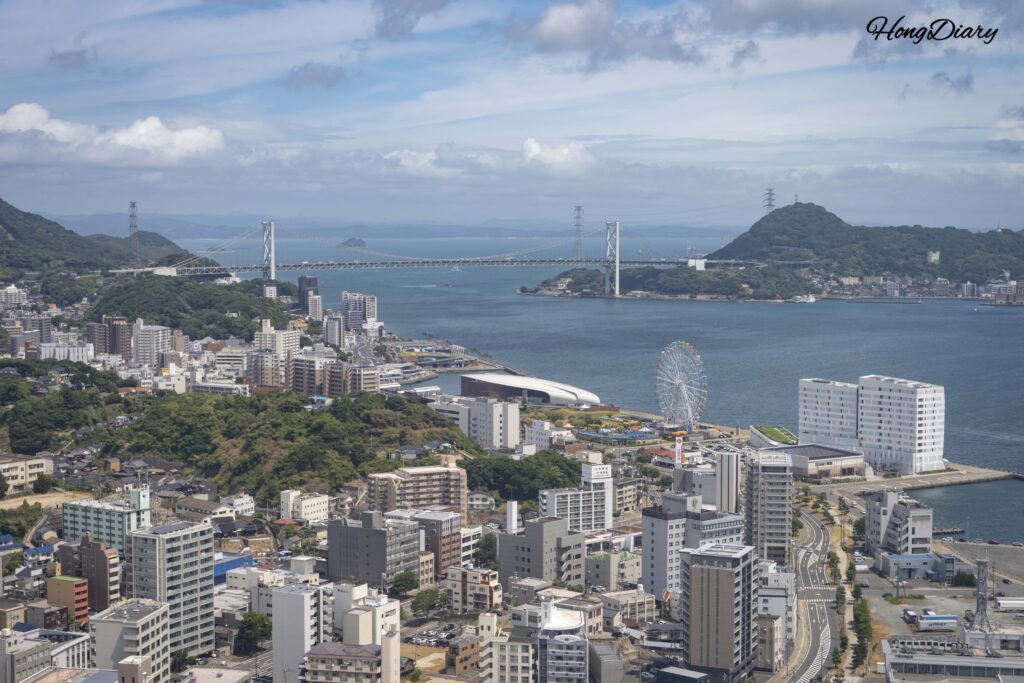
East (the popular side): This is the direction most visitors and guidebooks recommend, and for good reason. You can see Kanmon Bridge (関門橋) stretching across the strait, Karato Market (唐戸市場) along the waterfront, Kaikyokan Aquarium (海響館), and across the water, the Mojiko Retro (門司港レトロ) district on the Kyushu side. If you’re only taking one photo, make it from this angle.
South: Open ocean beyond the strait, with the coastline of Kitakyushu’s Moji district visible in the distance.
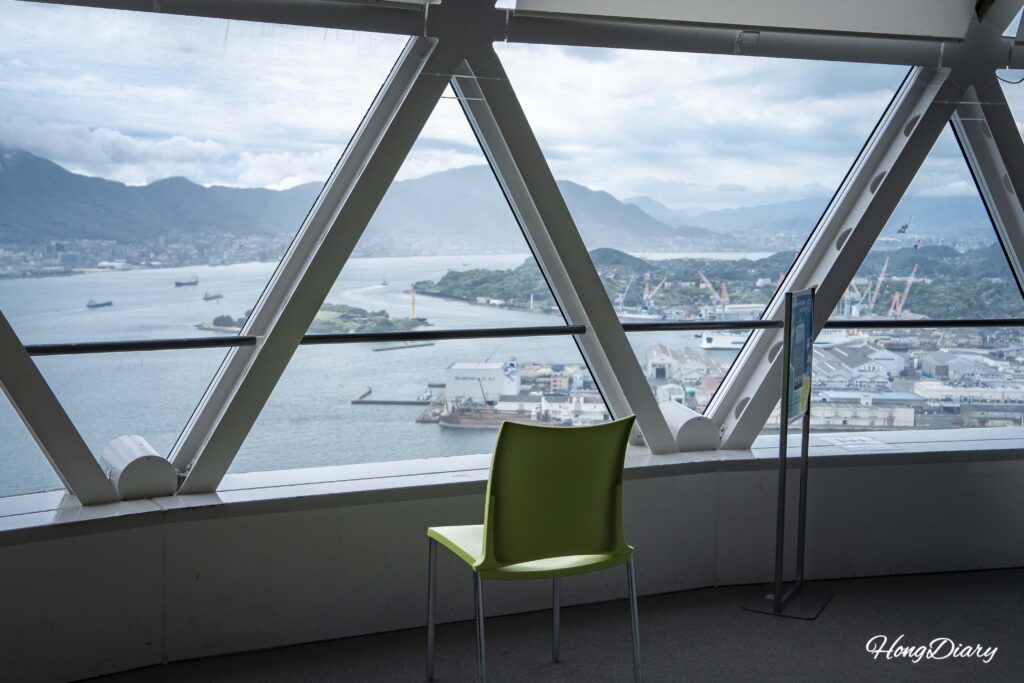
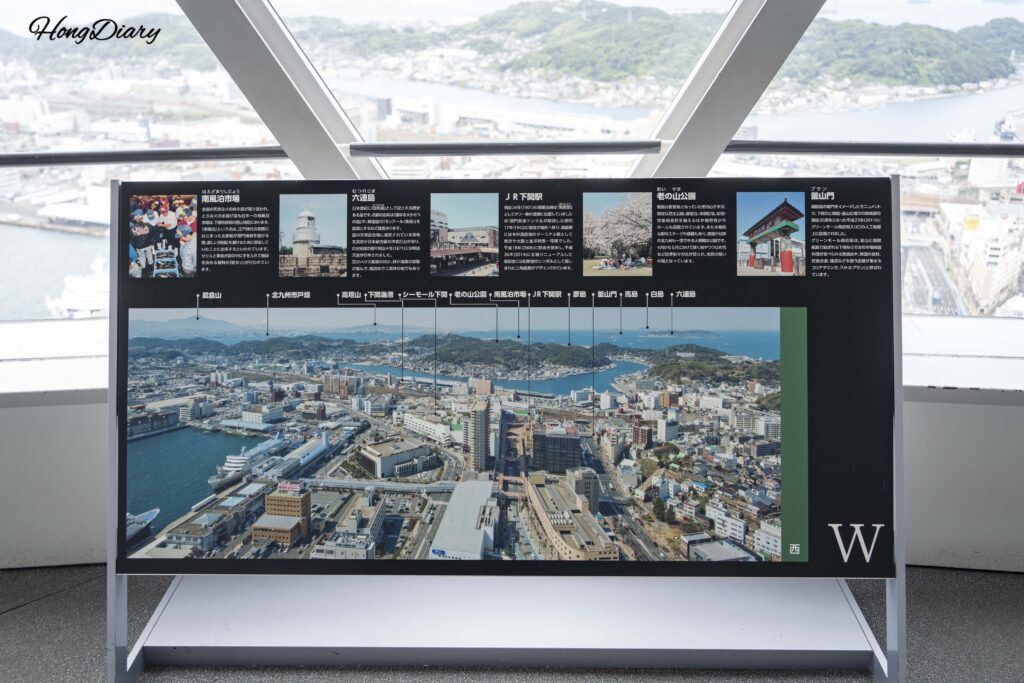
West (my personal pick): This side doesn’t get much attention, but I found it the most absorbing. You can see Shimonoseki Station and the rail yard below, where red and yellow local trains arrive and depart. Beyond the tracks sits Shimonoseki Port International Terminal (下関港国際ターミナル), and on the day I visited, the Kampu Ferry that runs to Busan was docked there, motionless on the water. The afternoon sun reflected off the sea, and the whole scene — the trains, the ferry, the quiet harbor — had a meditative quality to it. Not dramatic, not designed for social media, but the kind of view that makes you put your phone down and just sit.
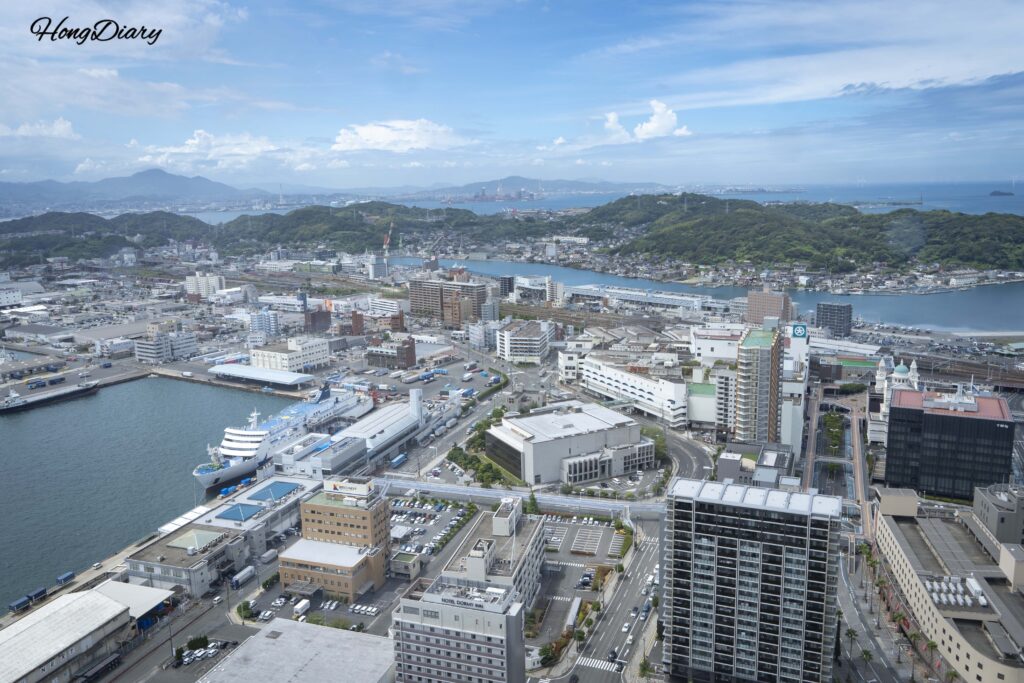
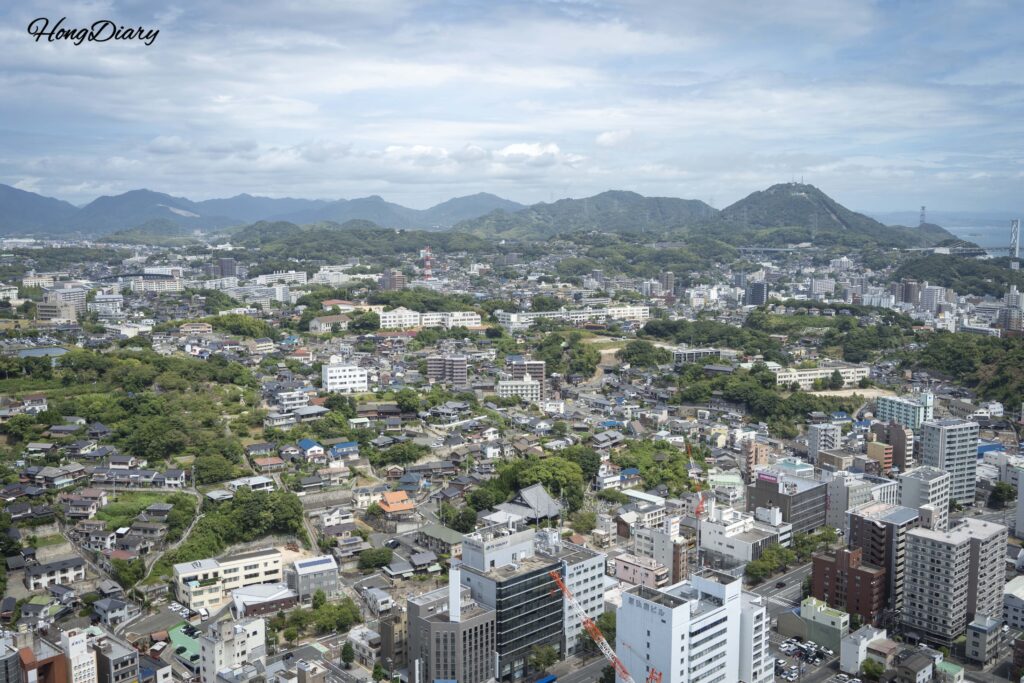
North: The residential and commercial streets of Shimonoseki’s city center spread out below — compact, low-rise, and unhurried.
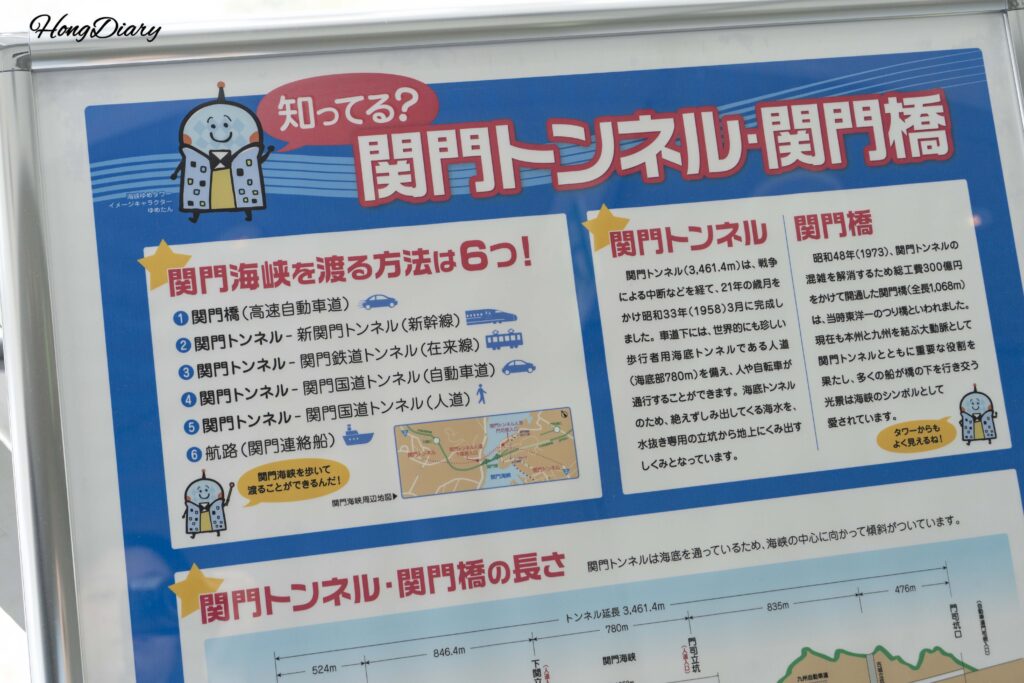
The observation deck also has informational panels explaining the Kanmon Bridge (関門橋) and the Kanmon Pedestrian Tunnel that connect Honshu and Kyushu — the signage is in Japanese only, but the diagrams and maps are easy to follow visually.
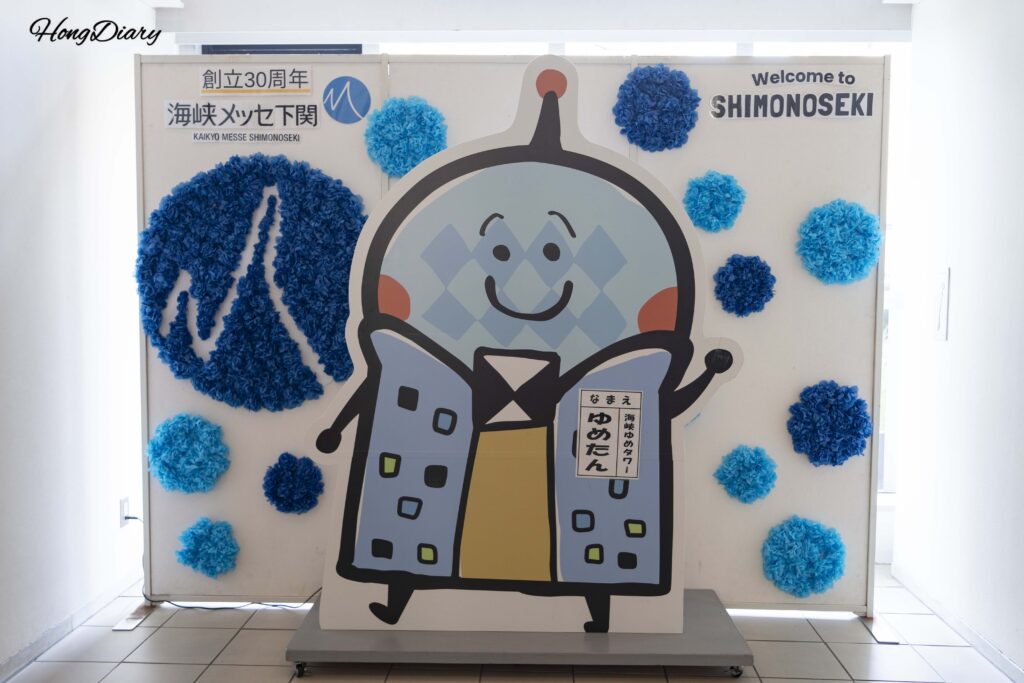
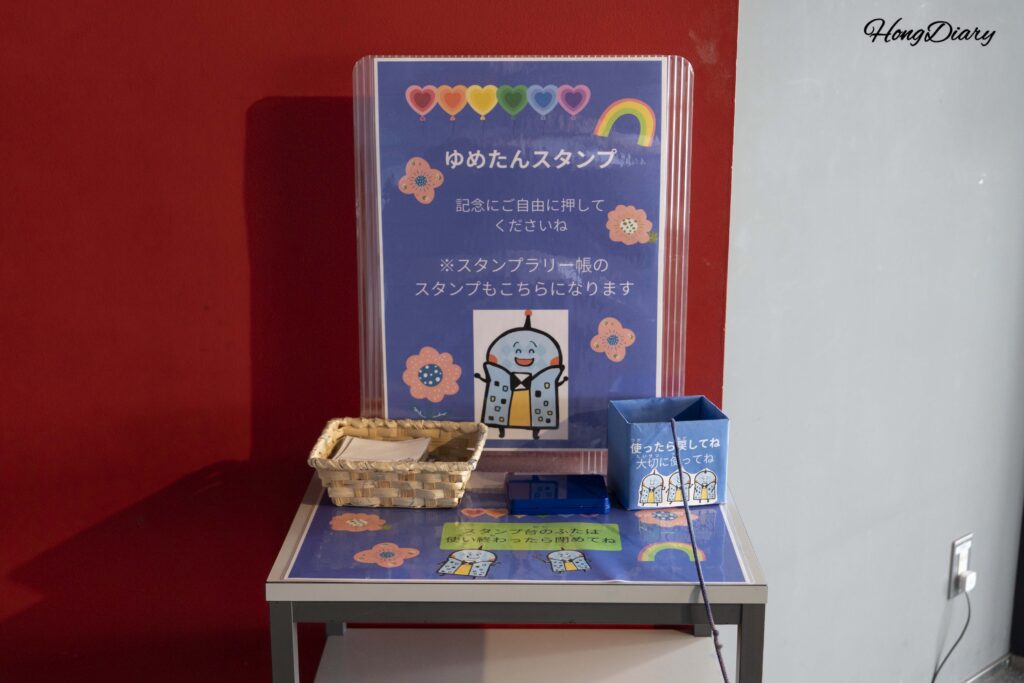
There’s a stamp corner near the windows where you can press a Yume-tan-themed stamp — a free souvenir if you’re carrying a travel notebook, and a common feature at Japanese tourist attractions.
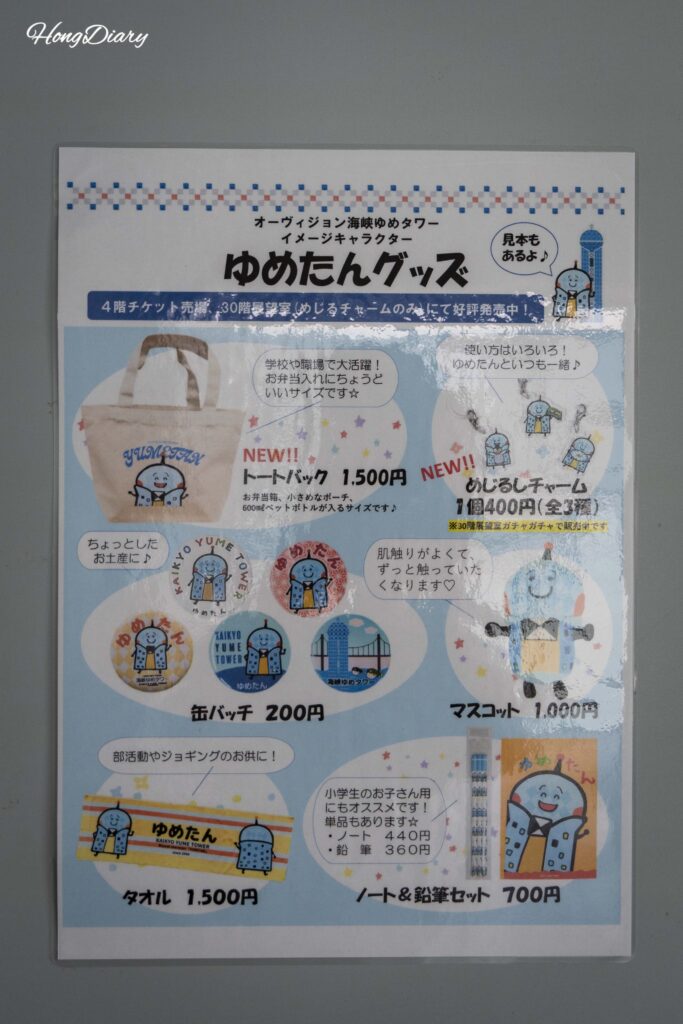
A panel on the wall lists the available Yume-tan merchandise with prices: eco bags for ¥1,500 ($9.49 / €8.47), plush toys for ¥1,000 ($6.33 / €5.65), character pens for ¥700 ($4.43 / €3.95), keychains for ¥400 ($2.53 / €2.26), and a couple of other items.
There’s also a gacha machine in the corner of the observation deck — one of those Japanese capsule-toy vending machines where you insert a coin, turn a crank, and receive a random small toy in a plastic capsule. My child insisted on trying it for ¥500 (~$3.16 / €2.82), won a small plush figure of Yume-tan (ゆめたん), the tower’s mascot character, and then lost it on the walk back to the hotel. There were tears.
29F — The Rest Lounge
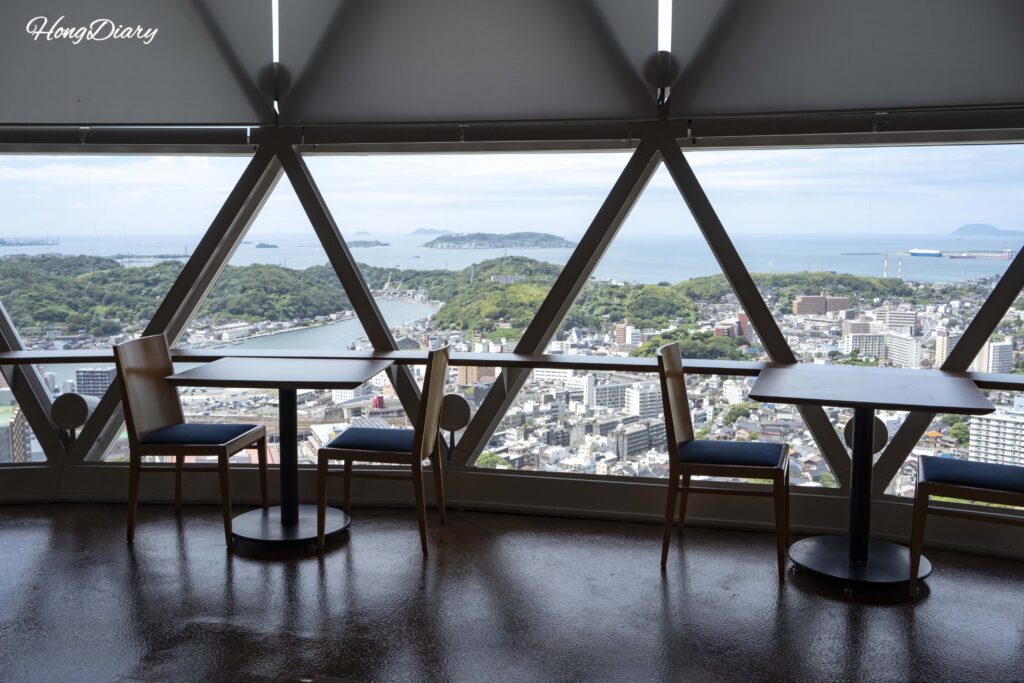
One floor down is a space that quietly sets Kaikyo Yume Tower apart from most observation decks in Japan: a rest area where you’re allowed to bring in outside food.
At most Japanese observation towers, outside food and drinks are either banned entirely or restricted to beverages purchased on-site. Here, the 29th floor has wooden tables and chairs — noticeably more comfortable than the plastic ones upstairs — and you’re welcome to eat sandwiches, onigiri (Japanese rice balls), or anything you’ve picked up on the way. The only rules are no alcohol, clean up after yourself, and take your trash with you. The lounge is open from 9:30 AM to 5:00 PM.
There’s also a vending machine with canned coffee, tea, and soft drinks if you didn’t bring anything.
A tip: The Hallo Day food market, located at the base of the tower complex, is a good place to grab drinks and light meals before heading up. Picking up a sandwich and a can of coffee, then sitting by the 29th-floor window with a view of Shimonoseki’s rooftops — that’s a version of this city you won’t get anywhere else.
The 30th-floor chairs are functional but stiff; if you want to spend more than a few minutes sitting and looking, the 29th floor is the better spot.
28F — The Love Shrine
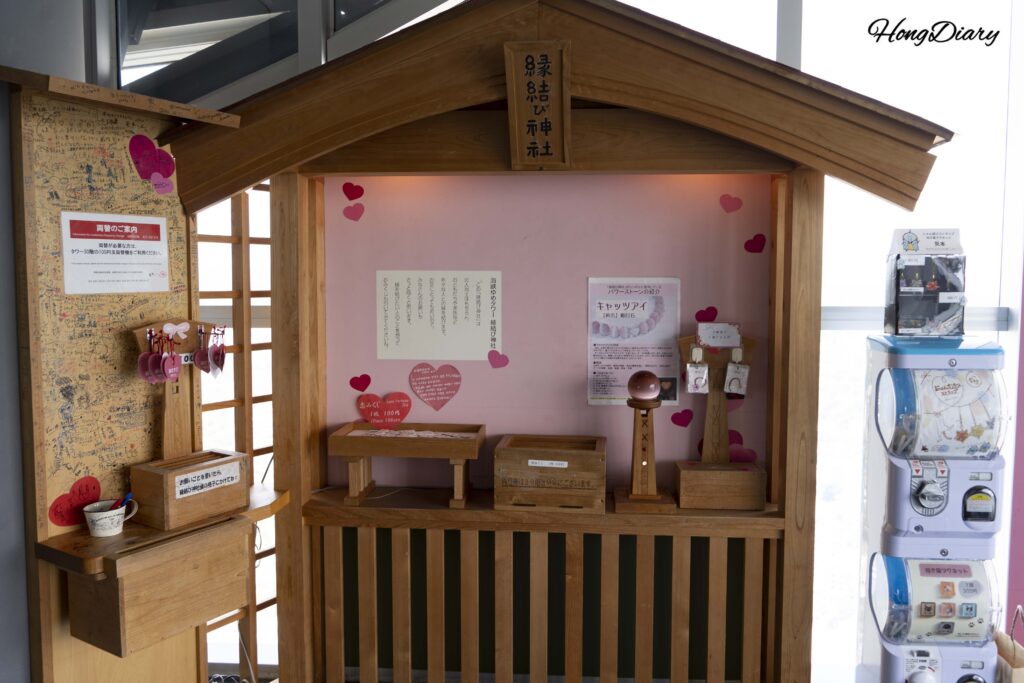
The 28th floor is themed around romance. Kaikyo Yume Tower holds an official designation as a “Lover’s Sanctuary” (恋人の聖地), a title given to select romantic spots across Japan, and this floor leans into that identity fully.
The centerpiece is a small Enmusubi Shrine (縁結び神社) — a setup modeled after a traditional Japanese Shinto shrine, but dedicated specifically to romantic wishes rather than general prayers. Visitors can purchase small wooden plaques or paper slips for ¥100–¥300 (~$0.63–$1.90 / €0.56–€1.69), write their hopes for love or relationships, and hang them on a display rack. The wall behind the shrine was already covered with messages in Japanese, Korean, Chinese, and English.
Nearby, you’ll find love locks — padlocks inscribed with couples’ names and fastened to a railing, a custom popular across many countries — and a cushioned two-seat sofa by the window. The sofa is more comfortable than any seat on the upper floors, but the glass on this level catches more glare, so the view isn’t quite as clear. If panoramic views are your priority, head back up to 30F.
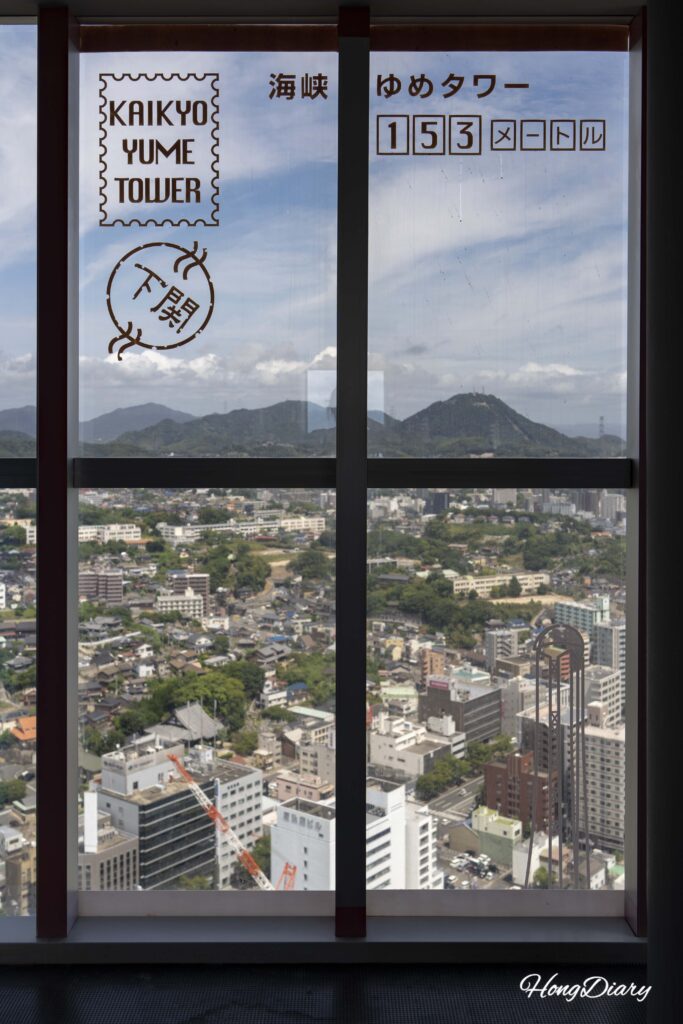
On one of the 28th-floor windows, the glass is printed with the tower’s name and postal code in semi-translucent lettering. The view outside blurs behind the text, creating an unexpectedly photogenic image — the kind of shot you don’t plan but end up liking the most.
Day or Night? When to Visit Kaikyo Yume Tower
Most observation deck guides in Japan recommend visiting at dusk for the transition from day to night. Kaikyo Yume Tower is one of the rare cases where I’d suggest the opposite — come during the day.
The daytime view is what makes this tower special. Watching container ships and ferries move through the Kanmon Strait, seeing the geography of two major islands separated by a thin channel of water, catching the light shift across the rooftops of a port town that moves at its own pace — none of this translates well after dark, when everything flattens into scattered points of light.
At night, I’d recommend staying outside. The tower’s exterior lighting puts on a quietly impressive display that changes based on the day of the week and the season:
Daily Light-Up Schedule (7:00 PM – 9:30 PM; from 7:30 PM in May–August):
| Day | Upper Tower Color |
|---|---|
| Monday | White |
| Tuesday | Green |
| Wednesday | Blue |
| Thursday | Yellow |
| Friday | Red and Blue |
| Saturday | Blue and Green |
| Sunday | Red |
Seasonal Tones: October through March features warm-toned lighting across the lower structure, while April through September shifts to cool tones.
The tower also lights up in special colors for designated awareness events throughout the year — blue for World Autism Awareness Day, orange for World Alzheimer’s Day, purple for the campaign to end violence against women, red and green for Christmas, and others. You can check the full schedule on the official website.
The best vantage points for seeing the tower lit up are from around Shimonoseki Station or from the waterfront near the ferry terminal.
30th Anniversary Events (November 2026)
Kaikyo Yume Tower opened in July 1996, and 2026 marks its 30th anniversary. A second wave of special events is scheduled for November:
| Event | Date | Time | Location | Cost |
|---|---|---|---|---|
| Free admission for families with children | Nov 1–30 | During regular hours | Tower entrance | Free (for groups entering with at least one child under 18) |
| Stair Climb Challenge — walk up 650 emergency stairs to the top | Nov 8 (Sun) | 10:00 AM – 3:00 PM (registration from 9:30 AM) | Indoor emergency staircase | Free (regular admission still applies) |
| Mini Festival & Yume-tan Photo Session — carnival-style games and a meet-and-greet with the tower’s mascot character | Nov 15 (Sun) | Festival: 10:30 AM – 5:00 PM / Photo: 2:00–2:30 PM & 3:00–3:30 PM | 28F / 30F | Games: paid / Photo: free |
| N-Gauge Train Exhibition — model trains based on rolling stock from the Shimonoseki area | Nov 23 (Mon, holiday) | 9:30 AM – 6:00 PM | 28F | Free |
| Yamaguchi Flower Photo Spot — a seasonal floral display using flowers from Yamaguchi Prefecture | Nov 20–24 | During regular hours | 28F | Free |
The free family admission during November is particularly worth noting — if you’re visiting Shimonoseki with kids during that period, this is one of the rare times the whole family can go up for free.
The Tower’s Story
The name Kaikyo Yume Tower translates to “Strait Dream Tower” — kaikyo (海峡) meaning “strait” and yume (夢) meaning “dream.” Its design is modeled after a lighthouse, a nod to Shimonoseki’s long history as a port city. The rounded glass sphere at the top — the observation deck — is meant to resemble a lighthouse lamp.
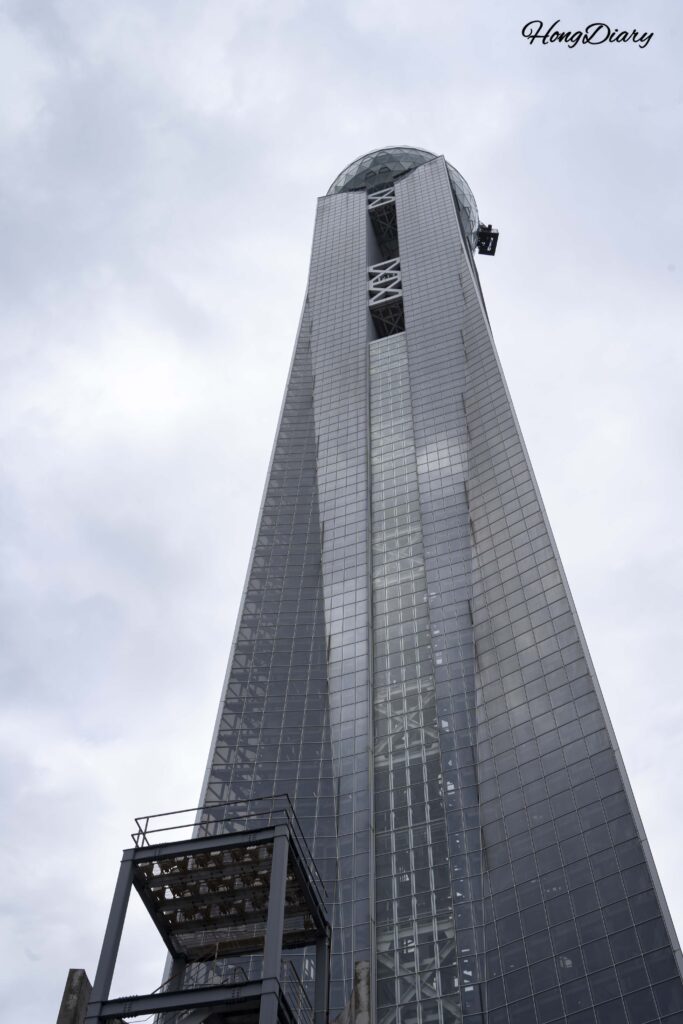
Shimonoseki built this tower in 1996 as part of a larger convention and trade complex, positioning the port area as a hub for international exchange. Three decades later, it remains the city’s most recognizable landmark, standing 153 meters tall and visible from almost anywhere downtown. The observation deck, on the afternoon I visited, belonged entirely to us.
That emptiness is part of what I appreciated most. I’ve been to the Busan LCT Tower, the Harukas 300 in Osaka, and several other observation decks with far bigger city views. Kaikyo Yume Tower doesn’t try to compete with any of them. What it offers instead is stillness — a place where you can sit with a can of coffee on the 29th floor, watch trains come and go below, and think your own thoughts without being shuffled along by the next wave of visitors.
Shimonoseki isn’t the kind of city that ends up on most international itineraries. It’s quieter than Fukuoka, less polished than Hiroshima, and easy to pass through on your way somewhere else. But there’s a version of Japan here that the bigger cities can’t offer — slower, unhurried, with a rhythm that rewards patience rather than planning. Kaikyo Yume Tower, more than anything else I visited here, captures that feeling.
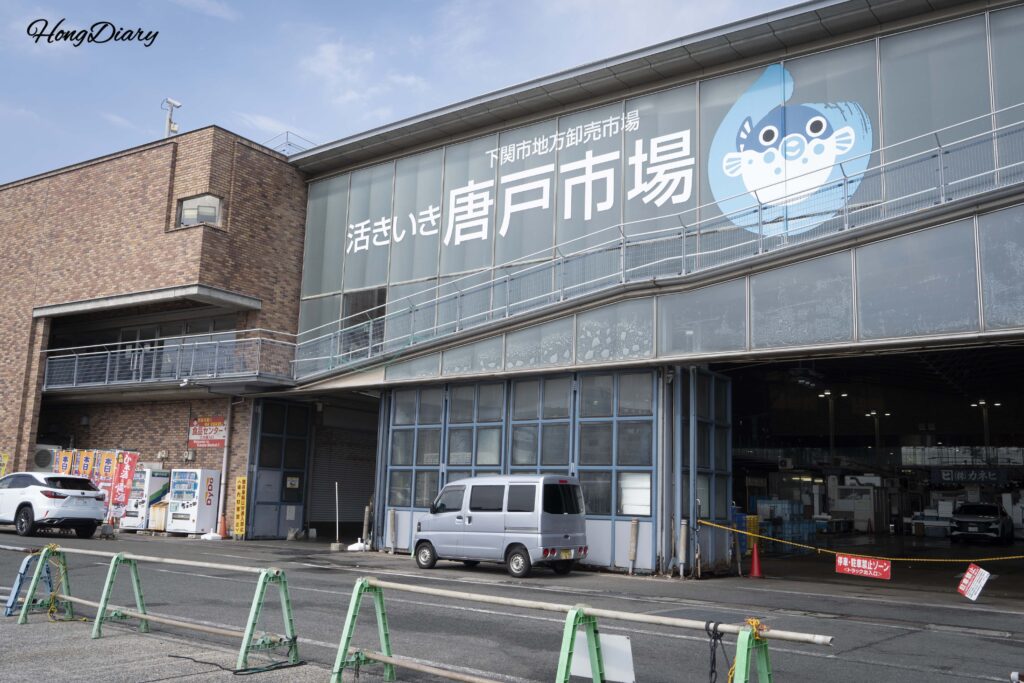
If you’re spending a few days exploring the area, pairing the tower with a morning at Karato Market, where weekend sushi stalls line the waterfront and you can eat fresh nigiri overlooking the strait, makes for a day that covers both sides of what this city does best: the food and the views.
Kaikyo Yume Tower: Frequently Asked Questions (FAQ)
How much does it cost to enter Kaikyo Yume Tower?
Regular admission is ¥750 ($4.75 / €4.24) for adults, ¥380 ($2.41 / €2.15) for high school students and seniors aged 65 and over, and ¥350 ($2.22 / €1.98) for children in middle school and under. The foreign tourist passport discount (previously 20–50% off) has been discontinued as of 2026. You can still save by using the 10% website coupon from yumetower.jp, or by purchasing JTB tickets at convenience stores like 7-Eleven (product code: 0267692) for ¥600 ($3.80 / €3.39) for adults and ¥280 (~$1.77 / €1.58) for children.
How do I get to Kaikyo Yume Tower from Shimonoseki Station?
The tower is approximately 600 meters from Shimonoseki Station’s east exit — about a 10-minute walk along a flat route. You’ll pass through port-side residential streets and Kaikyo Yume Plaza before reaching the tower complex. The entrance to the observation deck is on the 4th floor: you can either go through the adjacent International Trade Building and take the elevator up, or use the outdoor staircase on the station-facing side. If you’re arriving on the overnight Kampu Ferry from Busan, the port terminal is within easy walking distance of the station.
Is Kaikyo Yume Tower better to visit during the day or at night?
Daytime is recommended. The view that makes this tower distinctive — two of Japan’s main islands separated by the Kanmon Strait, with ships, bridges, and train lines all visible at once — is best appreciated in natural light. At night, the tower’s exterior light-up is the real attraction. The illumination runs from 7:00 PM to 9:30 PM (from 7:30 PM between May and August) and changes color each day of the week: white on Monday, green on Tuesday, blue on Wednesday, yellow on Thursday, red and blue on Friday, blue and green on Saturday, and red on Sunday. The best spots to see the light-up are from around Shimonoseki Station or the waterfront near the ferry terminal.
Can I bring food and drinks into the Kaikyo Yume Tower observation deck?
Yes. The 29th floor has a dedicated rest lounge (open 9:30 AM – 5:00 PM) with wooden tables and chairs where visitors are welcome to eat sandwiches, onigiri (Japanese rice balls), or other outside food. Alcohol is not permitted, and you must take your trash with you. A vending machine with canned coffee and soft drinks is also available on that floor. The Hallo Day food market at the base of the tower complex is a convenient place to pick up snacks and drinks before heading up.
Is there a discount for couples visiting Kaikyo Yume Tower on Fridays?
Yes. Every Friday is “Couples Day” at the tower. Pairs of visitors aged 18 to 64 can receive a 20% discount (reducing the adult price from ¥750 to ¥600, or ~$3.80 / €3.39 per person). To get the discount, tell the staff at the 4th-floor counter the tower’s secret phrase: “Dreams come true, love comes true, Kaikyo Yume Tower.” You can say it in English — the phrase is listed on the tower’s official English page. If you prefer, you can also show the Japanese version (夢かなう 恋かなう 海峡ゆめタワー) on your phone. The staff will not ask you to say it — you need to initiate it yourself. Some Fridays may be excluded, this discount cannot be combined with other offers, and no refunds or retroactive discounts are given after entry.
What can you see from the top of Kaikyo Yume Tower?
The 30th-floor observation deck offers a full 360-degree panorama through a spherical glass shell made of 8,700 panels. To the east, you can see Kanmon Bridge, Karato Market, Kaikyokan Aquarium, and the Mojiko Retro district on the Kyushu side — this is the most photographed direction. To the south lies open ocean. The west side faces Shimonoseki Station, the rail yard, and the ferry terminal where the Busan-bound Kampu Ferry docks. The north overlooks the city center. Directional maps on each side of the deck identify the landmarks visible in each direction.
Is the Kaikyo Yume Tower and Kaikyokan Aquarium combo ticket worth it?
If both are on your itinerary, yes. The combo costs ¥2,800 ($17.72 / €15.82) for adults and ¥1,200 ($7.59 / €6.78) for children — saving ¥550 ($3.48 / €3.11) per adult and ¥450 ($2.85 / €2.54) per child compared to buying separately. It also includes a ¥100 (~$0.63 / €0.56) coupon for Kamon Wharf, the nearby waterfront dining area. This combo is only available at the tower’s 4th-floor counter and is cash-only.