
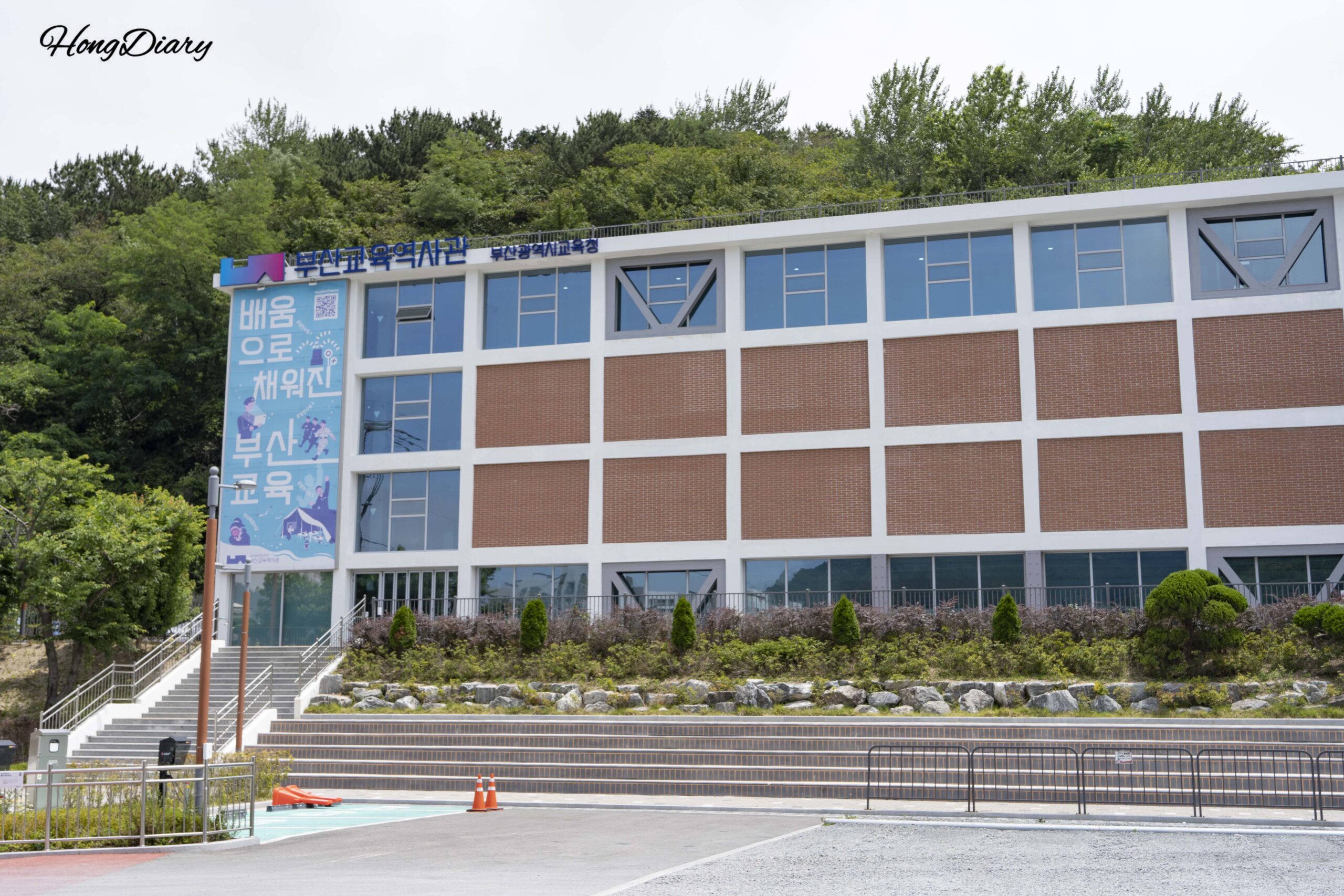
If you’ve visited Gamcheon Culture Village, you know the scene: steep hills, summer heat, and crowds everywhere by mid-morning. What most people don’t realize is that right above the village parking lot, there’s a free museum called the Busan Education History Museum that nearly everyone walks straight past. I almost did the same — but I’m glad I didn’t.
Table of Contents
Basic Information: Address, Hours, Parking, Admission, and How to Get to Busan Education History Museum
| Detail | Info |
|---|---|
| Name | Busan Education History Museum |
| Address | 130 Okcheon-ro, Saha-gu, Busan |
| Hours | 9:00 AM – 5:00 PM (lunch break 12:00–1:00 PM / last entry at 4:00 PM) |
| Closed | Mondays and public holidays (open on Sundays) |
| Admission | Free |
| Parking | On-site, ₩100 per 10 min / daily cap ₩2,400 (~$1.71 / €1.52) |
| Website | Busan Education History Museum (behm.pen.go.kr) |
| Getting there | Subway Line 1 → Goejeong Station Exit 6 → Maeul Bus (neighborhood mini bus) Saha 1 or Saha 1-1 → get off at Gamjeong Elementary stop → 5-min walk |
| Alternate route | Subway Line 1 → Toseong Station Exit 6 → Maeul Bus Saha 1-1, Seo-gu 2, or Seo-gu 2-2 → same stop |
| Time needed | About 1 to 1.5 hours |
Prices converted at approximately $1 USD ≈ ₩1,400 / €1 EUR ≈ ₩1,575 (as of September 2026). Rates may fluctuate.
How a Closed Elementary School Became a Museum
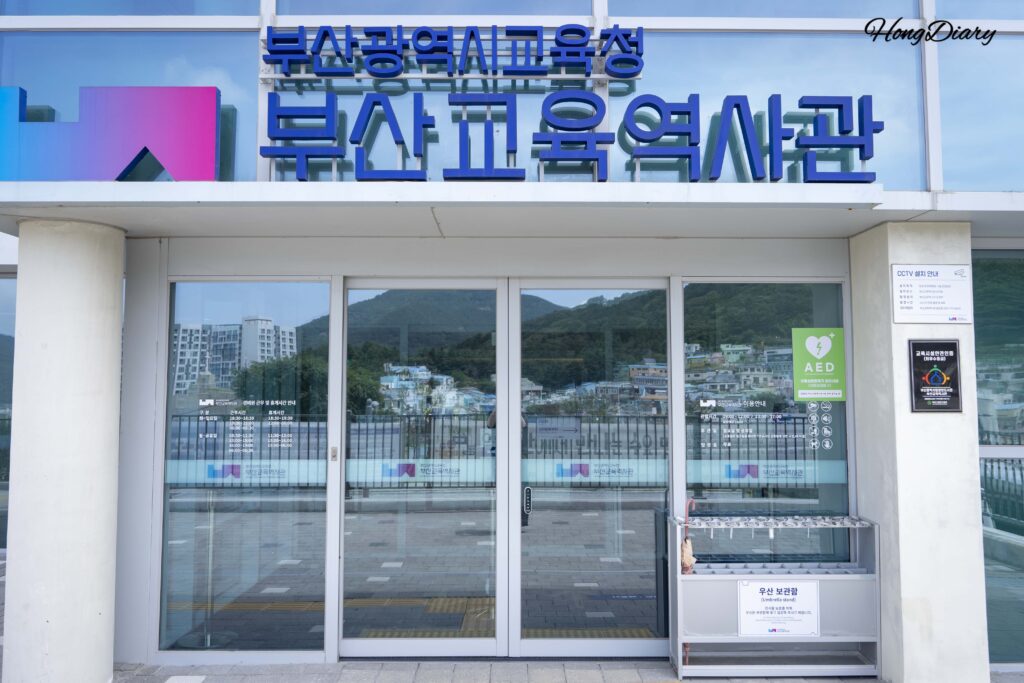
The building sits at 130 Okcheon-ro in Saha-gu, directly above Gamcheon Culture Village’s main parking lot — a five-minute walk at most. It used to be Gamjeong Elementary School, which served this hillside neighborhood for decades before closing in 2019. Busan’s education authority remodeled the empty classrooms, hallways, and playground into a full-scale museum, opening it in March 2024. It now operates as a branch of the Busan Metropolitan Central Library, which explains why everything feels well kept and properly managed.
Saha-gu sits on the southwestern slopes of Busan, an area deeply shaped by the Korean War. Many of the hillside villages here, including Gamcheon itself, were originally formed by refugees who settled on these steep ridges during the early 1950s. That wartime history isn’t just background context — it’s central to what you’ll see on the museum’s third floor.
What to Expect Inside: A Floor-by-Floor Walkthrough
The exhibitions start on the second floor and continue up to the fourth. Staff members are stationed at each level to point you in the right direction, and the flow between floors feels natural — follow the path and you won’t miss anything.
2F — Permanent Exhibition 1: From Joseon-Era Classrooms to Colonial Resistance
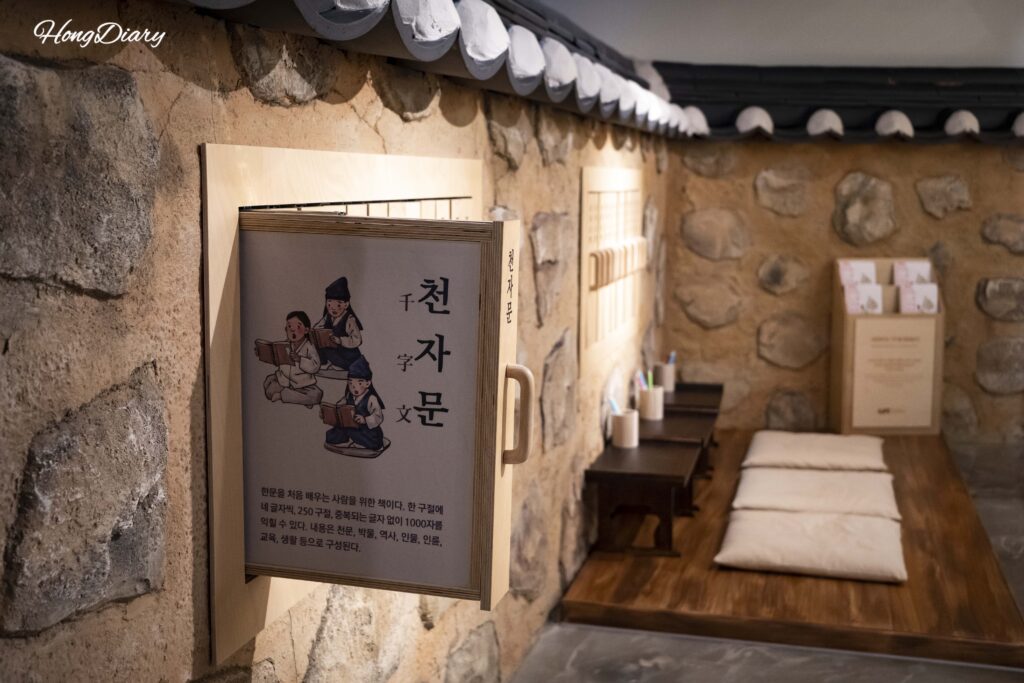
The first gallery takes you back to the Joseon Dynasty (1392–1897), when education happened in small private village schools called seodang — essentially one-room schoolhouses run by local scholars. You’ll see reproductions of Cheonjamun, the “Thousand Character Classic” that students once memorized as their first textbook, alongside actual school supplies and learning materials from that era. The contrast with how students learn today makes for a striking opening.
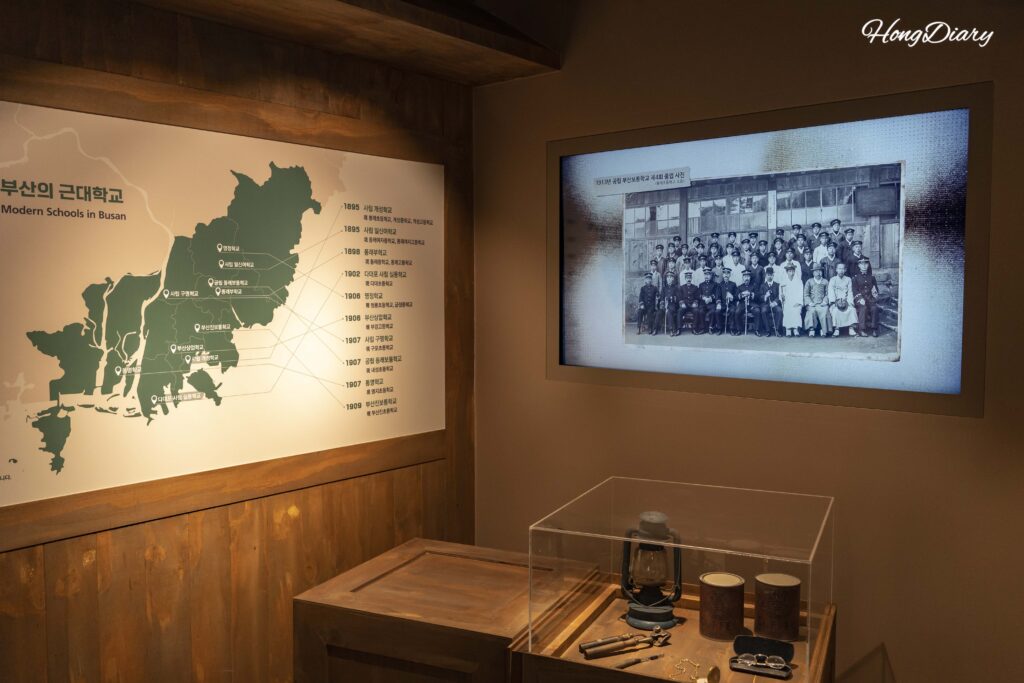
The timeline then moves into the late 19th and early 20th centuries, when Korea’s first modern schools began to appear. Maps and video displays trace how these institutions spread across Busan, and a dedicated section covers the Japanese colonial period (1910–1945). This part carries real weight: it documents student-led resistance movements, where young Koreans used education itself as a form of protest against colonial rule. Seeing original textbooks and documents from that era — inside a building that was once an actual school — adds a layer of meaning that a typical museum can’t replicate.
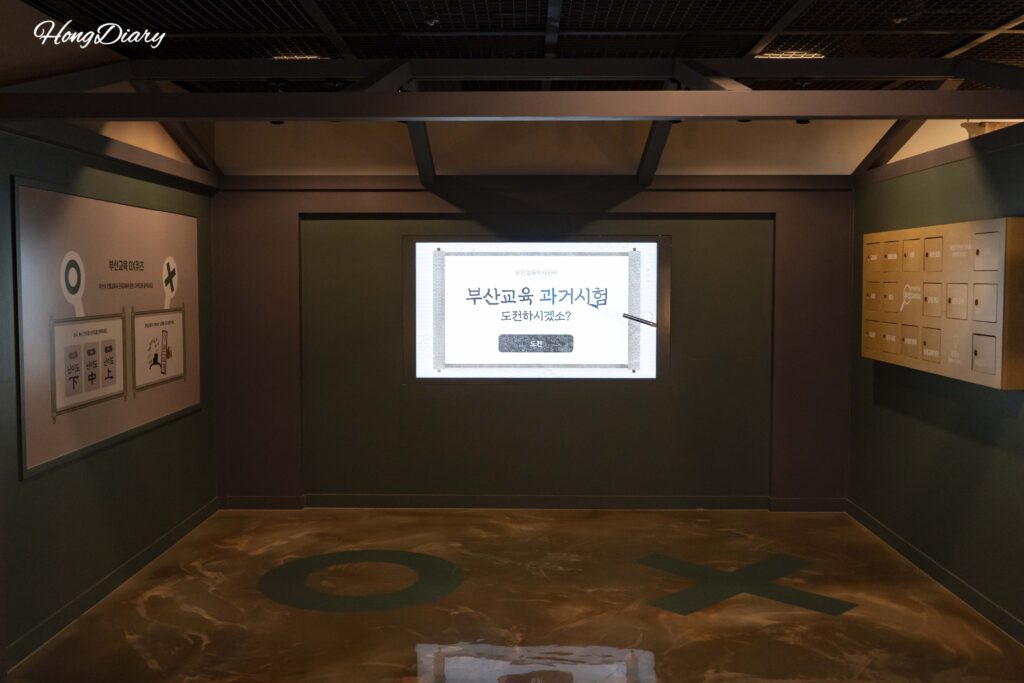
There’s also an interactive quiz zone on this floor where you can test what you’ve learned. It’s designed with younger visitors in mind, but it works for anyone who wants to absorb the material beyond just reading display panels. A separate special exhibition room on the same floor rotates its theme every year, so the content changes if you visit again.
3F — Permanent Exhibition: Wartime Busan and the Fight to Keep Learning
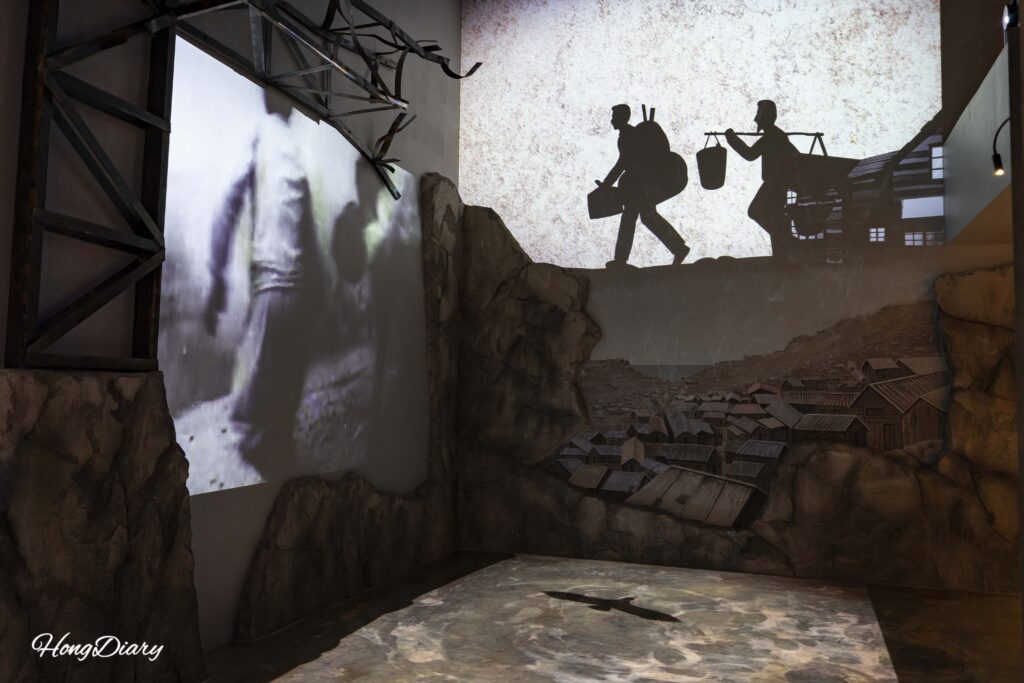
This floor changed the visit for me. When the Korean War broke out in 1950, Busan became South Korea’s provisional capital — the only major city not occupied by North Korean forces. Millions of refugees flooded into a port city built for a fraction of that population, and somehow, amid all the chaos, students kept going to school. The exhibits here tell that story through immersive video installations and life-size models that show what daily life looked like for displaced families trying to hold their world together.
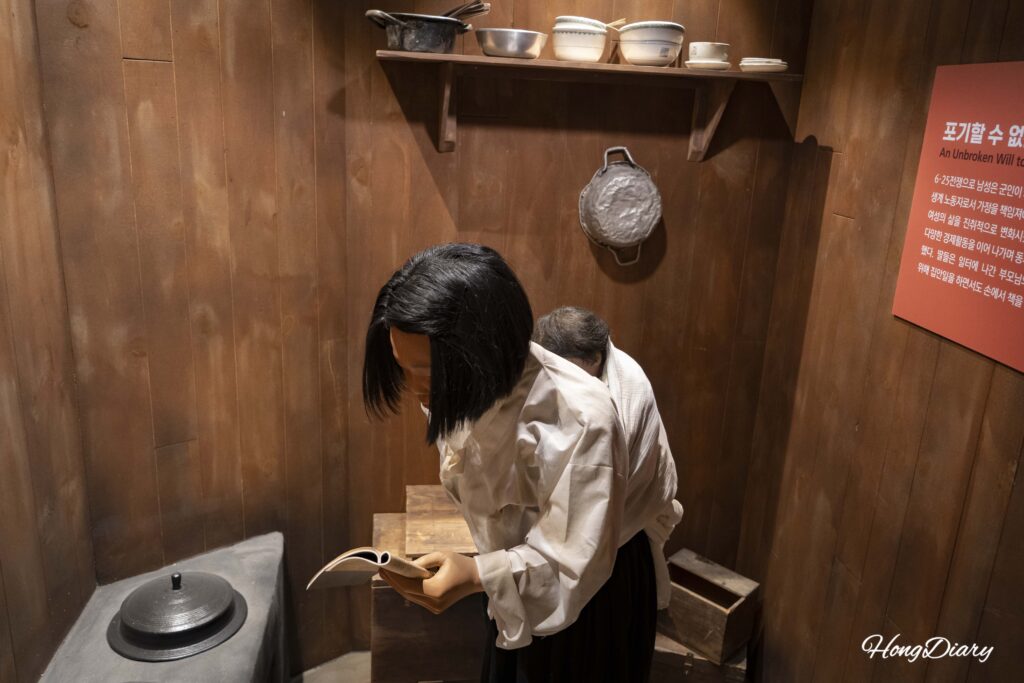
One display recreates a scene of a young student doing homework on the floor of a cramped refugee home while the rest of the family manages daily chores around them. It’s a small moment, but it captures something that statistics alone can’t — the quiet determination to keep learning when everything else was falling apart.
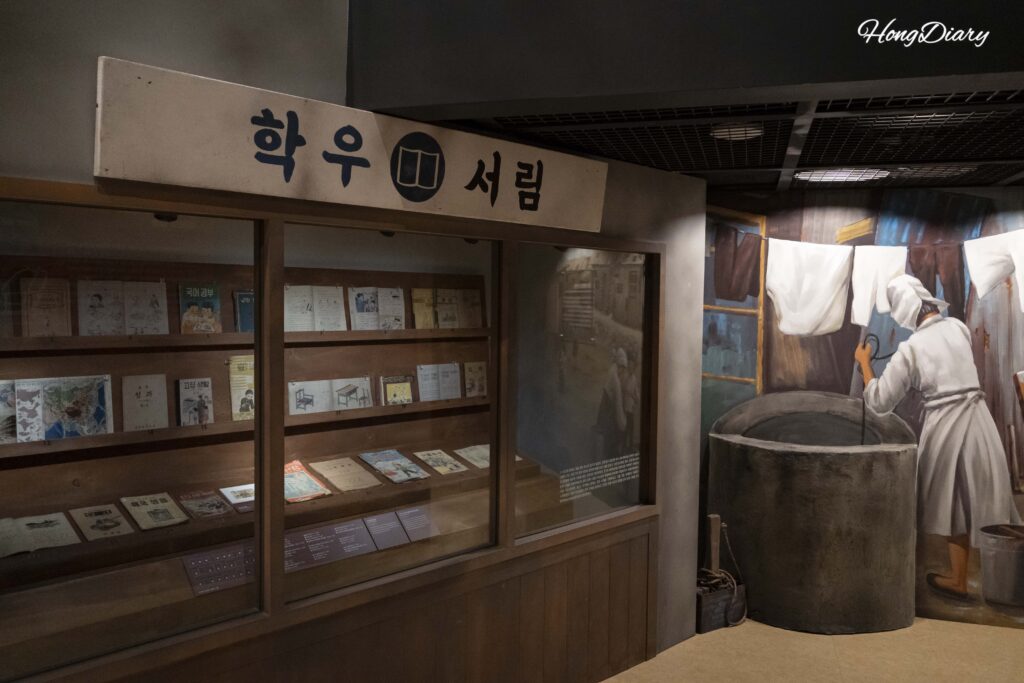
Wartime-era textbooks and school supplies sit in glass cases nearby. The pages are worn, the covers faded, and they carry the kind of authenticity that makes this floor feel less like a museum exhibit and more like stepping into someone’s memory.
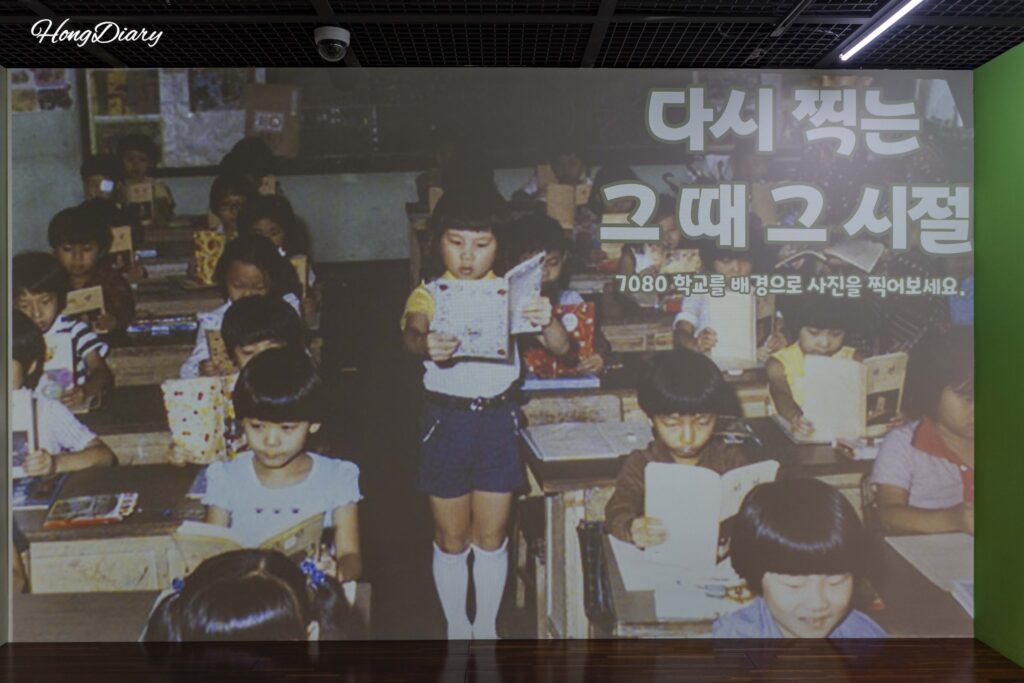
Further along, the exhibition shifts into the 1960s through the 1980s — Korea’s rapid industrialization and democracy era. A recreated 1970s–80s Korean classroom doubles as a photo spot, complete with wooden desks, a chalkboard, and retro school uniforms. It’s a lighter moment after the heavier wartime material, and it gives you a clear sense of how dramatically Korean education transformed in just a few decades.
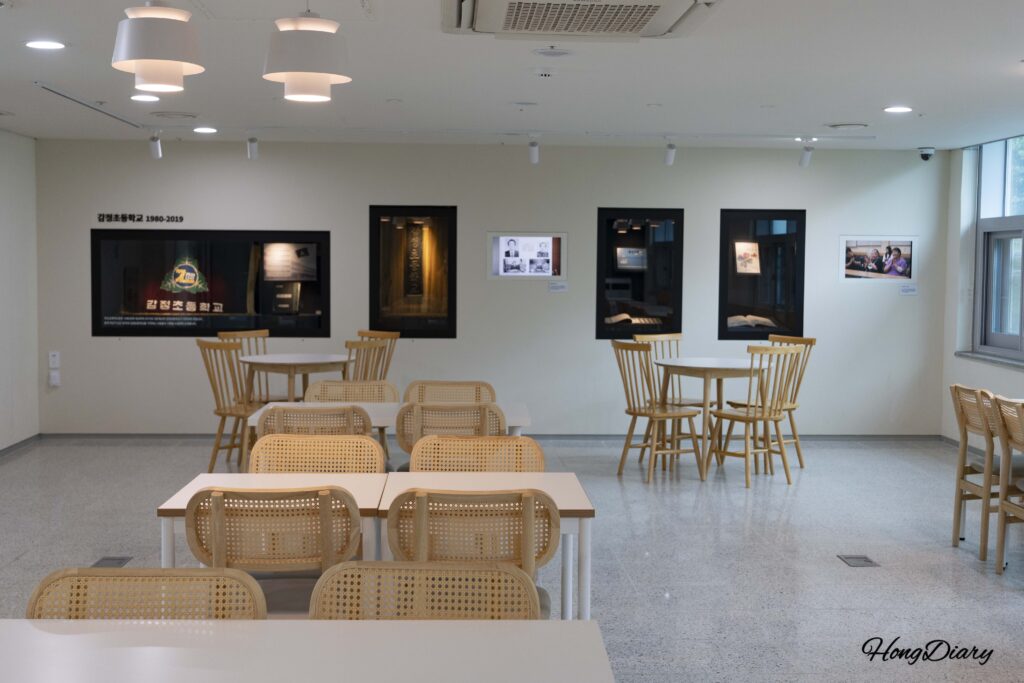
Before heading upstairs, there’s a section dedicated to Gamjeong Elementary School itself — the very building you’re standing in. The display covers the school’s founding, its years of service to the Gamcheon neighborhood, and its eventual closure. Tables and chairs are set up here too, so it doubles as a natural place to sit and rest for a few minutes.
4F — Dokdo Experience Hall
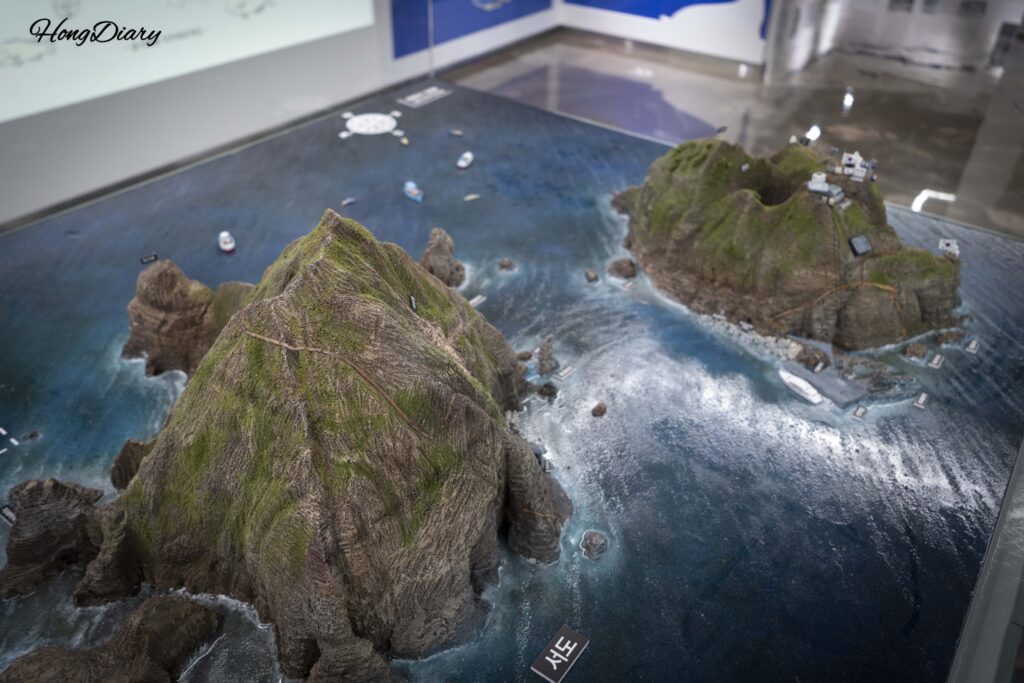
I assumed the exhibition ended on the third floor, but there’s one more level. The fourth floor is entirely dedicated to Dokdo — a pair of small, rocky islets in the East Sea (also known as the Sea of Japan) that carry deep symbolic importance in Korean culture and sovereignty. The experience hall uses video installations and a detailed miniature model to explain Dokdo’s ecosystem and its historical significance. Even if you’re unfamiliar with the territorial background, the displays are well produced and offer a perspective you won’t find at most other museums in Busan.
1F — The Reading Room and Outdoor Playground
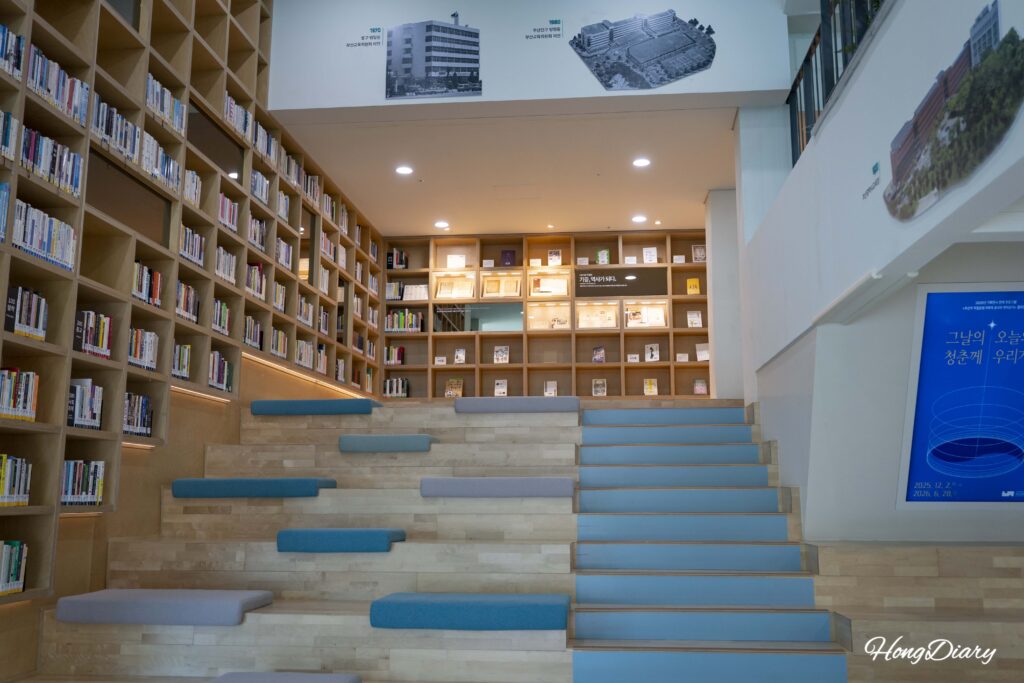
After working your way down from the upper floors, the ground level offers a calm finish. The moment you walk into the first-floor reading room, it feels like stepping into a small neighborhood library — shelves lined with books, soft lighting, comfortable seating. Since the museum is operated by Busan’s public library system, this space is a genuine reading spot as much as a museum amenity. If I’d had more time, I would have grabbed a book and settled in.
Outside, the former schoolyard has been turned into an open-air play area. If you’re visiting with kids, this is a practical bonus — they can run around and burn off some energy after the indoor exhibits. The museum also runs seasonal educational programs; check the official website for current schedules and registration.
A Few Things Worth Knowing Before You Go
The museum is fully climate-controlled. Air conditioning keeps the building cool in summer, and heating runs through the winter months. If you’re visiting Gamcheon Culture Village during Busan’s sticky humid season or on a bitter winter day, this is one of the few nearby indoor spaces where you can genuinely recharge — for free.
There’s a lunch break from 12:00 to 1:00 PM when the exhibition halls close, and last entry is at 4:00 PM. If you’re combining this with Gamcheon Culture Village, plan your timing around these windows.
The museum is remarkably quiet. On the day I visited, I had entire exhibition rooms to myself. Compared to the packed alleys of Gamcheon just a few minutes downhill, the contrast felt almost surreal.
Most of the signage is in Korean, but the visual displays, videos, and physical artifacts communicate clearly enough to follow without reading every panel. The wartime dioramas on the third floor and the Dokdo video installation on the fourth floor work especially well through imagery alone.
Where the Story Continues Beyond These Walls
What struck me most about the third-floor wartime exhibits wasn’t just the content — it was realizing how many of the places I’d already walked through in Busan were part of that same story. The Korean War didn’t just reshape education; it reshaped entire neighborhoods, markets, and streets that you can still visit today.
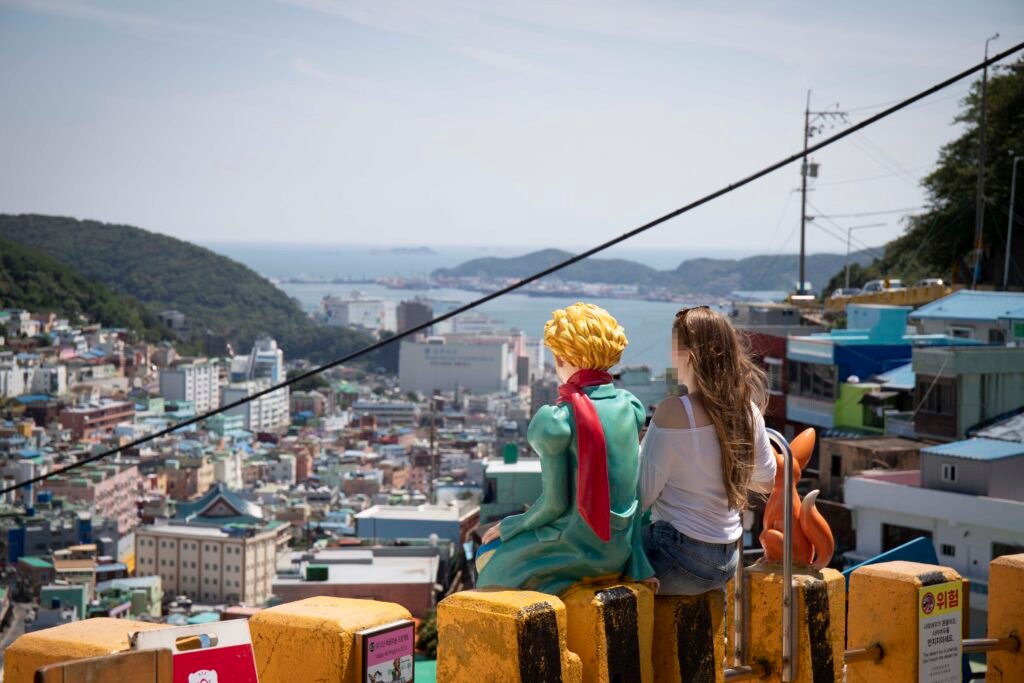
Gamcheon Culture Village — the colorful hillside neighborhood right below this museum — started as one of those wartime refugee settlements. The houses tourists photograph today were originally built by displaced families who fled south and carved out homes on these steep slopes during the 1950s. Walking the village with that context in mind turns it into a completely different experience.
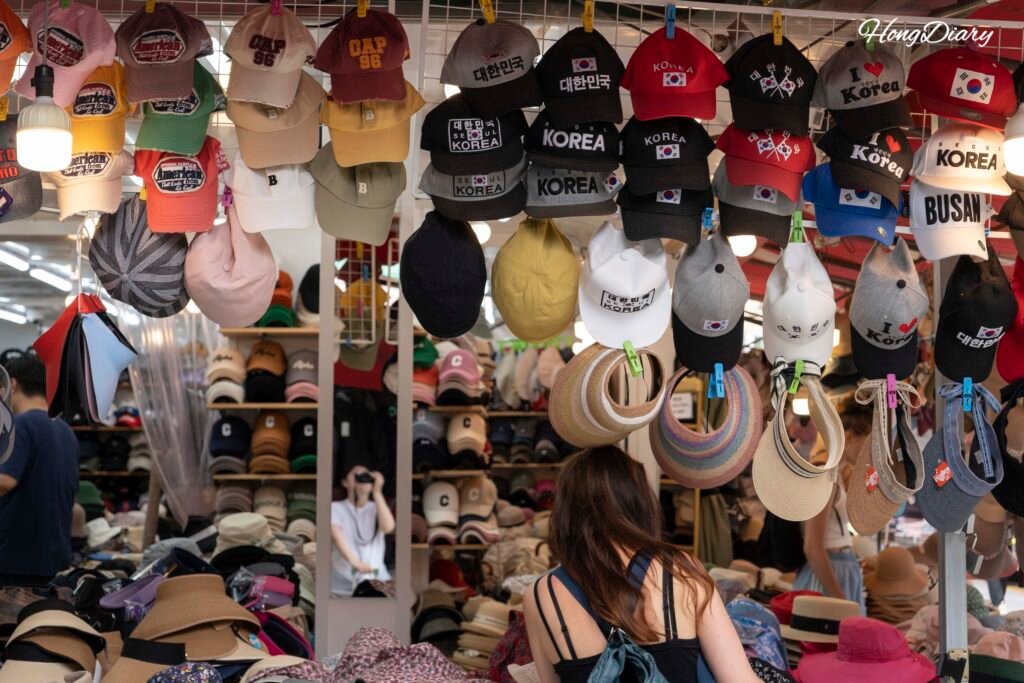
A short bus ride away, Gukje Market tells another chapter of the same wartime story. Refugees set up improvised stalls here to trade imported goods and daily necessities — that makeshift bazaar eventually grew into one of Busan’s largest and most energetic traditional markets. The atmosphere still carries traces of that raw, resourceful spirit.
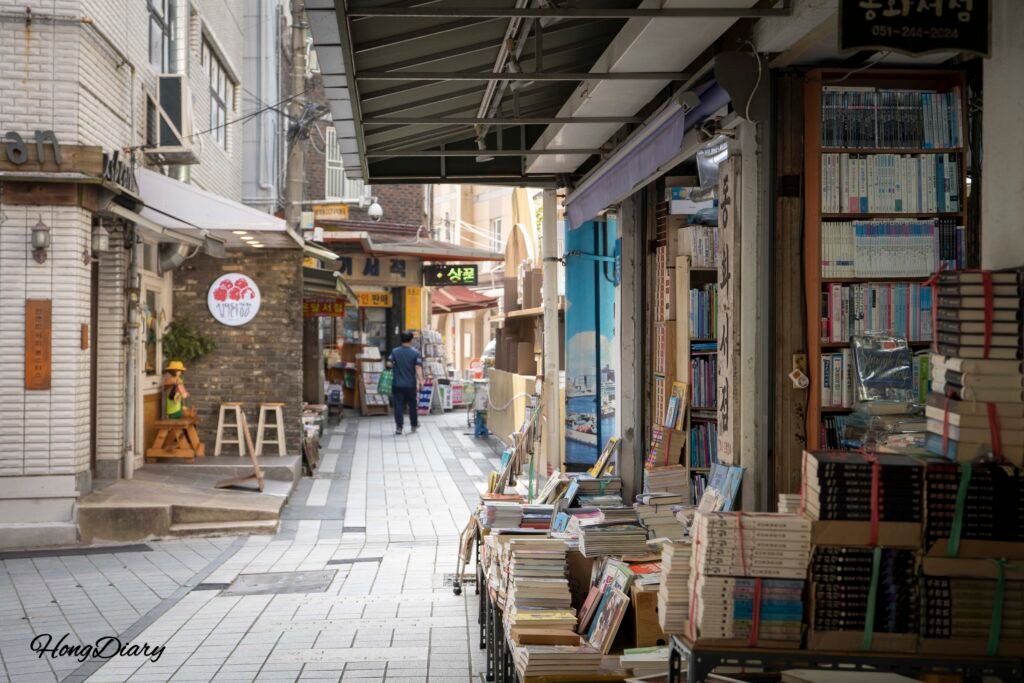
Just a few minutes on foot from Gukje Market,
Bosu-dong Book Street adds a quieter but deeply resonant layer to the narrative. During the Korean War, this narrow alley became a lifeline for knowledge — refugees and students bought and sold used textbooks here, keeping education alive when formal school systems had collapsed. The secondhand bookshops that remain today carry that legacy forward in the best possible way.
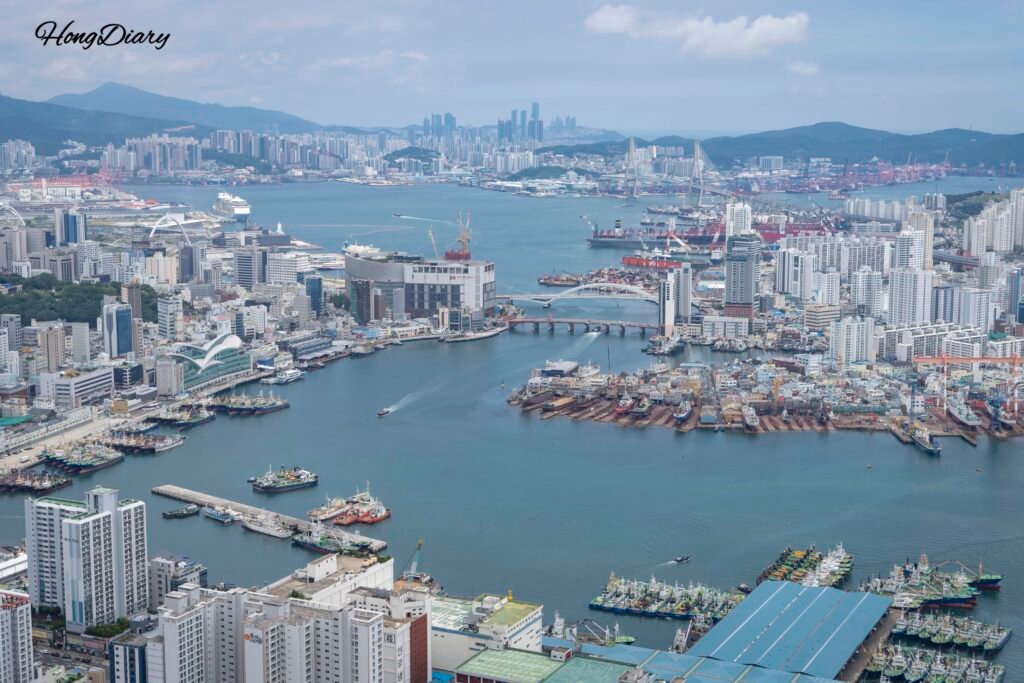
For a different kind of extension, Cheonmasan Observatory sits on the ridgeline above the museum and offers sweeping views over Saha-gu and the Busan coastline. It’s a recently opened skywalk-style observation deck that most visitors haven’t discovered yet, so you’ll likely have the platform largely to yourself.
The Busan Education History Museum probably won’t land on the standard tourist itinerary anytime soon — and honestly, that’s part of what makes it worth the detour. No crowds, no entrance fee, and a story about resilience and the stubborn human drive to keep learning that stays with you well after you leave. If you’re already heading to Gamcheon Culture Village, carve out an extra ninety minutes. You won’t regret it.
Visitor Guide & FAQ: Floor-by-Floor Highlights, Practical Tips, and Nearby Attractions in Saha-gu
Is the Busan Education History Museum free to enter?
Yes. Admission is completely free. The museum is operated as a branch of the Busan Metropolitan Central Library, so there is no entrance fee for any of the exhibition halls, including the Dokdo Experience Hall on the fourth floor and the reading room on the first floor.
How do I get to the Busan Education History Museum from Gamcheon Culture Village?
he museum sits directly above the Gamcheon Culture Village parking lot, so you can walk there in about five minutes on foot. If you’re coming by public transit, take Subway Line 1 to Goejeong Station (Exit 6) and catch Maeul Bus (a neighborhood mini bus) Saha 1 or Saha 1-1 to the Gamjeong Elementary stop. Alternatively, from Toseong Station (Exit 6), take Maeul Bus Saha 1-1, Seo-gu 2, or Seo-gu 2-2 to the same stop.
How long does it take to visit the Busan Education History Museum?
A thorough visit covering all floors — from the second-floor permanent exhibition through the fourth-floor Dokdo Experience Hall and the first-floor reading room — takes about 1 to 1.5 hours at a comfortable pace.
Is the Busan Education History Museum air-conditioned?
Yes. The entire building is climate-controlled year-round. Air conditioning runs in summer and heating in winter, making it a comfortable indoor stop regardless of the season — especially useful if you’re visiting nearby Gamcheon Culture Village during extreme weather.
What are the opening hours of the Busan Education History Museum?
The museum is open from 9:00 AM to 5:00 PM, with a lunch break from 12:00 to 1:00 PM when the exhibition halls close. Last entry is at 4:00 PM. It is closed on Mondays and public holidays, but remains open on Sundays.
Is the Busan Education History Museum suitable for children?
Yes. The second floor has an interactive quiz zone, the fourth floor features a hands-on Dokdo experience, and the first floor includes a library-style reading room. Outside, the former schoolyard has been converted into an open-air play area. The museum also runs seasonal educational programs for families — check the official website at behm.pen.go.kr for current offerings.
Is there parking at the Busan Education History Museum?
Yes. The museum has its own paid parking lot. The rate is ₩100 per 10 minutes (~$0.07 / €0.06), with a daily maximum of ₩2,400 (~$1.71 / €1.52). It’s the same parking area located at the base of Gamcheon Culture Village, so you can use it for both visits. Prices converted at approximately $1 USD ≈ ₩1,400 / €1 EUR ≈ ₩1,575 (as of September 2026). Rates may fluctuate.